
用于骨再生的基于地形学的植入物:设计、生物学机制及治疗方法。
Topography-based implants for bone regeneration: Design, biological mechanism, and therapeutics.
作者信息
Guo Weiwei, Yang Zuge, Liu Fuwei, Song Jianye, Yang Wenhao, Li Yunpeng, Hu Wenhui, Wang Kun
机构信息
Department of Stomatology, Xinqiao Hospital, Third Military Medical University, Chongqing, 400037, PR China.
State Key Laboratory of Oral & Maxillofacial Reconstruction and Regeneration, National Clinical Research Center for Oral Diseases, Shaanxi Clinical Research Center for Oral Diseases, Department of Oral and Maxillofacial Surgery, School of Stomatology, The Fourth Military Medical University, Xi'an, Shanxi, 710032, PR China.
出版信息
Mater Today Bio. 2025 Jul 13;34:102066. doi: 10.1016/j.mtbio.2025.102066. eCollection 2025 Oct.
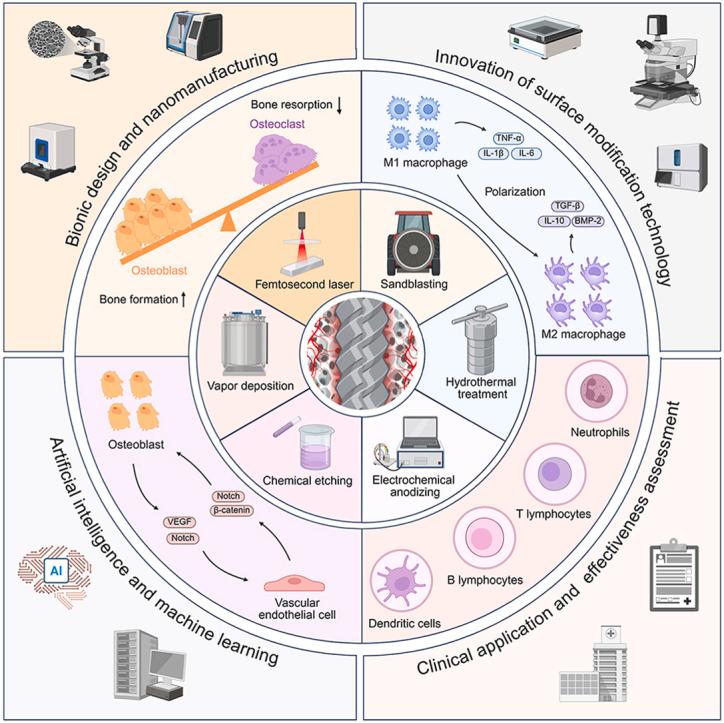
With the increasing demand for bone defect repair, bone implant materials have emerged as a critical alternative to traditional autologous or allogeneic bone grafts. However, their clinical performance remains limited due to challenges such as prolonged healing times and suboptimal repair quality. Moreover, in patients with certain pathological conditions (e.g., diabetes mellitus and osteoporosis), disruptions in the bone microenvironment further compromise regenerative outcomes. To address these limitations, surface modification strategies have been developed to regulate implant-bone tissue interactions and improve therapeutic efficacy. This review systematically summarizes recent advances in bone regeneration implants with a focus on topographical modifications, encompassing design principles, underlying biological mechanisms, and therapeutic applications. Particular attention is given to the influence of implant surface topography on the biological behaviors of osteoblasts, osteoclasts, and macrophages within the bone microenvironment, as well as their responses under complex pathological and physiological conditions. The review also discusses current challenges related to achieving micro/nanoscale structural balance, personalization, and clinical translation of implant surface topographies, and highlights future directions in precision bone regeneration through multidisciplinary approaches, artificial intelligence-driven optimization, and long-term clinical validation. Collectively, these insights may inform future research on bone implant materials and support the development of novel strategies for personalized treatment of bone defect repair.
随着对骨缺损修复需求的不断增加,骨植入材料已成为传统自体或异体骨移植的关键替代方案。然而,由于愈合时间长和修复质量欠佳等挑战,它们的临床性能仍然有限。此外,在患有某些病理状况(如糖尿病和骨质疏松症)的患者中,骨微环境的破坏会进一步损害再生效果。为解决这些局限性,已开发出表面改性策略来调节植入物与骨组织的相互作用并提高治疗效果。本综述系统总结了骨再生植入物的最新进展,重点关注形貌改性,包括设计原则、潜在生物学机制和治疗应用。特别关注植入物表面形貌对骨微环境中成骨细胞、破骨细胞和巨噬细胞生物学行为的影响,以及它们在复杂病理和生理条件下的反应。该综述还讨论了在实现植入物表面形貌的微/纳米尺度结构平衡、个性化和临床转化方面的当前挑战,并强调了通过多学科方法、人工智能驱动的优化和长期临床验证实现精准骨再生的未来方向。总的来说,这些见解可能为未来骨植入材料的研究提供参考,并支持开发个性化骨缺损修复治疗的新策略。



 Zotero 插件