
推进慢性乙型肝炎治疗性疫苗:整合反向疫苗学与免疫信息学
Advancing therapeutic vaccines for chronic hepatitis B: Integrating reverse vaccinology and immunoinformatics.
作者信息
Naully Patricia Gita, Tan Marselina Irasonia, El Khobar Korri Elvanita, Sukowati Caecilia H C, Giri-Rachman Ernawati Arifin
机构信息
School of Life Science and Technology, Institut Teknologi Bandung, Bandung 10432, Jawa Barat, Indonesia.
Faculty of Health Sciences and Technology, Jenderal Achmad Yani University, Cimahi 40525, Jawa Barat, Indonesia.
出版信息
World J Hepatol. 2025 Jul 27;17(7):107620. doi: 10.4254/wjh.v17.i7.107620.
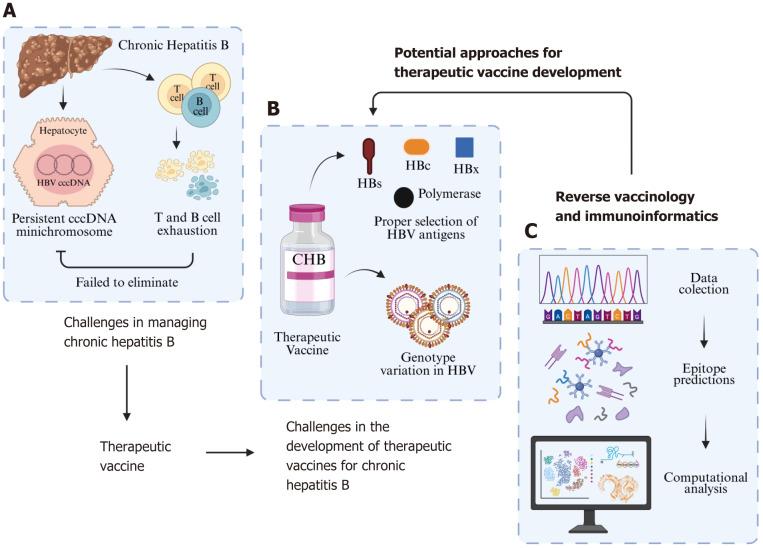
Current treatments for chronic hepatitis B (CHB) are lifelong, often accompanied by side effects and the risk of drug resistance, highlighting the urgent need for alternative therapies such as therapeutic vaccines. However, challenges such as selecting appropriate antigens and addressing multiple hepatitis B virus (HBV) genotypes hinder the development of these vaccines. One approach to overcoming these challenges is reverse vaccinology (RV) combined with immunoinformatics. RV uses computational methods to identify antigens from pathogen genetic information, including genomic and proteomic data. These methods have helped researchers identify conserved epitopes across bacterial strains or viral species, including multiple HBV genotypes. Computational tools, such as epitope mapping algorithms, molecular docking analysis, molecular dynamics simulations, and immune response simulations, enable key epitope identification, predict vaccine candidates' binding potential to immune cell receptors, and forecast the immune response. Together, these approaches streamline therapeutic vaccine design for CHB, making it faster, more cost-effective, and accurate. This review aims to explore the potential role of RV and immunoinformatics in advancing therapeutic vaccine design for CHB.
目前慢性乙型肝炎(CHB)的治疗是终身性的,常常伴有副作用和耐药风险,这凸显了对诸如治疗性疫苗等替代疗法的迫切需求。然而,诸如选择合适的抗原以及应对多种乙型肝炎病毒(HBV)基因型等挑战阻碍了这些疫苗的研发。克服这些挑战的一种方法是将反向疫苗学(RV)与免疫信息学相结合。RV利用计算方法从病原体遗传信息(包括基因组和蛋白质组数据)中识别抗原。这些方法帮助研究人员识别跨细菌菌株或病毒种类(包括多种HBV基因型)的保守表位。诸如表位作图算法、分子对接分析、分子动力学模拟和免疫反应模拟等计算工具能够识别关键表位,预测候选疫苗与免疫细胞受体的结合潜力,并预测免疫反应。这些方法共同简化了CHB治疗性疫苗的设计,使其更快、更具成本效益且更准确。本综述旨在探讨RV和免疫信息学在推进CHB治疗性疫苗设计中的潜在作用。
 Zotero 插件