
用于解释大规模重复项目中的收缩和异质性的元回归分析。
Meta-regression to explain shrinkage and heterogeneity in large-scale replication projects.
作者信息
Heyard Rachel, Held Leonhard
机构信息
Center for Reproducible Science, Epidemiology, Biostatistic and Prevention Institute, University of Zurich, Zurich, Switzerland.
出版信息
PLoS One. 2025 Aug 1;20(8):e0327799. doi: 10.1371/journal.pone.0327799. eCollection 2025.
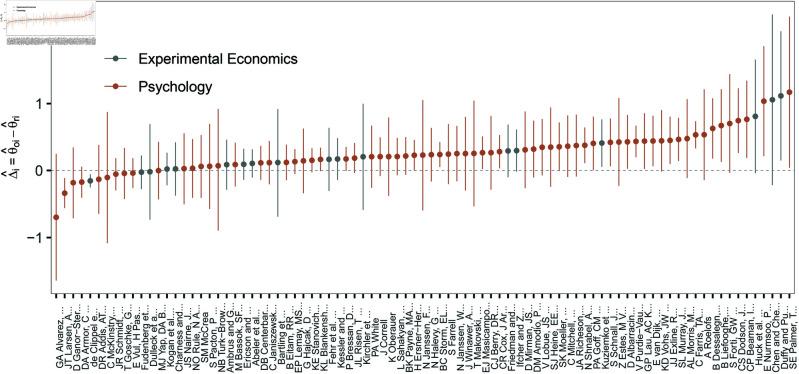
Recent large-scale replication projects (RPs) have estimated concerningly low reproducibility rates. Further, they reported substantial degrees of shrinkage of effect size, where the replication effect size was found to be, on average, much smaller than the original effect size. Within these RPs, the included original-replication study-pairs can vary with respect to aspects of study design, outcome measures, and descriptive features of both original and replication study population and study team. This often results in between-study-pair heterogeneity, i.e., variation in effect size differences across study-pairs that goes beyond expected statistical variation. When broader claims about the reproducibility of an entire field are based on such heterogeneous data, it becomes imperative to conduct a rigorous analysis of the amount and sources of shrinkage and heterogeneity within and between included study-pairs. Methodology from the meta-analysis literature provides an approach for quantifying the heterogeneity present in RPs with an additive or multiplicative parameter. Meta-regression methodology further allows for an investigation into the sources of shrinkage and heterogeneity. We propose the use of location-scale meta-regressions as a means to directly relate the identified characteristics with shrinkage (represented by the location) and heterogeneity (represented by the scale). This provides valuable insights into drivers and factors associated with high or low reproducibility rates and therefore contextualises results of RPs. The proposed methodology is illustrated using publicly available data from the Replication Project Psychology and the Replication Project Experimental Economics. All analysis scripts and data are available online.
近期的大规模重复验证项目(RPs)估计出了令人担忧的低重复率。此外,这些项目报告了效应量的大幅缩减,即发现重复验证的效应量平均而言远小于原始效应量。在这些重复验证项目中,纳入的原始 - 重复研究对在研究设计、结果测量以及原始研究和重复验证研究人群与研究团队的描述特征等方面可能存在差异。这通常会导致研究对之间的异质性,即研究对之间效应量差异的变化超出了预期的统计变化范围。当基于此类异质性数据对整个领域的可重复性提出更广泛的主张时,对纳入的研究对内部和之间的缩减量及异质性来源进行严格分析就变得势在必行。元分析文献中的方法提供了一种通过加法或乘法参数来量化重复验证项目中存在的异质性的方法。元回归方法进一步允许对缩减和异质性的来源进行调查。我们建议使用位置 - 尺度元回归作为一种手段,将所识别的特征与缩减(由位置表示)和异质性(由尺度表示)直接联系起来。这为与高或低重复率相关的驱动因素和因素提供了有价值的见解,从而使重复验证项目的结果更具背景信息。使用来自心理学重复验证项目和实验经济学重复验证项目的公开数据对所提出的方法进行了说明。所有分析脚本和数据均可在线获取。


 Zotero 插件