
视神经炎作为自身免疫与痴呆风险之间的联系。
Optic neuritis as a link between autoimmunity and dementia risk.
作者信息
Kim Jaeryung, Han Kyungdo, Jung Jin-Hyung, Oh Sei Yeul, Park Kyung-Ah, Min Ju-Hong
机构信息
Department of Ophthalmology, Samsung Medical Center, Sungkyunkwan University School of Medicine, 81 Irown-ro, Gangnam-gu, Seoul, Republic of Korea.
Department of Statistics and Actuarial Science, Soongsil University, 369 Sangdo-ro, Dongjak-gu, Seoul, Republic of Korea.
出版信息
Commun Med (Lond). 2025 Aug 7;5(1):335. doi: 10.1038/s43856-025-01050-y.
BACKGROUND
Our limited understanding of dementia's complex pathogenesis confines treatment options primarily to symptom management rather than targeting underlying disease processes, underscoring the need for innovative treatment and preventive strategies. This study aimed to examine the relationship between optic neuritis (ON), an autoimmune inflammatory condition of the optic nerve, and the risk of developing dementia.
METHODS
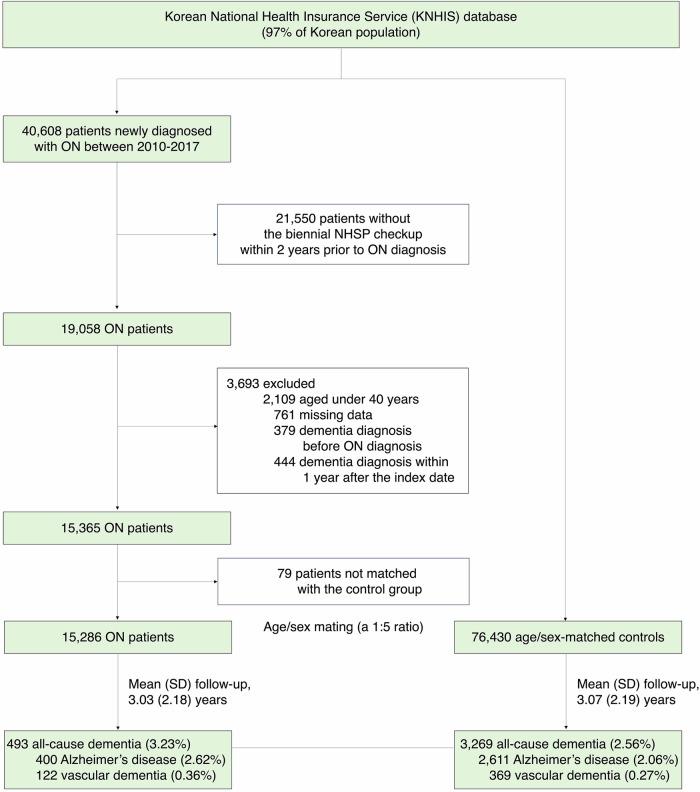
This nationwide, population-based cohort study was conducted in Korea, analyzing a cohort of 15,286 ON patients newly diagnosed between 2010 and 2017 who were age and sex matched against 76,430 controls without ON. Primary outcomes were incident cases of Alzheimer's disease, vascular dementia, or other types of dementia. Cox proportional hazards regression models were employed to assess the association between ON and dementia risk after adjusting for demographic characteristics, lifestyle factors, and other comorbidities. Dementia risk was assessed through hazard ratios (HRs), with an average follow-up period of 3.06 years.
RESULTS
ON patients shows greater risks of all-cause dementia (HR: 1.258) and Alzheimer's disease (HR: 1.264). Associations between ON and dementia are prominent in younger patients and current smokers.
CONCLUSION
This research suggests that autoimmunity, particularly in the form of ON, may significantly contribute to dementia development. This study implies that younger ON patients who smoke could be at a high risk of developing dementia, emphasizing the need for preventative strategies and additional research to establish causality. This work broadens the scope of known dementia risk factors and opens new avenues for research into autoimmune mechanisms as targets for therapeutic intervention.
背景
我们对痴呆症复杂发病机制的了解有限,这使得治疗选择主要局限于症状管理,而非针对潜在的疾病进程,凸显了创新治疗和预防策略的必要性。本研究旨在探讨视神经炎(一种视神经的自身免疫性炎症疾病)与患痴呆症风险之间的关系。
方法
这项基于全国人口的队列研究在韩国进行,分析了2010年至2017年间新诊断的15286例视神经炎患者组成的队列,这些患者在年龄和性别上与76430名无视神经炎的对照者相匹配。主要结局是阿尔茨海默病、血管性痴呆或其他类型痴呆的发病病例。采用Cox比例风险回归模型,在调整人口统计学特征、生活方式因素和其他合并症后,评估视神经炎与痴呆风险之间的关联。通过风险比(HR)评估痴呆风险,平均随访期为3.06年。
结果
视神经炎患者出现全因痴呆(HR:1.258)和阿尔茨海默病(HR:1.264)的风险更高。视神经炎与痴呆之间的关联在年轻患者和当前吸烟者中尤为显著。
结论
这项研究表明,自身免疫,尤其是视神经炎形式的自身免疫,可能在痴呆症的发展中起重要作用。这项研究表明,吸烟的年轻视神经炎患者患痴呆症的风险可能很高,强调了预防策略的必要性以及为确定因果关系进行更多研究的必要性。这项工作拓宽了已知痴呆风险因素的范围,并为将自身免疫机制作为治疗干预靶点的研究开辟了新途径。

 Zotero 插件