
肉鸡中沙门氏菌对噬菌体处理的适应性特征分析。
Characterization of Salmonella adaptation in response to phage treatment in broiler chickens.
作者信息
Agapé Lorna, Menanteau Pierrette, Kempf Florent, Morinet Madeline, Nicolas Marianne, Boulesteix Olivier, Riou Mickaël, Virlogeux-Payant Isabelle, Schouler Catherine, Velge Philippe
机构信息
INRAE, UMR ISP, Université de Tours, 37380, Nouzilly, France.
INRAE, PFIE, 37380, Nouzilly, France.
出版信息
Vet Res. 2025 Aug 8;56(1):167. doi: 10.1186/s13567-025-01589-7.
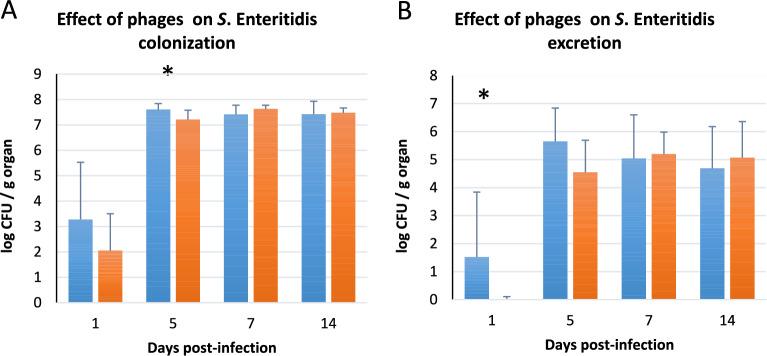
Salmonella constitutes a significant public health threat due to its widespread association with foodborne diseases, particularly those associated with contaminated poultry products. In this context, phage therapy has emerged as a promising strategy to control these infections. However, the natural emergence of phage-insensitive bacterial strains poses challenges for the efficacy of phage therapy. Understanding the adaptive response of Salmonella to phages in vivo is essential for developing effective therapeutic interventions. This study investigates the adaptive responses of Salmonella to phages-induced challenges, deciphers the underlying mechanisms and analyzes their in vivo consequences. Following repeated administrations of a six-phage cocktail in chickens, a panel of 145 random Salmonella isolates was recovered and characterized. Among these, 48% exhibited reduced sensitivity to a single phage from the phage cocktail, without evidence of cross-resistance; the vast majority of isolates remained susceptible to other phages. We identified two distinct bacterial adaptation profiles both associated with modifications in the lipopolysaccharide (LPS) structure, which appears as the phage receptor. The first profile displayed a complete resistance phenotype resulting in a rough-type Salmonella due to a genetic mutation in the rfbD gene involved in LPS biosynthesis. The second profile exhibited a transient and partial resistance phenotype, due to increased LPS glucosylation, likely associated to phase variation. This phenomenon leads to coexistence of phages and bacteria within the host. Furthermore, we highlighted that these modifications could in part impair Salmonella's ability to colonize the gut. Overall, our findings suggest that phage-induced evolutionary pressure may be harnessed not only to control bacterial populations but also to attenuate their pathogenicity. Therefore, bacterial resistance what is often view as a limitation of phage therapy may be leveraged as a functional advantage in phage cocktail design.
沙门氏菌与食源性疾病广泛相关,尤其是与受污染的家禽产品相关的疾病,因此对公众健康构成重大威胁。在此背景下,噬菌体疗法已成为控制这些感染的一种有前景的策略。然而,噬菌体不敏感细菌菌株的自然出现对噬菌体疗法的疗效构成了挑战。了解沙门氏菌在体内对噬菌体的适应性反应对于开发有效的治疗干预措施至关重要。本研究调查了沙门氏菌对噬菌体诱导挑战的适应性反应,破译了潜在机制并分析了它们在体内的后果。在鸡体内反复施用六噬菌体混合物后,回收并鉴定了一组145株随机的沙门氏菌分离株。其中,48% 的分离株对噬菌体混合物中的单一噬菌体敏感性降低,且无交叉耐药证据;绝大多数分离株对其他噬菌体仍敏感。我们确定了两种不同的细菌适应模式,均与作为噬菌体受体的脂多糖(LPS)结构的修饰有关。第一种模式表现出完全耐药表型,由于参与LPS生物合成的rfbD基因突变,导致沙门氏菌成为粗糙型。第二种模式表现出短暂和部分耐药表型,这是由于LPS糖基化增加,可能与相变有关。这种现象导致噬菌体和细菌在宿主体内共存。此外,我们强调这些修饰可能部分损害沙门氏菌在肠道定植的能力。总体而言,我们的研究结果表明,噬菌体诱导的进化压力不仅可用于控制细菌种群,还可用于减弱其致病性。因此,通常被视为噬菌体疗法局限性的细菌耐药性,在噬菌体混合物设计中可被用作一种功能优势。



 Zotero 插件