
基于人群的家庭调查得出的尼日利亚两个州的新冠病毒血清流行率和新冠疫苗接种覆盖率
SARS-CoV-2 seroprevalence and COVID-19 vaccination coverage in two states of Nigeria from a population based household survey.
作者信息
Enyereibe Nwachukwu William, Ilori Elsie, Steinhardt Laura, Stafford Kristen, Dan-Nwafor Chioma, Ochu Chinwe Lucia, Ibrahim Dalhatu, Alagi Matthias, Ibrahim Baffa Sule, Iwara Iwara Emem, Mba Nwando, Ibrahim Zainab, Ahmed Rabiatu Aliyu, Botson Iliya, Ogbonna Stanley Uche, Igumbor Ehimario, Abubakar Jafiya, Ahmed Nasir, Nwiyi Gloria Ogochukwu, Ihemeje Chima Emmanuel, Okoi Catherine, John Doris, Ashikeni Matthew, Muhammad Basheer Lawan, Iriemenam Nnaemeka C, Okunoye Olumide, Greby Stacie M, Bassey Orji, Okoye McPaul, Blanco Natalia, Mitchell Andrew, Ipadeola Oladipupo, Antonza Gladys S, Mpamugo Augustine, Makava Favour, Charurat Manhattan, Adebajo Sylvia, Swaminathan Mahesh, Ifedayo Adetifa, Ihekweazu Chikwe
机构信息
Nigeria Centre for Disease Control and Prevention, Abuja, Nigeria.
Division of Global HIV & TB, United States Centers for Disease Control and Prevention, Abuja, Nigeria.
出版信息
Sci Rep. 2025 Aug 10;15(1):29272. doi: 10.1038/s41598-025-14253-z.
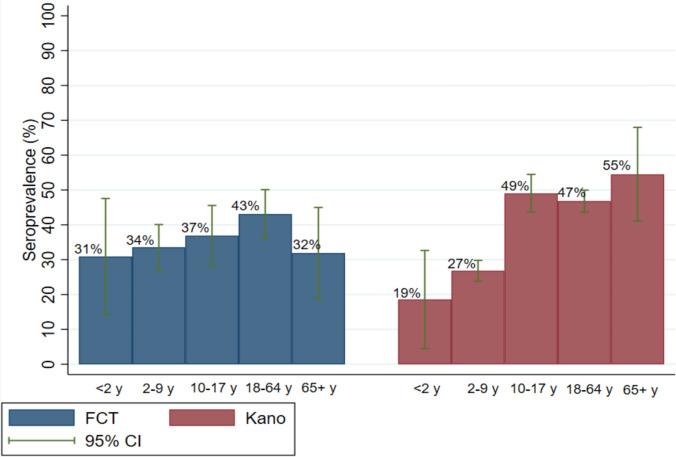
SARS-CoV-2 population-based seroprevalence surveys are useful for estimating the extent of SARS-CoV-2 infections, which may be underestimated by COVID-19 case counts. Surveys conducted in October 2020 in four Nigerian states showed that SARS-CoV-2 seroprevalence ranged from 9.3% in Gombe (northeast) to 25.2% in Enugu (southeast) after the first COVID-19 wave, more than 100 and 700 times higher than the official number of COVID-19 cases in these two states, respectively. We conducted a serosurvey after the second COVID-19 wave to evaluate the extent of SARS-CoV-2 infections, attitudes to COVID-19 vaccines, and COVID-19 vaccination coverage in two regions of Nigeria. Using the World Health Organization (WHO) Unity protocol, 34 enumeration areas (EAs) each in the Federal Capital Territory (FCT) (Northcentral Zone) and Kano State (Northwest Zone) were sampled in June 2021, using probability proportional to estimated size; 20 households in one EA were randomly selected. All consenting and assenting members of a household were asked about risk behaviors; adults who were 18 years and above (the eligible population for COVID-19 vaccination in Nigeria) responded to questions on COVID-19 vaccine attitudes and receipt. Blood and nasal/oropharyngeal samples were taken from all consenting and assenting household members. Blood samples collected were tested with the Luminex xMAP® SARS-CoV-2 Multi-Antigen IgG Assay and swabs by reverse-transcriptase-PCR (RT-PCR). Overall response rates were 76.8% in the FCT (n = 1,505 blood draws) and 80.4% in Kano State (n = 2,178 blood draws). Following the second COVID-19 wave in Nigeria, more than 40% of residents in the FCT (40.3%, 95% CI: 34.7-45.9) and Kano State (42.6%, 95% CI: 39.4-45.8) had evidence of prior SARS-CoV-2 infection. There were no active SARS-CoV-2 infections detected by RT-PCR in either the FCT or Kano State. In the FCT and Kano State, 3.4% and 1.6% of people surveyed reported receipt of any COVID-19 vaccine, three months after vaccines were available in country. In the FCT, 77.5% of adults were aware of COVID-19 vaccines, of whom 46.9% reported willingness to receive them. In Kano State, 48.7% of adults were aware of COVID-19 vaccines, of whom 61.1% were willing to receive them. In both regions, about 84% of those reporting unwillingness to accept COVID-19 vaccines cited concerns over vaccine safety. "Serosurvey findings revealed that SARS-CoV-2 infection was far more widespread in both the Federal Capital Territory and Kano State than indicated by reported case numbers. Despite high awareness, COVID-19 vaccine uptake remained low, primarily due to concerns about vaccine safety. These results highlight the urgent need for targeted risk communication to address vaccine hesitancy and improve coverage. Serosurveys provide valuable insights that can guide public health interventions and future pandemic preparedness in Nigeria."
基于人群的新冠病毒血清流行率调查有助于估算新冠病毒感染的程度,而新冠疫情病例数可能会低估这一程度。2020年10月在尼日利亚四个州进行的调查显示,在第一波新冠疫情之后,新冠病毒血清流行率在贡贝州(东北部)为9.3%,在埃努古州(东南部)为25.2%,分别比这两个州官方公布的新冠疫情病例数高出100多倍和700多倍。我们在第二波新冠疫情之后开展了一项血清学调查,以评估尼日利亚两个地区的新冠病毒感染程度、对新冠疫苗的态度以及新冠疫苗接种覆盖率。2021年6月,采用世界卫生组织(WHO)的统一方案,在联邦首都地区(中北部地区)和卡诺州(西北部地区)分别抽取了34个普查区(EAs),抽样方法为概率与估计规模成比例;在一个普查区随机选择20户家庭。询问了所有同意并表示赞成的家庭成员的风险行为;18岁及以上的成年人(尼日利亚新冠疫苗接种的 eligible population)回答了关于新冠疫苗态度和接种情况的问题。从所有同意并表示赞成的家庭成员中采集血液和鼻拭子/咽拭子样本。采集的血液样本采用Luminex xMAP®新冠病毒多抗原IgG检测法进行检测,拭子样本采用逆转录聚合酶链反应(RT-PCR)检测。联邦首都地区的总体回应率为76.8%(n = 1505次采血),卡诺州为80.4%(n = 2178次采血)。在尼日利亚第二波新冠疫情之后,联邦首都地区超过40%的居民(40.3%,95%置信区间:34.7 - 45.9)和卡诺州(42.6%,95%置信区间:39.4 - 45.8)有既往新冠病毒感染的证据。在联邦首都地区或卡诺州,通过RT-PCR均未检测到活跃的新冠病毒感染。在联邦首都地区和卡诺州,在该国疫苗可用三个月后,接受调查的人中分别有3.4%和1.6%报告接种了任何新冠疫苗。在联邦首都地区,77.5%的成年人知晓新冠疫苗,其中46.9%报告愿意接种。在卡诺州,48.7%的成年人知晓新冠疫苗,其中61.1%愿意接种。在这两个地区,约84%报告不愿意接种新冠疫苗的人提到了对疫苗安全性的担忧。“血清学调查结果显示,新冠病毒感染在联邦首都地区和卡诺州的传播范围远比报告的病例数所显示的要广泛。尽管知晓率很高,但新冠疫苗接种率仍然很低,主要原因是对疫苗安全性的担忧。这些结果凸显了进行有针对性的风险沟通以解决疫苗犹豫问题并提高接种覆盖率的迫切需求。血清学调查提供了宝贵的见解,可指导尼日利亚的公共卫生干预措施和未来的疫情防范工作。” (注:原文中“eligible population”未明确给出准确中文释义,暂保留英文)

 Zotero 插件