
不同采食量蛋鸡肝脏大分子的多组学分析:抗氧化能力调节的机制洞察
Multi-omics profiling of hepatic macromolecules in laying hens with difference feed intake: Mechanistic insights into antioxidant capacity modulation.
作者信息
Gao Zhouyang, Jie Yuchen, Qin Yuhui, Liu Xianli, Zheng Chuanwei, Ma Guoming, Wu Yan, Fu Songchuan, Meng Xiangrui, Xu Guiyun
机构信息
College of Animal Science and Technology, China Agricultural University, Beijing 100193, China.
Beinongda Technology Co., Ltd., Beijing 100083, China.
出版信息
Poult Sci. 2025 Jul 16;104(10):105575. doi: 10.1016/j.psj.2025.105575.
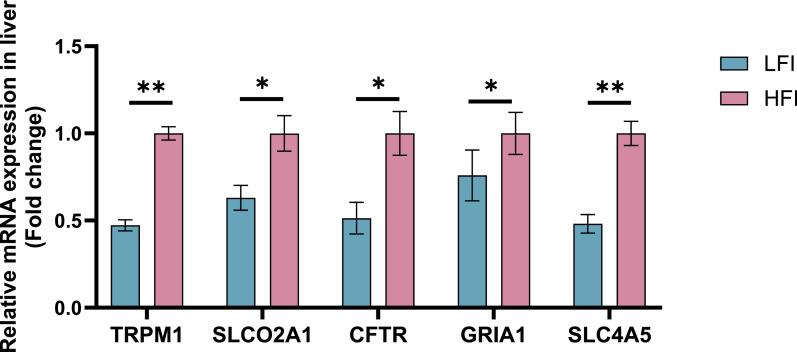
Currently, the cost of poultry feed accounts for more than 70 % of the total cost of poultry production. Therefore, it is crucial to find appropriate strategies to reduce feed cost and improve feed efficiency in livestock genetic improvement programs. The feed intake of poultry not only affects their growth and development but also acts as a key factor that affects feed efficiency. Liver, the most important digestive and metabolic organ in the body, has a critical regulatory role in the feeding behavior of laying hens. However, to date, limited research has been conducted on the effect of the liver on the feed intake of laying hens. In the present study, we used RNA sequencing and liquid chromatography-mass spectrometry to analyze the differential genes and key metabolites in the livers of high-yield laying hens with low and high feed intake levels. The results indicated that the genes TRPM1, SLCO2A1, CFTR, GRIA1, and SLC4A5 as well as the metabolites l-threonine, l-ascorbate, and l-tyrosine were the key factors regulating feed intake in laying hens. Additionally, the measurement of antioxidant activity revealed that low-feed laying hens showed higher antioxidant enzyme activity than high-feed laying hens, which suggests that reducing feed intake does not negatively affect the health of laying hens.
目前,家禽饲料成本占家禽生产总成本的70%以上。因此,在畜禽遗传改良计划中找到合适的策略来降低饲料成本并提高饲料效率至关重要。家禽的采食量不仅影响其生长发育,也是影响饲料效率的关键因素。肝脏是体内最重要的消化和代谢器官,对蛋鸡的采食行为具有关键的调节作用。然而,迄今为止,关于肝脏对蛋鸡采食量影响的研究有限。在本研究中,我们使用RNA测序和液相色谱-质谱联用技术分析了低采食量和高采食量高产蛋鸡肝脏中的差异基因和关键代谢物。结果表明,TRPM1、SLCO2A1、CFTR、GRIA1和SLC4A5基因以及L-苏氨酸、L-抗坏血酸和L-酪氨酸代谢物是调节蛋鸡采食量的关键因素。此外,抗氧化活性的测定表明,低采食量蛋鸡的抗氧化酶活性高于高采食量蛋鸡,这表明减少采食量不会对蛋鸡健康产生负面影响。



 Zotero 插件