
机器学习与机理建模相结合在预测小分子血浆暴露中的应用。
Application of machine learning in combination with mechanistic modeling to predict plasma exposure of small molecules.
作者信息
Mavroudis Panteleimon D, Teutonico Donato, Abos Alexandra, Pillai Nikhil
机构信息
Quantitative Pharmacology Research, DMPK, Sanofi, Cambridge, MA, United States.
Translational Medicine and Early Development, Sanofi, Chilly-Mazarin, France.
出版信息
Front Syst Biol. 2023 Jun 20;3:1180948. doi: 10.3389/fsysb.2023.1180948. eCollection 2023.
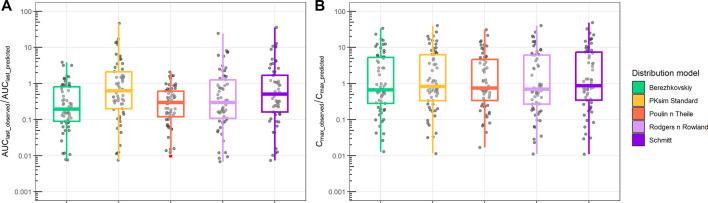
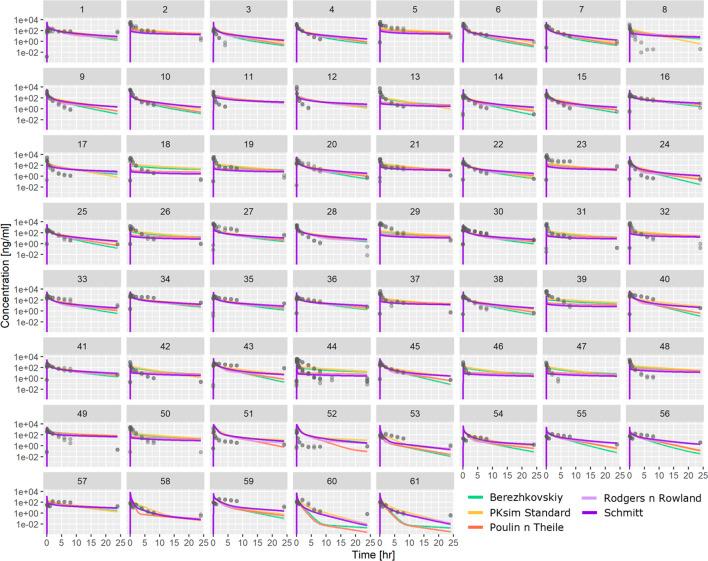
Prediction of a new molecule's exposure in plasma is a critical first step toward understanding its efficacy/toxicity profile and concluding whether it is a possible first-in-class, best-in-class candidate. For this prediction, traditional pharmacometrics use a variety of scaling methods that are heavily based on pre-clinical pharmacokinetic (PK) data. We here propose a novel framework based on which preclinical exposure prediction is performed by applying machine learning (ML) in tandem with mechanism-based modeling. In our proposed method, a relationship is initially established between molecular structure and physicochemical (PC)/PK properties using ML, and then the ML-driven PC/PK parameters are used as input to mechanistic models that ultimately predict the plasma exposure of new candidates. To understand the feasibility of our proposed framework, we evaluated a number of mechanistic models (1-compartment, physiologically based pharmacokinetic (PBPK)), PBPK distribution models (Berezhkovskiy, PK-Sim standard, Poulin and Theil, Rodgers and Rowland, and Schmidt), and PBPK parameterizations (using , or clearance). For most of the scenarios tested, our results demonstrate that PK profiles can be adequately predicted based on the proposed framework. Our analysis further indicates some limitations when liver microsomal intrinsic clearance (CLint) is used as the only clearance pathway and underscores the necessity of investigating the variability emanating from the different distribution models when providing PK predictions. The suggested approach aims at earlier exposure prediction in the drug development process so that critical decisions on molecule screening, chemistry design, or dose selection can be made as early as possible.
预测新分子在血浆中的暴露情况是了解其疗效/毒性特征并判断其是否可能成为同类首创、同类最佳候选药物的关键第一步。对于这种预测,传统的药物计量学使用多种缩放方法,这些方法严重依赖临床前药代动力学(PK)数据。我们在此提出一种新颖的框架,在此框架下,通过将机器学习(ML)与基于机制的建模相结合来进行临床前暴露预测。在我们提出的方法中,首先使用ML建立分子结构与物理化学(PC)/PK特性之间的关系,然后将ML驱动的PC/PK参数用作机制模型的输入,这些模型最终预测新候选药物的血浆暴露情况。为了了解我们提出的框架的可行性,我们评估了许多机制模型(一室模型、基于生理的药代动力学(PBPK))、PBPK分布模型(别列日科夫斯基模型、PK-Sim标准模型、普林和泰尔模型、罗杰斯和罗兰模型以及施密特模型)以及PBPK参数化(使用、或清除率)。对于测试的大多数情况,我们的结果表明,基于所提出的框架可以充分预测PK曲线。我们的分析进一步表明,当将肝微粒体固有清除率(CLint)用作唯一的清除途径时存在一些局限性,并强调在提供PK预测时研究不同分布模型产生的变异性的必要性。所建议的方法旨在在药物开发过程中更早地进行暴露预测,以便能够尽早对分子筛选、化学设计或剂量选择做出关键决策。



 Zotero 插件