
奥密克戎亚变体BA.1刺突蛋白中的655和969位氨基酸残基控制TMPRSS2与组织蛋白酶L依赖性进入途径的使用以及细胞嗜性。
Amino acid residues 655 and 969 in the spike protein of Omicron subvariant BA.1 control use of TMPRSS2 versus Cathepsin L dependent entry pathways and cell tropism.
作者信息
Rocha Cheila, Arora Prerna, Zhang Lu, Sidarovich Anzhalika, Graichen Luise, Moldenhauer Anna-Sophie, Pöhlmann Stefan, Hoffmann Markus
机构信息
Infection Biology Unit, German Primate Center - Leibniz Institute for Primate Research, Göttingen, Germany.
Faculty of Biology and Psychology, Georg-August-University Göttingen, Göttingen, Germany.
出版信息
PLoS One. 2025 Aug 14;20(8):e0328879. doi: 10.1371/journal.pone.0328879. eCollection 2025.
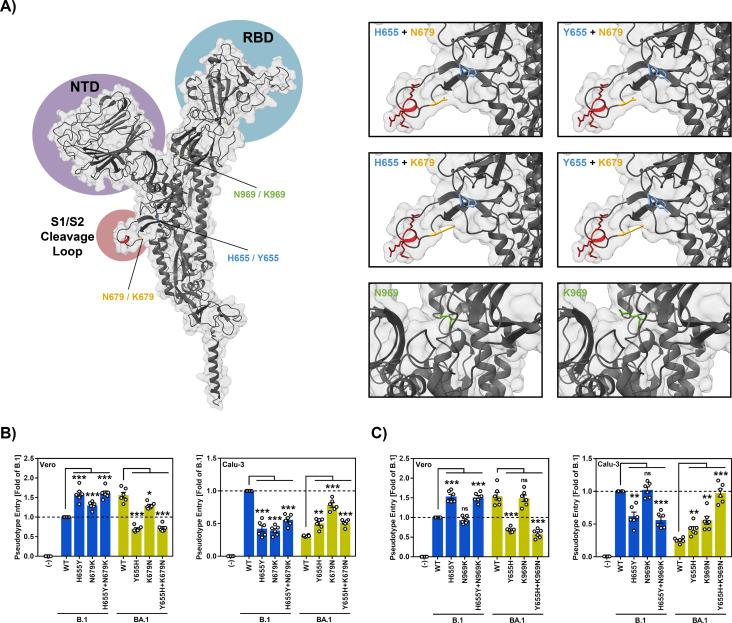
The spike (S) protein of the severe acute respiratory syndrome coronavirus 2 (SARS-CoV-2) is activated by the host cell proteases cathepsin L or TMPRSS2. The ancestral virus circulating in Wuhan in 2020 and early variants mainly use TMPRSS2 for entry into Calu-3 lung cells while the Omicron subvariant BA.1 and most subsequently circulating Omicron subvariants employ both cathepsin L and TMPRSS2 for Calu-3 cell entry. Here, we investigated which amino acid residues in the S protein of the Omicron subvariant BA.1 control protease choice. We show that Y655 promotes S protein cleavage and cathepsin L-dependent entry while H655 jointly with N969 promotes TMPRSS2-dependent entry. These results define molecular signatures of SARS-CoV-2 protease choice and lung cell infection.
严重急性呼吸综合征冠状病毒2(SARS-CoV-2)的刺突(S)蛋白由宿主细胞蛋白酶组织蛋白酶L或跨膜丝氨酸蛋白酶2(TMPRSS2)激活。2020年在武汉传播的原始病毒和早期变体主要利用TMPRSS2进入Calu-3肺细胞,而奥密克戎亚变体BA.1和大多数随后传播的奥密克戎亚变体则同时利用组织蛋白酶L和TMPRSS2进入Calu-3细胞。在此,我们研究了奥密克戎亚变体BA.1的S蛋白中的哪些氨基酸残基控制蛋白酶的选择。我们发现,Y655促进S蛋白裂解和组织蛋白酶L依赖性进入,而H655与N969共同促进TMPRSS2依赖性进入。这些结果确定了SARS-CoV-2蛋白酶选择和肺细胞感染的分子特征。


 Zotero 插件