
中国湖北省西北部食源分离株的抗生素耐药性、生物膜形成及分子流行病学
Antibiotic Resistance, Biofilm Formation, and Molecular Epidemiology of Foodborne Isolated in Northwest Hubei Province, China.
作者信息
Tang Yitong, Li Yanyan, Xiao Na, Wang Lu, Li Shichao, Zou JiuMing, Yu Yanmin, Shao Jinhui, Jiang Ming
机构信息
Medicine College Hubei University of Arts and Science Xiangyang China.
Medicine College Pingdingshan University Pingdingshan China.
出版信息
Food Sci Nutr. 2025 Aug 16;13(8):e70791. doi: 10.1002/fsn3.70791. eCollection 2025 Aug.
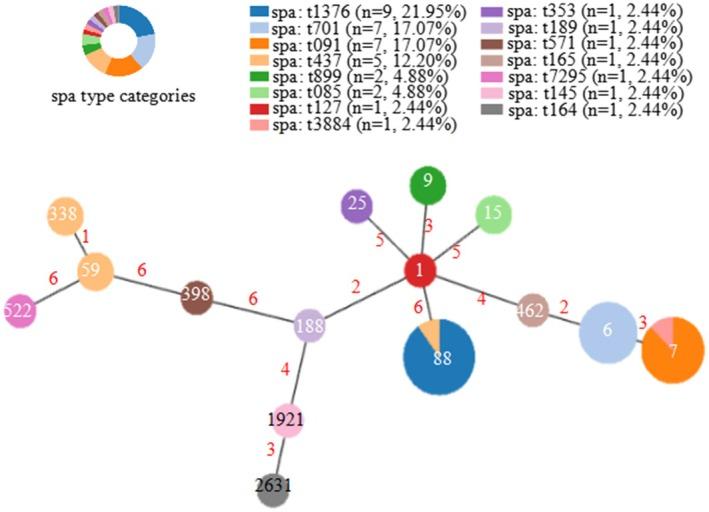
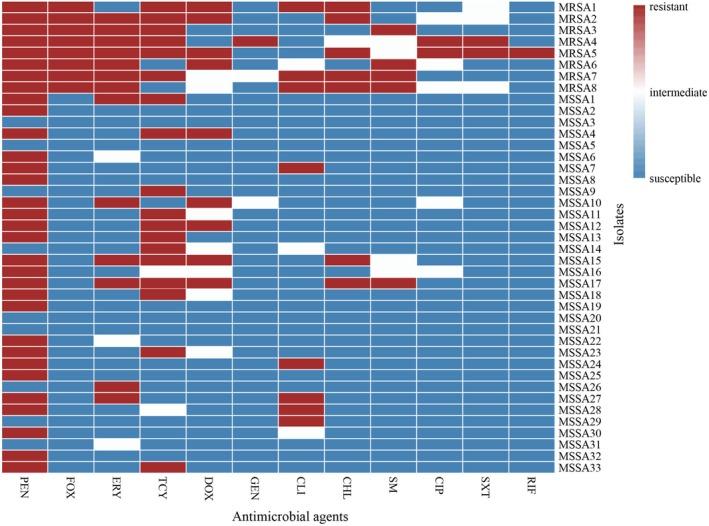
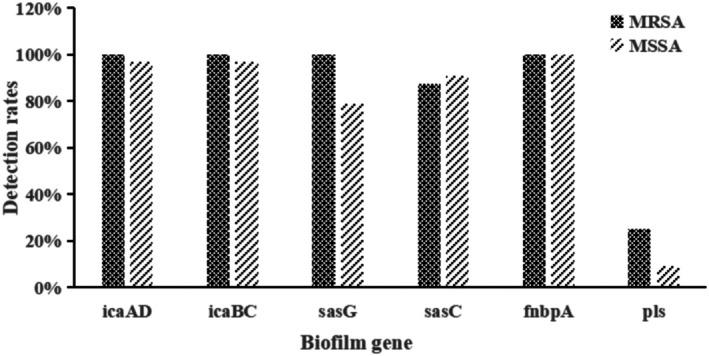
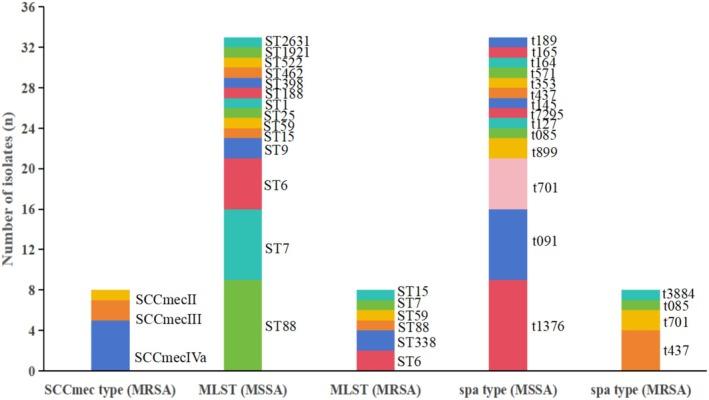
is a common pathogen responsible for foodborne infections worldwide. This study investigated the antibiotic resistance profiles, biofilm formation capacity, and molecular epidemiological characteristics of foodborne isolates from northwest Hubei Province, China, as well as the correlation among these factors. Among the 303 food samples collected from Xiangyang, Suizhou, and Shiyan cities, 41 yielded non-duplicate strains. Of the 41 isolates, 8 (19.51%) were identified as MRSA, while 33 (80.49%) were methicillin-susceptible (MSSA). High resistance was observed to penicillin (78.05%), tetracycline (43.90%), and erythromycin (31.71%), with MRSA strains demonstrating significantly stronger resistance profiles than MSSA strains. Among MRSA isolates, 50% (4/8) demonstrated strong biofilm-forming capacity, compared to only 9.09% (3/33) of MSSA isolates. Strong biofilm formation was observed more frequently in isolates from frozen meat (66.67%, 4/6) than in those from vegetarian salads (0%, 0/9) or fresh meat (12.50%, 2/16). The prevalence of Panton-Valentine leukocidin (PVL) gene was higher in MRSA strains, whereas enterotoxin genes were more commonly found in MSSA strains, though differences between groups were not statistically significant. The primary epidemic clones identified were CC88-ST88-t1376/t437, CC7-ST7-t091/t3884, and CC5-ST6/ST462-t701/t165, constituting 63.41% (26/41) of isolates. The CC59-ST59/338 strain exhibited a pronounced capacity for strong biofilm formation. SCCmecII-CC15-ST15-t085 and SCCmecIII-CC7-ST7-t3884 strains exhibited the highest antibiotic resistance, with resistance to 9 and 7 antibiotics, whereas CC88-ST88-t1376, CC7-ST7-t091, and CC5-ST6-t701 showed resistance to fewer than three antibiotics. The findings enhance the understanding of the drug resistance profiles and molecular epidemiology of foodborne , providing a foundation for more effective control measures.
是一种在全球范围内导致食源性感染的常见病原体。本研究调查了中国湖北省西北部食源性分离株的抗生素耐药谱、生物膜形成能力和分子流行病学特征,以及这些因素之间的相关性。在从襄阳、随州和十堰市采集的303份食品样本中,41份产生了非重复菌株。在这41株分离株中,8株(19.51%)被鉴定为耐甲氧西林金黄色葡萄球菌(MRSA),而33株(80.49%)对甲氧西林敏感(MSSA)。观察到对青霉素(78.05%)、四环素(43.90%)和红霉素(31.71%)的耐药性较高,MRSA菌株的耐药谱明显强于MSSA菌株。在MRSA分离株中,50%(4/8)表现出较强的生物膜形成能力,而MSSA分离株中只有9.09%(3/33)表现出这种能力。在冷冻肉分离株中观察到较强生物膜形成的频率更高(66.67%,4/6),而在素食沙拉分离株(0%,0/9)或鲜肉分离株(12.50%,2/16)中则较低。Panton-Valentine杀白细胞素(PVL)基因在MRSA菌株中的流行率较高,而肠毒素基因在MSSA菌株中更常见,尽管两组之间的差异无统计学意义。鉴定出的主要流行克隆为CC88-ST88-t1376/t437、CC7-ST7-t091/t3884和CC5-ST6/ST462-t701/t165,占分离株的63.41%(26/41)。CC59-ST59/338菌株表现出明显的强生物膜形成能力。SCCmecII-CC15-ST15-t085和SCCmecIII-CC7-ST7-t3884菌株表现出最高的抗生素耐药性,对9种和7种抗生素耐药,而CC88-ST88-t1376、CC7-ST7-t091和CC5-ST6-t701对少于三种抗生素耐药。这些发现增进了对食源性耐药谱和分子流行病学的理解,并为更有效的控制措施提供了基础。

 Zotero 插件