
免疫压力是理解在长期感染中观察到的呼吸道病毒进化模式的关键。
Immune pressure is key to understanding observed patterns of respiratory virus evolution in prolonged infections.
作者信息
Coats Amber, Wang Yintong R, Koelle Katia
机构信息
Program in Microbiology and Molecular Genetics, Emory University, 1462 Clifton Road NE, Atlanta, GA 30322, United States.
Department of Biology, Emory University, 1510 Clifton Road NE, Atlanta, GA 30322, United States.
出版信息
Virus Evol. 2025 Jul 21;11(1):veaf054. doi: 10.1093/ve/veaf054. eCollection 2025.
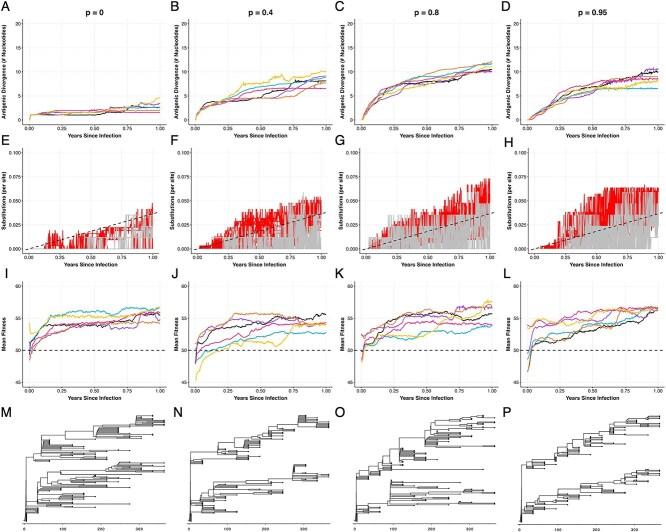
Analyses of viral samples from prolonged SARS-CoV-2 infections as well as from prolonged infections with other respiratory viruses have indicated that there are several consistent patterns of evolution observed across these infections. These patterns include accelerated rates of nonsynonymous substitution, viral genetic diversification into distinct lineages, parallel substitutions across infected individuals, and heterogeneity in rates of antigenic evolution. Here, we use within-host model simulations to explore the drivers of these intrahost evolutionary patterns. Our simulations build on a tunably rugged fitness landscape model to first assess the role that mutations that impact only viral replicative fitness have in driving these patterns. We then further incorporate pleiotropic sites that jointly impact replicative fitness and antigenicity to assess the role that immune pressure has on these patterns. Through simulation, we find that the empirically observed patterns of viral evolution in prolonged infections cannot be robustly explained by viral populations evolving on replicative fitness landscapes alone. Instead, we find that immune pressure is needed to consistently reproduce the observed patterns. Moreover, our simulations show that the amount of antigenic change that occurs is higher when immune pressure is stronger and at intermediate immune breadth. While our simulation models were designed to shed light on drivers of viral evolution in prolonged infections with respiratory viruses that generally cause acute infection, their structure can be used to better understand viral evolution in other acutely infecting viruses such as noroviruses that can cause prolonged infection as well as viruses such as HIV that are known to chronically infect.
对来自新冠病毒长期感染以及其他呼吸道病毒长期感染的病毒样本分析表明,在这些感染中观察到了几种一致的进化模式。这些模式包括非同义替换率加快、病毒基因多样化形成不同谱系、感染个体间的平行替换以及抗原进化速率的异质性。在这里,我们使用宿主内模型模拟来探究这些宿主内进化模式的驱动因素。我们的模拟基于一个可调崎岖适应度景观模型,首先评估仅影响病毒复制适应度的突变在驱动这些模式中所起的作用。然后,我们进一步纳入共同影响复制适应度和抗原性的多效性位点,以评估免疫压力对这些模式的作用。通过模拟,我们发现,在长期感染中经验观察到的病毒进化模式不能仅由在复制适应度景观上进化的病毒群体有力地解释。相反,我们发现需要免疫压力才能一致地重现观察到的模式。此外,我们的模拟表明,当免疫压力更强且处于中等免疫广度时,发生的抗原变化量更高。虽然我们的模拟模型旨在阐明一般导致急性感染的呼吸道病毒长期感染中病毒进化的驱动因素,但其结构可用于更好地理解其他急性感染病毒的病毒进化,如可导致长期感染的诺如病毒,以及已知会慢性感染的艾滋病毒等。


 Zotero 插件