
亚马逊土壤真菌CBMAI 2758对氯喹的生物降解作用
Biodegradation of Chloroquine by a Fungus from Amazonian Soil, CBMAI 2758.
作者信息
de Almeida Nóbrega Patrícia, Lopes Samuel Q, Sá Lucas S, da Silva Ramos Ryan, Holanda Fabrício H E, de Araújo Inana F, Porto André Luiz M, Birolli Willian G, Ferreira Irlon M
机构信息
Biocatalysis and Applied Organic Synthesis Laboratory, Federal University of Amapá, Macapá 68903-419, AP, Brazil.
Post-Graduate Program in Biotechnology and Biodiversity-BIONORTE Network, Federal University of Amapá, Macapá 68902-280, AP, Brazil.
出版信息
J Fungi (Basel). 2025 Aug 4;11(8):579. doi: 10.3390/jof11080579.
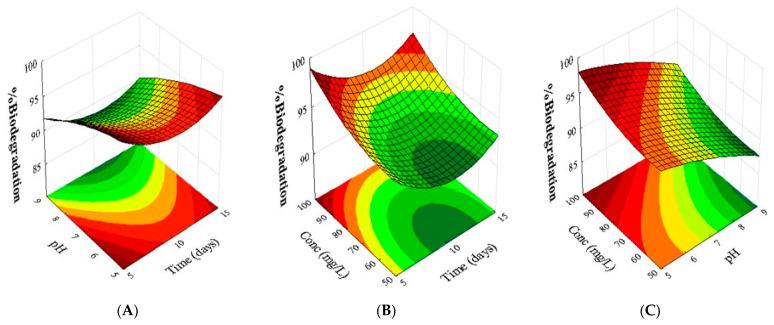
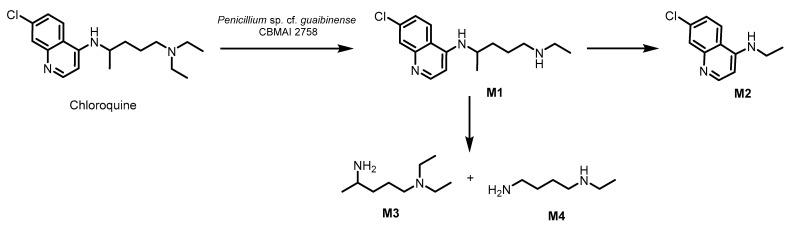
Concern over the presence of pharmaceutical waste in the environment has prompted research into the management of emerging organic micropollutants (EOMs). In response, sustainable technologies have been applied as alternatives to reduce the effects of these contaminants. This study investigated the capacity of filamentous fungi isolated from iron mine soil in the Amazon region to biodegrade the drug chloroquine diphosphate. An initial screening assessed the growth of four fungal strains on solid media containing chloroquine diphosphate: CBMAI 2752, CBMAI 2753, CBMAI 2754, and sp. cf. CBMAI 2758. Among them, sp. cf. CBMAI 2758 was selected for further testing in liquid media. A Box-Behnken factorial design was applied with three variables, pH (5, 7, and 9), incubation time (5, 10, and 15 days), and chloroquine diphosphate concentration (50, 75, and 100 mg·L), totaling 15 experiments. The samples were analyzed by gas chromatography-mass spectrometry (GC-MS). The most effective conditions for chloroquine biodegradation were pH 7, 100 mg·L concentration, and 10 days of incubation. Four metabolites were identified: one resulting from -deethylation M1 (4-(7-chloroquinolin-4-yl)-1-ethylpentane-1,4-diamine), two from carbon-carbon bond cleavage M2 (7-chloro--ethylquinolin-4-amine) and M3 (1,1-diethylpentane-1,4-diamine), and one from aromatic deamination M4 (1-ethylbutane-1,4-diamine) by enzymatic reactions. The toxicity analysis showed that the products obtained from the biodegradation of chloroquine were less toxic than the commercial formulation of this compound. These findings highlight the biotechnological potential of Amazonian fungi for drug biodegradation and decontamination.
对环境中药物废弃物存在的担忧促使人们对新兴有机微污染物(EOMs)的管理展开研究。作为回应,可持续技术已被用作替代方法以减少这些污染物的影响。本研究调查了从亚马逊地区铁矿土壤中分离出的丝状真菌对药物二磷酸氯喹进行生物降解的能力。初步筛选评估了四种真菌菌株在含有二磷酸氯喹的固体培养基上的生长情况:CBMAI 2752、CBMAI 2753、CBMAI 2754以及类CBMAI 2758菌株。其中,类CBMAI 2758菌株被选出来在液体培养基中进行进一步测试。采用Box-Behnken析因设计,涉及三个变量,即pH值(5、7和9)、培养时间(5、10和15天)以及二磷酸氯喹浓度(50、75和100 mg·L),总共进行15次实验。通过气相色谱 - 质谱联用(GC-MS)对样品进行分析。二磷酸氯喹生物降解的最有效条件为pH值7、浓度100 mg·L以及培养10天。鉴定出了四种代谢产物:一种是由脱乙基作用产生的M1(4-(7-氯喹啉-4-基)-1-乙基戊烷-1,4-二胺),两种是由碳 - 碳键断裂产生的M2(7-氯- - 乙基喹啉-4-胺)和M3(1,1-二乙基戊烷-1,4-二胺),还有一种是由芳香脱氨作用产生的M4(1-乙基丁烷-1,4-二胺),这些都是通过酶促反应产生的。毒性分析表明,氯喹生物降解得到的产物比该化合物的商业制剂毒性更低。这些发现凸显了亚马逊真菌在药物生物降解和去污方面的生物技术潜力。


 Zotero 插件