
多领域户外锻炼干预对健康老龄化的心血管健康和功能能力的影响:一项随机对照试验(ACTIVA-老年研究)
Impact of a Multidomain Outdoor Exercise Intervention on Cardiovascular Health and Functional Capacity for Healthy Aging: A Randomized Controlled Trial (ACTIVA-Senior Study).
作者信息
García-Llorente Antonio Manuel, Lopes Machado Dalmo Roberto, Casimiro-Andújar Antonio Jesús, Marcos-Pardo Pablo Jorge
机构信息
SPORT Research Group (CTS-1024), CIBIS (Centro de Investigación para el Bienestar y la Inclusión Social) Research Center, University of Almeria, 04120 Almeria, Spain.
School of Physical Education and Sport of Ribeirão Preto, University of São Paulo, Ribeirão Preto 05508, SP, Brazil.
出版信息
Healthcare (Basel). 2025 Aug 12;13(16):1975. doi: 10.3390/healthcare13161975.
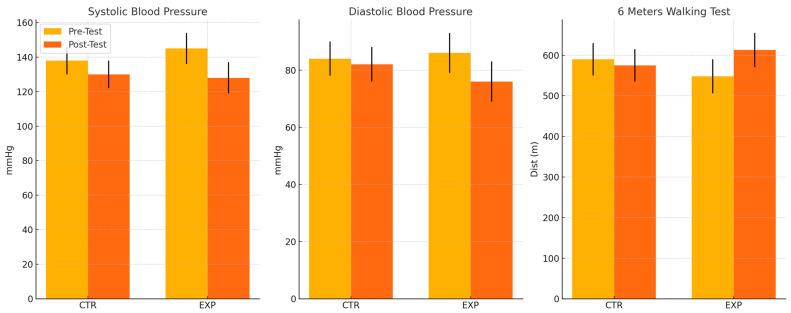
: Population aging calls for effective, scalable interventions to enhance cardiovascular and functional health in older adults. : The objective was to evaluate the effects of an 18-week multidomain outdoor exercise program on cardiovascular and functional outcomes. : Fifty-two participants (mean age: 66.0 ± 5.1 years; BMI: 27.2 ± 3.7 kg/m; body fat: 35.0 ± 7.0%) were randomized into intervention (n = 26) and control (n = 26) groups. The intervention involved twice-weekly, 60 min outdoor sessions integrating resistance (30-60 s isometric holds), aerobic training (Borg RPE 6-7), balance, and cognitive exercises. : Forty-six participants completed the study (intervention: n = 25; control: n = 21). The intervention group (mean age 65.6 ± 5.3) demonstrated significant improvements compared to the controls (mean age 66.4 ± 4.9): a systolic blood pressure reduction of 17.4 mmHg (95% CI: -21.9 to -12.9, < 0.001, ηp = 0.376), diastolic blood pressure reduction of 9.2 mmHg (95% CI: -12.1 to -6.3, < 0.001, ηp = 0.248), and Six-Minute Walk Test improvement of 64.7 m (95% CI: 45.9 to 83.5, < 0.001, ηp = 0.463). Body composition showed modest but significant improvements in percent body fat (-1.3%, = 0.007) and visceral fat levels (-0.9 units, = 0.002). However, these changes were not significant between groups. The Number Needed to Treat was 2.2 for clinically significant blood pressure reduction and 1.4 for meaningful functional improvement. : The ACTIVA-Senior multidomain outdoor intervention led to clinically meaningful improvements in cardiovascular function and functional capacity. The results suggest strong potential for scalable outdoor aging interventions. These findings support the integration of structured outdoor exercise programs into healthy aging strategies and public health initiatives.
人口老龄化需要有效的、可扩展的干预措施来增强老年人的心血管和身体机能健康。目的是评估一项为期18周的多领域户外锻炼计划对心血管和身体机能指标的影响。52名参与者(平均年龄:66.0±5.1岁;体重指数:27.2±3.7kg/m;体脂率:35.0±7.0%)被随机分为干预组(n = 26)和对照组(n = 26)。干预措施包括每周两次、每次60分钟的户外训练,融合了阻力训练(30 - 60秒等长收缩)、有氧训练(Borg主观用力程度分级6 - 7级)、平衡训练和认知训练。46名参与者完成了研究(干预组:n = 25;对照组:n = 21)。与对照组(平均年龄66.4±4.9)相比,干预组(平均年龄65.6±5.3)有显著改善:收缩压降低17.4mmHg(95%置信区间:-21.9至-12.9,P<0.001,偏η² = 0.376),舒张压降低9.2mmHg(95%置信区间:-12.1至-6.3,P<0.001,偏η² = 0.248),六分钟步行试验成绩提高64.7米(95%置信区间:45.9至83.5,P<0.001,偏η² = 0.463)。身体成分方面,体脂百分比有适度但显著的改善(-1.3%,P = 0.007),内脏脂肪水平有显著改善(-0.9个单位,P = 0.002)。然而,这些变化在两组之间不显著。临床上显著降低血压的需治疗人数为2.2,有意义的身体机能改善的需治疗人数为1.4。ACTIVA - Senior多领域户外干预措施使心血管功能和身体机能能力得到了临床上有意义的改善。结果表明可扩展的户外老龄化干预措施具有很大潜力。这些发现支持将结构化户外锻炼计划纳入健康老龄化策略和公共卫生倡议。

 Zotero 插件