
基于抗体系统的靶向蛋白质修饰
Targeted Protein Modification with an Antibody-Based System.
作者信息
Rimon Oded, Konc Juraj, Černauskienė Inga, Ali Montader, Roy Chowdhury Vaidehi, Sormanni Pietro, Bernardes Gonçalo J L, Vendruscolo Michele
机构信息
#Centre for Misfolding Diseases, §Yusuf Hamied Department of Chemistry, University of Cambridge, Cambridge, CB2 1EW, United Kingdom.
Translational Chemical Biology Group, Spanish National Cancer Research Centre (CNIO), C/ Melchor Fernández Almagro, 3. 28029 Madrid, Spain.
出版信息
ACS Cent Sci. 2025 Jul 7;11(8):1364-1376. doi: 10.1021/acscentsci.5c00651. eCollection 2025 Aug 27.
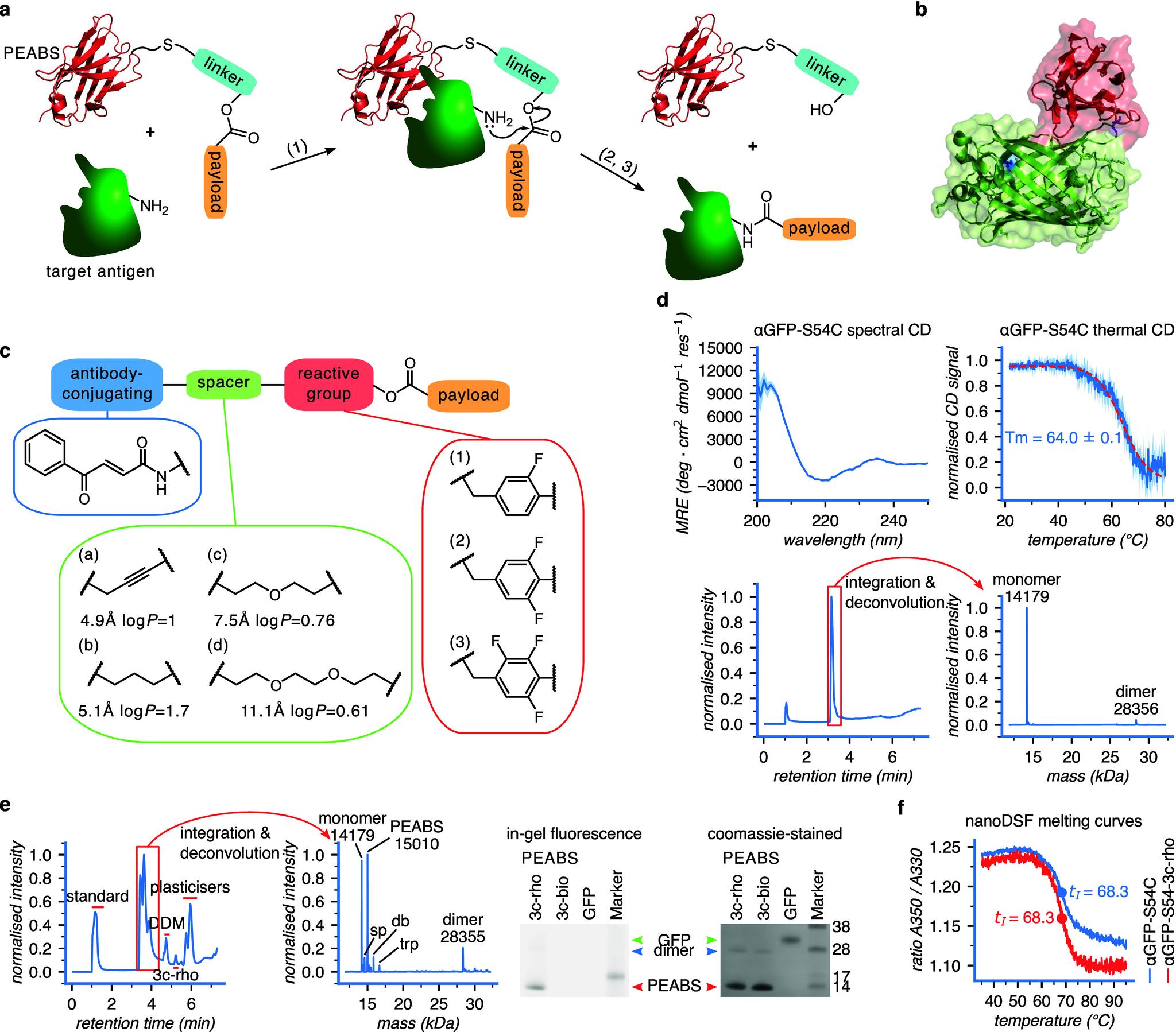
The chemical modification of proteins is one of the major mechanisms used to regulate the properties and functions of these macromolecules in the cell. It is therefore of great interest to develop tools to exploit this type of modification for applications in molecular biology, medicine, and biotechnology. Here we present a method of using antibodies to perform post-translational covalent modifications of endogenous proteins in complex environments by exploiting proximity-driven chemistry. The method is based on the ability of antibodies to hold a weakly reactive group close to its intended site of reaction by binding the target protein on a nearby epitope. We characterize this approach by modifying the green fluorescent protein in increasingly complex environments and illustrate its applicability by targeting the disease-associated protein beta-2 microglobulin.
蛋白质的化学修饰是细胞中用于调节这些大分子性质和功能的主要机制之一。因此,开发利用这种修饰类型用于分子生物学、医学和生物技术应用的工具具有极大的意义。在此,我们提出一种利用抗体通过邻近驱动化学对复杂环境中的内源性蛋白质进行翻译后共价修饰的方法。该方法基于抗体通过结合附近表位上的靶蛋白,将弱反应性基团靠近其预期反应位点的能力。我们通过在日益复杂的环境中修饰绿色荧光蛋白来表征这种方法,并通过靶向疾病相关蛋白β-2微球蛋白来说明其适用性。



 Zotero 插件