
比较ALKA和CRS评分以预测阿拉伯联合酋长国2019冠状病毒病感染患者的预后。
Comparison of the ALKA and CRS scores to predict outcomes among patients with coronavirus disease 2019 infection in United Arab Emirates.
作者信息
Kurban Bushra, Agha Adnan, Kurban Lutfi Ali S, Guy Virgie, Yasin Javed, Alshamsi Fayez, Ismail Mohamed, Bakoush Omran
机构信息
Department of Internal Medicine, College of Medicine and Health Sciences, United Arab Emirates University, Al Ain, United Arab Emirates.
Department of Radiology, College of Medicine and Health Sciences, United Arab Emirates University, Al Ain, United Arab Emirates.
出版信息
Front Med (Lausanne). 2025 Aug 18;12:1553189. doi: 10.3389/fmed.2025.1553189. eCollection 2025.
INTRODUCTION
The coronavirus disease 2019 (COVID-19) pandemic resulted in significant global mortality and morbidity, with emerging mutant strains continuing to potentially precipitate severe respiratory illness. Two clinical assessment tools, namely, the COVID-19 Risk of Complications Score (CRS), based on 13 comorbidities, and the ALKA (age, lactate dehydrogenase, kidney function, and albumin) score have been developed to predict disease severity among patients who are symptomatic at presentation. This study aimed to compare the performance of these two risk-scoring systems in predicting hospital admission, critical illness, and mortality.
METHODS
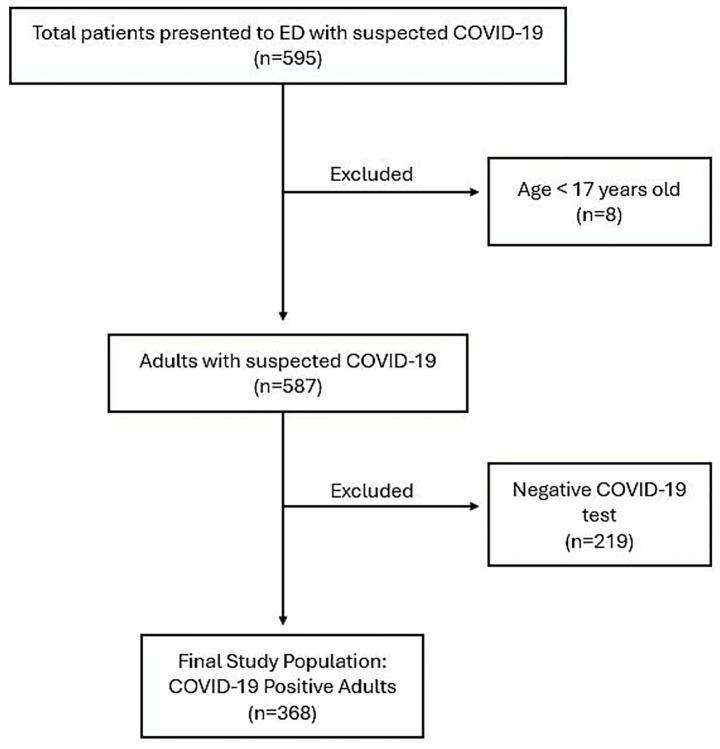
This retrospective study included 368 patients diagnosed with COVID-19 at SEHA hospitals in Al Ain over a six-month period. The CRS and ALKA scores were calculated to predict hospital admission, critical illness, and mortality. Predictive ability was assessed using receiver operating characteristic (ROC) curve analysis. Odds ratios (ORs) were calculated to assess the risk of hospital admission, critical illness, and mortality.
RESULTS
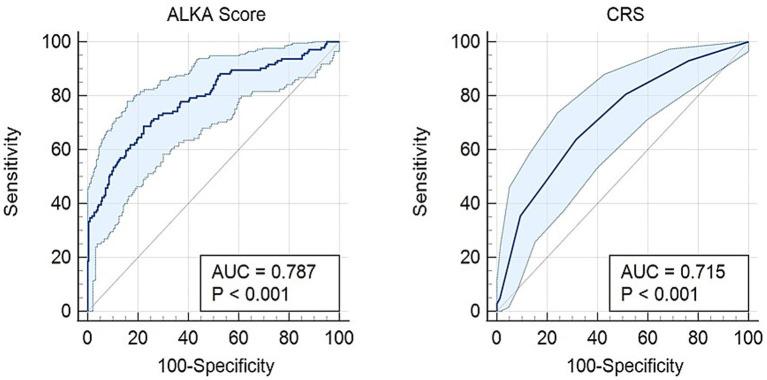
The mean age of the patients was 51 ± 19.42 years, and 145 (39.4%) of them were male. Among the patients, 162 required inpatient care, 13 required invasive ventilation, and the mortality rate was 4.9% (eight patients). ROC analysis revealed that ALKA outperformed CRS in predicting hospital admission (ALKA area under the curve [AUC] 0.79 vs. CRS AUC 0.71), critical illness (ALKA AUC 0.76 vs. CRS AUC 0.67), and mortality (ALKA AUC 0.96 vs. CRS AUC 0.82). The OR for ALKA outperformed CRS in predicting hospital admission (ALKA 3.12 vs. CRS 1.12), critical illness (ALKA 2.9 vs. CRS 2.01), and mortality (ALKA 6.25 vs. CRS 1.1).
CONCLUSION
Our study demonstrated that ALKA score outperforms CRS in predicting hospital admission, critical illness, and mortality among patients with symptomatic COVID-19 at initial presentation. Further external validation of both tools is required to assess their effectiveness in different healthcare settings.
引言
2019年冠状病毒病(COVID-19)大流行导致全球大量死亡和发病,新出现的突变株继续有可能引发严重的呼吸道疾病。已经开发了两种临床评估工具,即基于13种合并症的COVID-19并发症风险评分(CRS)和ALKA(年龄、乳酸脱氢酶、肾功能和白蛋白)评分,以预测就诊时有症状患者的疾病严重程度。本研究旨在比较这两种风险评分系统在预测住院、危重症和死亡率方面的表现。
方法
这项回顾性研究纳入了在艾因市SEHA医院6个月内确诊为COVID-19的368例患者。计算CRS和ALKA评分以预测住院、危重症和死亡率。使用受试者工作特征(ROC)曲线分析评估预测能力。计算比值比(OR)以评估住院、危重症和死亡风险。
结果
患者的平均年龄为51±19.42岁,其中145例(39.4%)为男性。患者中,162例需要住院治疗,13例需要有创通气,死亡率为4.9%(8例患者)。ROC分析显示,在预测住院(ALKA曲线下面积[AUC]0.79对CRS AUC 0.71)、危重症(ALKA AUC 0.76对CRS AUC 0.67)和死亡率(ALKA AUC 0.96对CRS AUC 0.82)方面,ALKA优于CRS。在预测住院(ALKA 3.12对CRS 1.12)、危重症(ALKA 2.9对CRS 2.01)和死亡率(ALKA 6.25对CRS 1.1)方面,ALKA的OR优于CRS。
结论
我们的研究表明,在预测初诊时有症状的COVID-19患者的住院、危重症和死亡率方面,ALKA评分优于CRS。需要对这两种工具进行进一步的外部验证,以评估它们在不同医疗环境中的有效性。


 Zotero 插件