
全光多模态分析:一种用于识别抗菌作用机制和检测新型作用机制的全息与深度学习工具。
HoloMoA: a holography and deep learning tool for the identification of antimicrobial mechanisms of action and the detection of novel MoA.
作者信息
Sedaghat Zohreh, Courbon Benoît, Botrel Héloïse, Dugua Hélène, Tulinski Pawel, Alibaud Laethitia, Pagani Lucia, Mercer Derry, Guyard Cyril, Védrine Christophe, Dixneuf Sophie
机构信息
BIOASTER, Lyon, France.
BIOASTER, Paris, France.
出版信息
Front Microbiol. 2025 Aug 22;16:1640252. doi: 10.3389/fmicb.2025.1640252. eCollection 2025.
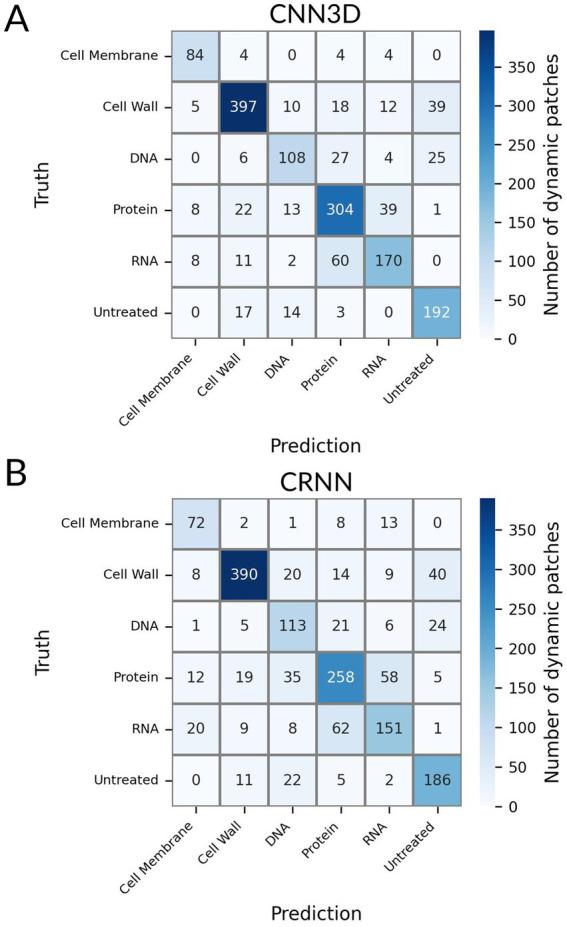
We propose an innovative technology to classify the Mechanism of Action (MoA) of antimicrobials and predict their novelty, called HoloMoA. Our rapid, robust, affordable and versatile tool is based on the combination of time-lapse Digital Inline Holographic Microscopy (DIHM) and Deep Learning (DL). In combination with hologram reconstruction. DIHM enables a label-free, time-resolved visualization of bacterial cell morphology and quantitative phase map to reveal phenotypic responses to antimicrobials, while DL techniques are powerful tools to extract discriminative features from image sequences and classify them. We assessed the performance of HoloMoA on ATCC 25922 treated for up to 2 hours with 22 antibiotics representing 5 conventional functional classes (i.e. Cell Wall synthesis inhibitors, Cell Membrane synthesis inhibitors, Protein synthesis inhibitors, DNA and RNA synthesis inhibitors). First, using reconstructed phase images as input to a Convolutional Recurrent Neural Network (CRNN), we detected the MoA of known antibiotics with 95% accuracy. Secondly, we showed how our CRNN model combined with a Siamese Neural Network architecture can be used for the novelty assessment of the MoA of candidate antibiotics. We successfully evaluated our novelty detector on a test set containing three unseen molecules - two belonging to the conventional functional classes and one molecule from an additional class (Folate synthesis inhibitors, herein represented by trimethoprim-sulfamethoxazole). We demonstrated that the DIHM and DL combination provides a promising tool for determining the MoA of antimicrobial candidates using a large image database for known antimicrobials.
我们提出了一种创新技术,用于对抗菌药物的作用机制(MoA)进行分类并预测其新颖性,称为全息作用机制(HoloMoA)。我们这种快速、稳健、经济且通用的工具基于延时数字全息显微镜(DIHM)和深度学习(DL)的结合。结合全息图重建,DIHM能够对细菌细胞形态进行无标记、时间分辨的可视化以及定量相位图,以揭示对抗菌药物的表型反应,而DL技术是从图像序列中提取判别特征并对其进行分类的强大工具。我们用代表5种传统功能类别的22种抗生素(即细胞壁合成抑制剂、细胞膜合成抑制剂、蛋白质合成抑制剂、DNA和RNA合成抑制剂)对ATCC 25922进行长达2小时的处理,评估了HoloMoA的性能。首先,使用重建的相位图像作为卷积循环神经网络(CRNN)的输入,我们以95%的准确率检测出了已知抗生素的作用机制。其次,我们展示了我们的CRNN模型与暹罗神经网络架构相结合如何用于候选抗生素作用机制的新颖性评估。我们在一个包含三种未见分子的测试集上成功评估了我们的新颖性检测器——其中两种属于传统功能类别,一种来自额外的类别(叶酸合成抑制剂,此处由甲氧苄啶 - 磺胺甲恶唑代表)。我们证明,DIHM和DL的结合为利用已知抗菌药物的大型图像数据库确定候选抗菌药物的作用机制提供了一种有前景的工具。


 Zotero 插件