
在针对不同铜含量涂层表面的测试中,单一细菌与细菌参考群落的比较。
Comparison of single bacteria and a bacterial reference community in a test against coated surfaces of varying copper content.
作者信息
Ly-Sauerbrey Yen, Anton Ronja, Kopruch Laura, Krämer Carolin Luisa, Boschert Alessa L, Neidhöfer Claudio, Schwengers Oliver, Zander Daniela, Leuko Stefan
机构信息
Institute of Aerospace Medicine, German Aerospace Center, Cologne, Germany.
Institute for Frontier Materials on Earth and in Space, German Aerospace Center, Cologne, Germany.
出版信息
Front Microbiol. 2025 Aug 26;16:1659828. doi: 10.3389/fmicb.2025.1659828. eCollection 2025.
INTRODUCTION
Pathogens can easily transmit via surfaces and objects. In light of the ongoing pandemic of antimicrobial resistance, silently threatening millions worldwide, this is of particular concern in clinical and public environments. Thus, it is crucial to understand how antimicrobial materials influence surface-associated microbes and microbial communities. Copper, known for its antimicrobial activity, has demonstrated effectiveness against numerous clinically relevant pathogens. However, these pure cultures are in stark contrast to the microbial communities. Additionally, the application of pure copper surfaces is high in cost and maintenance.
METHODS
Hence, in this study we not only tested the antibacterial effectivity of different copper concentrations against single species, but also against a reference bacterial community representing the most abundant bacterial genera in public transport. This allowed a comparison of the antibacterial efficacy of copper against a bacterial community and against single species. Coatings on glass, which were composed of full copper (100 at.% Cu) and copper-aluminum alloys with different Cu contents (79 at.%, 53 at.% and 24 at.%) were tested with two selected single species ( DSM 23089T and DSM 111179) and those species within the bacterial community.
RESULTS
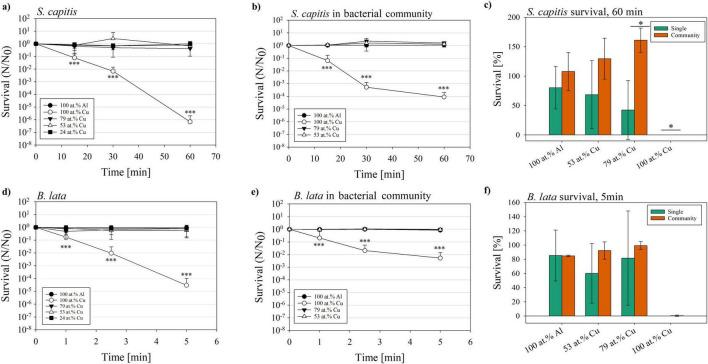
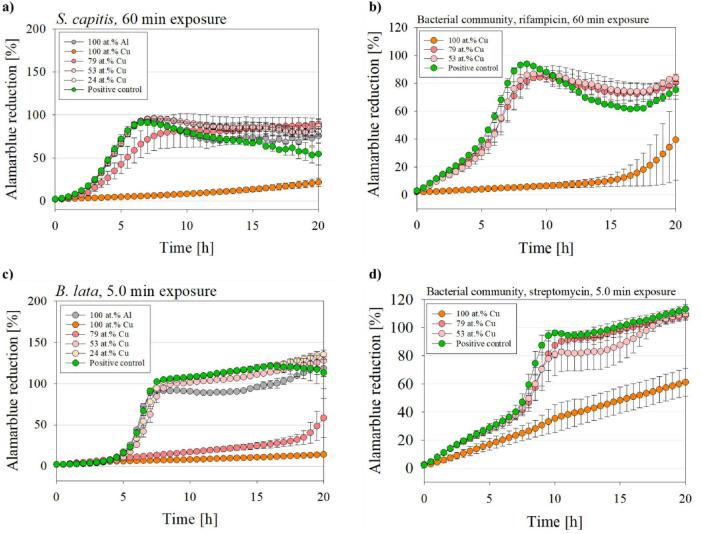
In general, the survival of the two species within the bacterial community was higher compared to their respective survival as a single species, significantly for . Surfaces with 100 at.% copper content showed the greatest antibacterial effect in terms of bacterial survival, with a reduced survival of up to 10. The 79 at.% Cu coating only had an inhibitory effect on the metabolic activity of when exposed to the surfaces as single species.
DISCUSSION
Our results highlight the benefits of additional testing of microbial communities rather than pure cultures. These experiments allow for enhanced evaluation of antimicrobial surfaces since they also take complex and diverse interactions within a surface microbiota into account. Therefore, community testing might be the more holistic approach for the testing of antibacterial materials.
引言
病原体可轻易通过表面和物体传播。鉴于持续的抗菌药物耐药性大流行正悄然威胁着全球数百万人,这在临床和公共环境中尤为令人担忧。因此,了解抗菌材料如何影响与表面相关的微生物和微生物群落至关重要。铜以其抗菌活性而闻名,已证明对多种临床相关病原体有效。然而,这些纯培养物与微生物群落形成鲜明对比。此外,纯铜表面的应用成本和维护成本很高。
方法
因此,在本研究中,我们不仅测试了不同铜浓度对单一物种的抗菌效果,还测试了对代表公共交通中最丰富细菌属的参考细菌群落的抗菌效果。这使得能够比较铜对细菌群落和单一物种的抗菌效果。对由全铜(100原子%铜)和不同铜含量(79原子%、53原子%和24原子%)的铜铝合金组成的玻璃涂层,用两种选定的单一物种(DSM 23089T和DSM 111179)以及细菌群落中的那些物种进行了测试。
结果
总体而言,细菌群落中这两个物种的存活率高于它们作为单一物种时各自的存活率,对于[具体物种]而言差异显著。就细菌存活率而言,铜含量为100原子%的表面显示出最大的抗菌效果,存活率降低高达10倍。当作为单一物种暴露于表面时,79原子%铜涂层仅对[具体物种]的代谢活性有抑制作用。
讨论
我们的结果突出了对微生物群落而非纯培养物进行额外测试的益处。这些实验能够增强对抗菌表面的评估,因为它们还考虑了表面微生物群内复杂多样的相互作用。因此,群落测试可能是测试抗菌材料更全面的方法。
 Zotero 插件