
利用CD8+ T细胞中的先天免疫信号来增强抗肿瘤免疫力。
Leveraging innate immune signals in CD8+ T cells to boost antitumor immunity.
作者信息
Albert Gabriella K, Cao Phoebe, Davila Eduardo
机构信息
Department of Medicine, Division of Medical Oncology, University of Colorado School of Medicine, Aurora, CO, United States.
University of Colorado Comprehensive Cancer Center, Aurora, CO, United States.
出版信息
Front Immunol. 2025 Aug 29;16:1617773. doi: 10.3389/fimmu.2025.1617773. eCollection 2025.
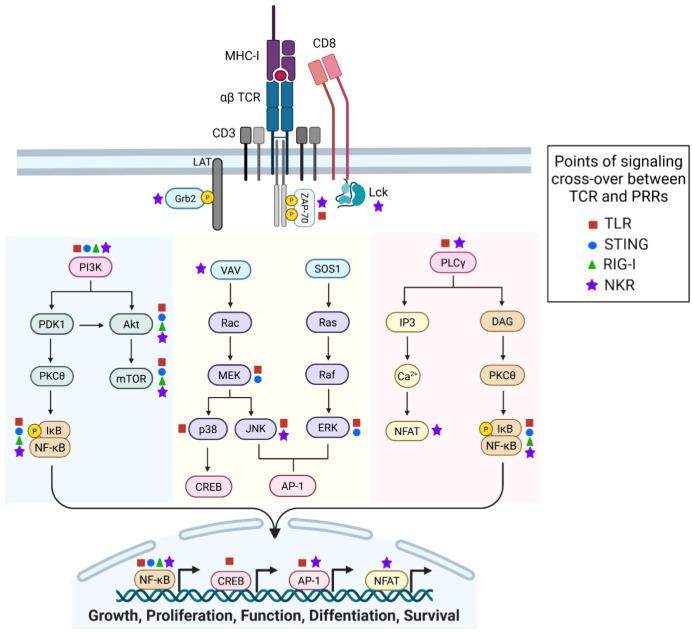
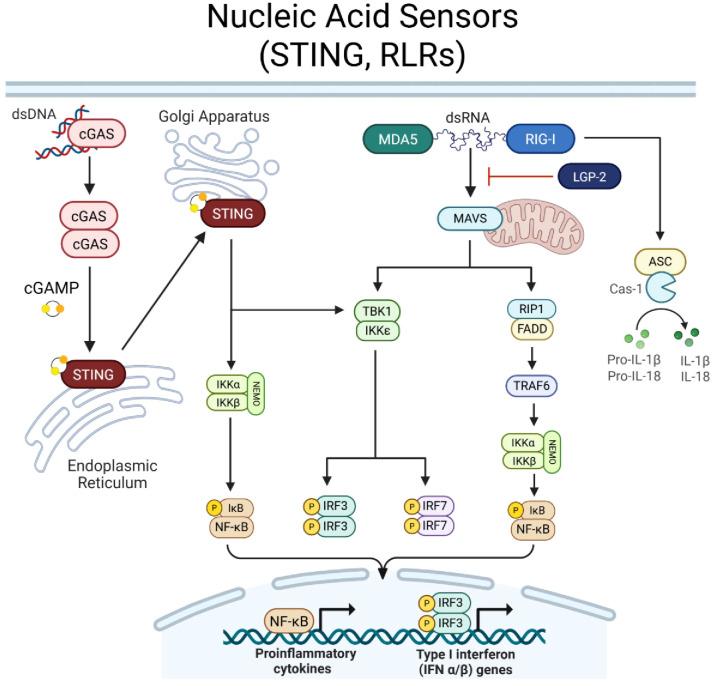
Pattern recognition receptors (PRRs), traditionally characterized in innate immune cells, are emerging as critical modulators of T cell function. Toll-like receptors (TLRs), STING, RIG-I-like receptors (RLRs), and natural killer receptors (NKRs) are expressed by CD8+ T cells, where they influence various cellular responses. Primarily serving as noncanonical costimulatory signals, TLRs can modulate T cell activation, differentiation, metabolic fitness, and memory formation. RLRs and STING can promote T cell expansion and cytokine production. Both activating and inhibitory NKRs can also alter T cell cytotoxicity and differentiation. As demonstrated in recent advancements, the capacity of these signaling cascades to enhance T cell responses offers promising therapeutic opportunities in cancer. Clinical strategies are being developed to selectively harness each of these pathways, such as TLR and STING agonists to bolster antitumor responses, and NKR-based approaches to amplify cytotoxic function. Additionally, adoptive T cell therapies, such as chimeric antigen receptor (CAR)-T cells, are incorporating these innate signaling components to overcome tumor-mediated immunosuppression, enhance functional longevity, and improve therapeutic efficacy. This review discusses the progress made to characterize the role of T cell intrinsic PRR activity in shaping T cell functions and highlights recent advancements in that leverage innate receptor signaling to enhance the efficacy of cancer immunotherapies.
模式识别受体(PRR)传统上是在固有免疫细胞中得以表征,如今正成为T细胞功能的关键调节因子。Toll样受体(TLR)、干扰素基因刺激蛋白(STING)、视黄酸诱导基因I样受体(RLR)和自然杀伤受体(NKR)在CD8 + T细胞中表达,在这些细胞中它们影响各种细胞反应。TLR主要作为非经典共刺激信号,可调节T细胞活化、分化、代谢适应性和记忆形成。RLR和STING可促进T细胞扩增和细胞因子产生。激活型和抑制型NKR也均可改变T细胞的细胞毒性和分化。正如最近的进展所表明的,这些信号级联增强T细胞反应的能力为癌症治疗提供了有前景的治疗机会。正在制定临床策略以选择性地利用这些途径中的每一种,例如使用TLR和STING激动剂来增强抗肿瘤反应,以及基于NKR的方法来增强细胞毒性功能。此外,过继性T细胞疗法,如嵌合抗原受体(CAR)-T细胞,正在纳入这些固有信号成分,以克服肿瘤介导的免疫抑制、延长功能寿命并提高治疗效果。本综述讨论了在表征T细胞内在PRR活性在塑造T细胞功能中的作用方面所取得的进展,并强调了利用固有受体信号增强癌症免疫疗法疗效的最新进展。


 Zotero 插件