
轮班工作与脑龄差距之间的关联:一项使用基于磁共振成像的脑龄预测算法的神经影像学研究。
Association between shift work and brain age gap: a neuroimaging study using MRI-based brain age prediction algorithms.
作者信息
Kim Youjin, Choi Joon Yul, Petrovskiy Evgeny, Lee Wanhyung
机构信息
Department of Preventive Medicine, College of Medicine, Chung-Ang University, Seoul, Republic of Korea.
Department of Biomedical Engineering, Yonsei University, Wonju, Republic of Korea.
出版信息
Front Aging Neurosci. 2025 Aug 29;17:1650497. doi: 10.3389/fnagi.2025.1650497. eCollection 2025.
BACKGROUND
Shift work is increasingly common and associated with numerous adverse health effects. Although studies show that shift work affects brain structure and neurological stress, its direct impact on brain aging remains unclear. Therefore, this study aims to investigate the association between shift work and brain aging using the brain age gap (BAG)-a neuroimaging biomarker calculated by comparing predicted brain age derived from structural magnetic resonance imaging (MRI) scans to chronological age.
METHODS
Structural MRI data (T1-weighted and T2-weighted) were collected from 113 healthcare workers, including 33 shift workers and 80 fixed daytime workers. Brain age was estimated using seven validated machine learning models. BAG was calculated as the difference between predicted brain age and chronological age. Statistical analyses, including ANCOVA, adjusted for chronological age, sex, intracranial volume (ICV), education level, and occupational type.
RESULTS
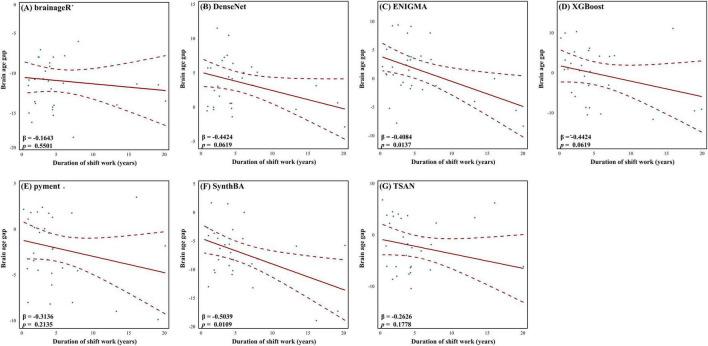
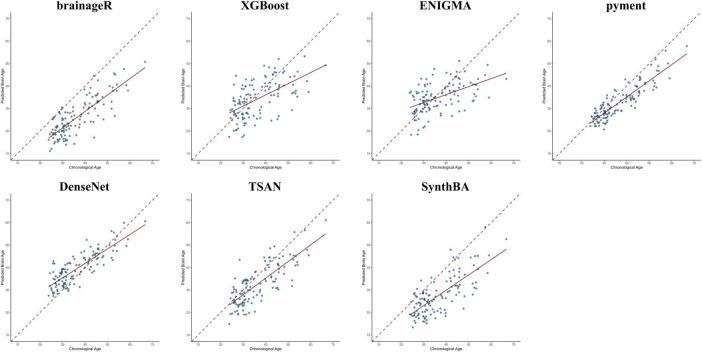
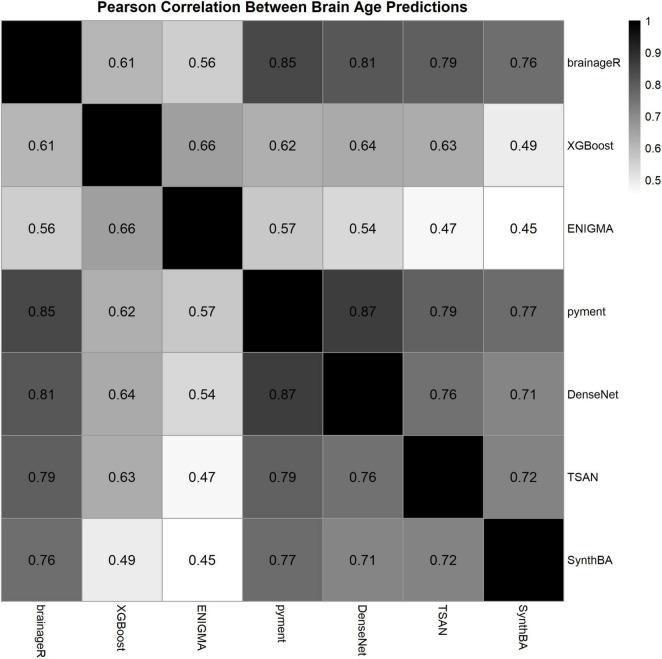
The association between BAG and shift work duration was also evaluated. Model performance varied (maximum R = 0.79) and showed systematic age-related bias, typically underestimating brain age in older participants. Unadjusted analyses initially indicated lower BAG values in younger shift workers. However, after covariate adjustments, shift workers consistently exhibited significantly higher BAG values, suggesting accelerated brain aging. Two models retained statistical significance despite adjustment for potential confounders. Longer shift work duration correlated with a decreasing BAG trend, suggesting potential neuroadaptive changes or selective retention of resilient workers.
CONCLUSION
These findings demonstrate that shift work is associated with accelerated apparent brain aging, even after controlling for systematic model bias and demographic covariates. The observed reduction in BAG with extended shift work exposure may reflect adaptive or selective effects, emphasizing the need for longitudinal studies to clarify these mechanisms. This research highlights the importance of incorporating occupational exposures in neuroimaging and brain health investigations.
背景
轮班工作日益普遍,且与众多不良健康影响相关。尽管研究表明轮班工作会影响脑结构和神经应激,但其对脑老化的直接影响仍不明确。因此,本研究旨在利用脑年龄差距(BAG)——一种通过比较结构磁共振成像(MRI)扫描得出的预测脑年龄与实际年龄计算出的神经影像生物标志物,来探究轮班工作与脑老化之间的关联。
方法
收集了113名医护人员的结构MRI数据(T1加权和T2加权),其中包括33名轮班工作者和80名固定白班工作者。使用七个经过验证的机器学习模型估算脑年龄。BAG计算为预测脑年龄与实际年龄之间的差值。统计分析包括协方差分析(ANCOVA),并对实际年龄、性别、颅内体积(ICV)、教育水平和职业类型进行了调整。
结果
还评估了BAG与轮班工作时长之间的关联。模型性能各异(最大R = 0.79),并显示出与年龄相关的系统性偏差,通常会低估老年参与者的脑年龄。未经调整的分析最初表明年轻轮班工作者的BAG值较低。然而,在进行协变量调整后,轮班工作者始终表现出显著更高的BAG值,表明脑老化加速。尽管对潜在混杂因素进行了调整,但仍有两个模型具有统计学意义。较长的轮班工作时长与BAG呈下降趋势相关,表明可能存在神经适应性变化或对有适应能力的工作者的选择性保留。
结论
这些发现表明,即使在控制了系统性模型偏差和人口统计学协变量之后,轮班工作仍与明显的脑老化加速有关。随着轮班工作暴露时间延长,观察到的BAG降低可能反映了适应性或选择性效应,强调需要进行纵向研究以阐明这些机制。本研究强调了在神经影像和脑健康研究中纳入职业暴露因素的重要性。
 Zotero 插件