
衰老相关代谢途径的饮食和药理学调节:分子见解、临床证据及转化模型
Dietary and Pharmacological Modulation of Aging-Related Metabolic Pathways: Molecular Insights, Clinical Evidence, and a Translational Model.
作者信息
Murillo-Cancho Antonio Fernando, Lozano-Paniagua David, Nievas-Soriano Bruno José
机构信息
Department of Nursing, Physiotherapy and Medicine, Faculty of Health Sciences, University of Almeria, 04120 Almeria, Spain.
Faculty of Health Sciences, International University of La Rioja, 26006 Logroño, Spain.
出版信息
Int J Mol Sci. 2025 Oct 2;26(19):9643. doi: 10.3390/ijms26199643.
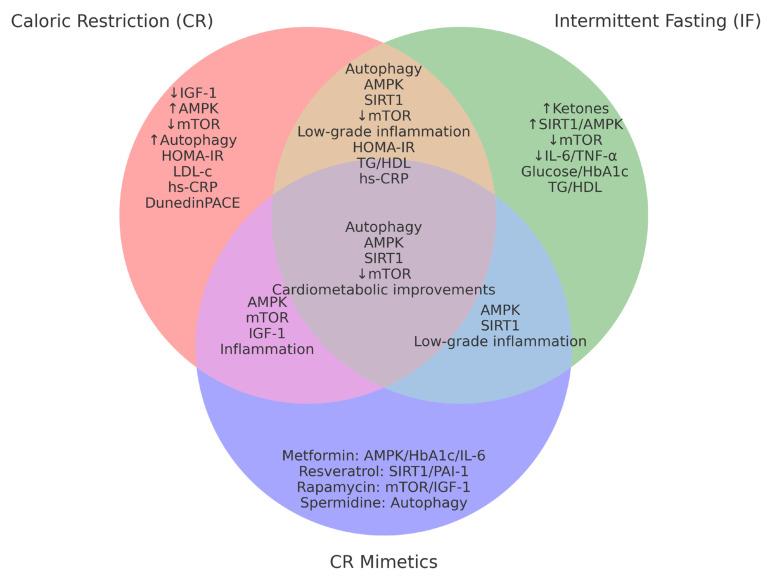
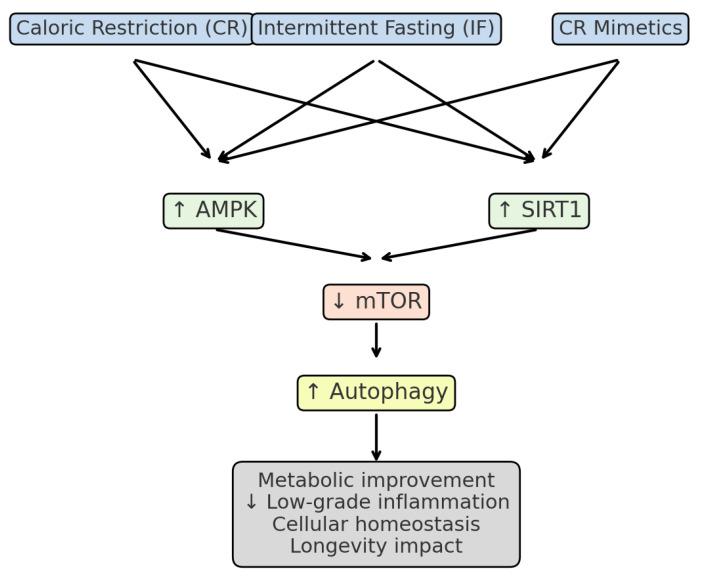
Advances in geroscience suggest that aging is modulated by molecular pathways that are amenable to dietary and pharmacological intervention. We conducted an integrative critical review of caloric restriction (CR), intermittent fasting (IF), and caloric restriction mimetics (CR-mimetics) to compare shared mechanisms, clinical evidence, limitations, and translational potential. Across modalities, CR and IF consistently activate AMP-activated protein kinase and sirtuins, inhibit mTOR (mechanistic target of rapamycin) signaling, and enhance autophagy, aligning with improvements in insulin sensitivity, lipid profile, low-grade inflammation, and selected epigenetic aging measures in humans. CR-mimetics, such as metformin, resveratrol, rapamycin, and spermidine, partially reproduce these effects; however, long-term safety and efficacy in healthy populations remain incompletely defined. Methodological constraints-short trial duration, selective samples, intermediate (nonclinical) endpoints, and limited adherence monitoring-impede definitive conclusions on hard outcomes (frailty, disability, hospitalization, mortality). We propose the Active Management of Aging and Longevity (AMAL) model, a three-level biomarker-guided framework that integrates personalized diet, chrono-nutrition, exercise, and the selective use of CR-mimetics, along with digital monitoring and decision support. AMAL emphasizes epigenetic clocks, multi-omics profiling, inflammatory and microbiome metrics, and adaptive protocols to enhance adherence and clinical relevance. Overall, CR, IF, and CR mimetics constitute promising, complementary strategies to modulate biological aging; rigorous long-term trials with standardized biomarkers and clinically meaningful endpoints are needed to enable their scalable implementation.
老年科学的进展表明,衰老受分子途径调控,这些途径可通过饮食和药物干预来调节。我们对热量限制(CR)、间歇性禁食(IF)和热量限制模拟物(CR模拟物)进行了综合批判性综述,以比较它们的共同机制、临床证据、局限性和转化潜力。在各种方式中,CR和IF始终能激活AMP激活的蛋白激酶和沉默调节蛋白,抑制雷帕霉素靶蛋白(mTOR)信号传导,并增强自噬,这与人类胰岛素敏感性、血脂水平、低度炎症以及某些表观遗传衰老指标的改善相一致。CR模拟物,如二甲双胍、白藜芦醇、雷帕霉素和亚精胺,能部分重现这些效果;然而,健康人群中的长期安全性和有效性仍未完全明确。方法学上的限制——试验持续时间短、样本有选择性、采用中间(非临床)终点以及依从性监测有限——妨碍了我们就硬性结局(衰弱、残疾、住院、死亡率)得出明确结论。我们提出了主动管理衰老与长寿(AMAL)模型,这是一个三级生物标志物引导的框架,整合了个性化饮食、时间营养学、运动以及CR模拟物的选择性使用,同时还包括数字监测和决策支持。AMAL强调表观遗传时钟、多组学分析、炎症和微生物组指标以及适应性方案,以提高依从性和临床相关性。总体而言,CR、IF和CR模拟物构成了调节生物衰老的有前景的互补策略;需要进行严格的长期试验,采用标准化生物标志物和具有临床意义的终点,以便能够对其进行可扩展的实施。

 Zotero 插件