
神经元前沿一切平静:朊病毒蛋白对NMDA受体的抑制作用
All quiet on the neuronal front: NMDA receptor inhibition by prion protein.
作者信息
Steele Andrew D
机构信息
Division of Biology, California Institute of Technology, Pasadena, CA 91125, USA.
出版信息
J Cell Biol. 2008 May 5;181(3):407-9. doi: 10.1083/jcb.200803152. Epub 2008 Apr 28.
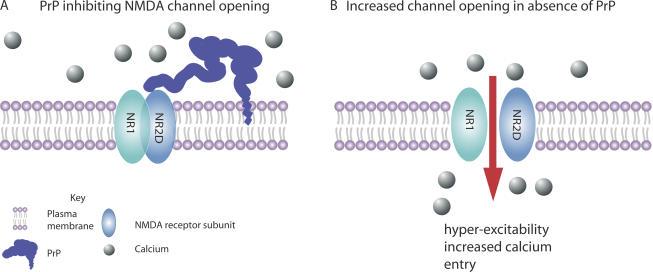
The normal function of the prion protein (PrP)-the causative agent of mad cow or prion disease-has long remained out of reach. Deciphering PrP's function may help to unravel the complex chain of events triggered by PrP misfolding during prion disease. In this issue of the JCB, an exciting paper (Khosravani, H., Y. Zhang, S. Tsutsui, S. Hameed, C. Altier, J. Hamid, L. Chen, M. Villemaire, Z. Ali, F.R. Jirik, and G.W. Zamponi. 2008. J. Cell Biol. 181:551-565) connects diverse observations regarding PrP into a coherent framework whereby PrP dampens the activity of an N-methyl-d-aspartate (NMDA) receptor (NMDAR) subtype and reduces excitotoxic lesions. The findings of this study suggest that understanding the normal function of proteins associated with neurodegenerative disease may elucidate the molecular pathogenesis.
朊病毒蛋白(PrP)是疯牛病或朊病毒疾病的病原体,其正常功能长期以来一直难以捉摸。破解PrP的功能可能有助于揭示朊病毒疾病期间由PrP错误折叠引发的复杂事件链。在本期《细胞生物学杂志》中,一篇令人兴奋的论文(Khosravani, H., Y. Zhang, S. Tsutsui, S. Hameed, C. Altier, J. Hamid, L. Chen, M. Villemaire, Z. Ali, F.R. Jirik, and G.W. Zamponi. 2008. J. Cell Biol. 181:551-565)将关于PrP的各种观察结果整合到一个连贯的框架中,据此PrP可抑制N-甲基-D-天冬氨酸(NMDA)受体(NMDAR)亚型的活性并减少兴奋性毒性损伤。这项研究的结果表明,了解与神经退行性疾病相关蛋白质的正常功能可能有助于阐明分子发病机制。
 Zotero 插件