
含硒氨基酸是髓过氧化物酶衍生的次碘酸的作用靶点:绝对速率常数的测定及对生物损伤的影响。
Selenium-containing amino acids are targets for myeloperoxidase-derived hypothiocyanous acid: determination of absolute rate constants and implications for biological damage.
机构信息
The Heart Research Institute, 7 Eliza St, Newtown, Sydney, NSW 2042, Australia.
出版信息
Biochem J. 2012 Jan 1;441(1):305-16. doi: 10.1042/BJ20101762.
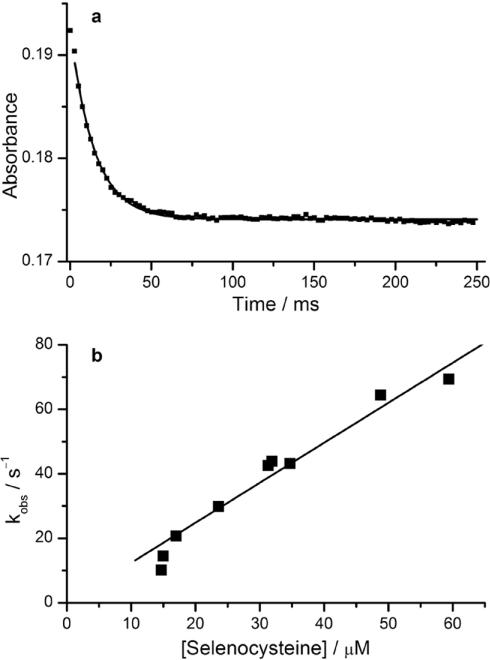
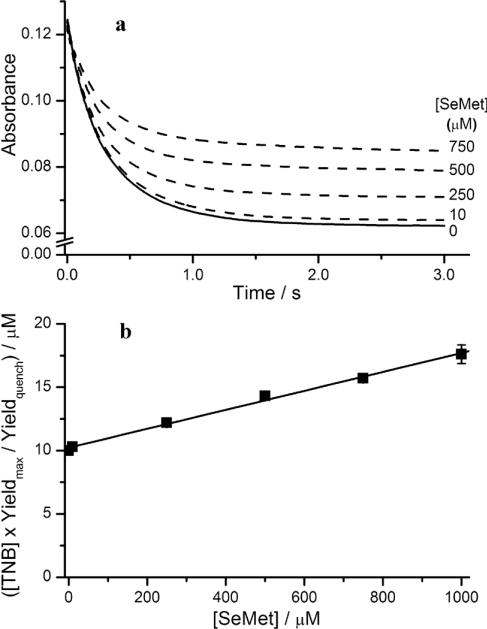
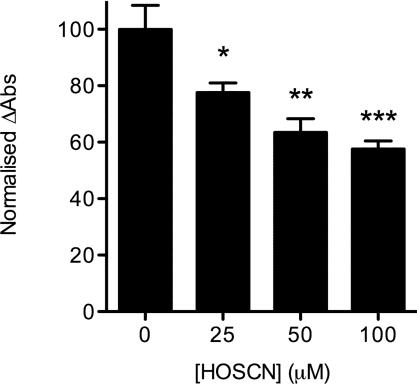
Elevated MPO (myeloperoxidase) levels are associated with multiple human inflammatory pathologies. MPO catalyses the oxidation of Cl-, Br- and SCN- by H2O2 to generate the powerful oxidants hypochlorous acid (HOCl), hypobromous acid (HOBr) and hypothiocyanous acid (HOSCN) respectively. These species are antibacterial agents, but misplaced or excessive production is implicated in tissue damage at sites of inflammation. Unlike HOCl and HOBr, which react with multiple targets, HOSCN targets cysteine residues with considerable selectivity. In the light of this reactivity, we hypothesized that Sec (selenocysteine) residues should also be rapidly oxidized by HOSCN, as selenium atoms are better nucleophiles than sulfur. Such oxidation might inactivate critical Sec-containing cellular protective enzymes such as GPx (glutathione peroxidase) and TrxR (thioredoxin reductase). Stopped-flow kinetic studies indicate that seleno-compounds react rapidly with HOSCN with rate constants, k, in the range 2.8×10(3)-5.8×10(6) M-1·s-1 (for selenomethionine and selenocystamine respectively). These values are ~6000-fold higher than the corresponding values for H2O2, and are also considerably larger than for the reaction of HOSCN with thiols (16-fold for cysteine and 80-fold for selenocystamine). Enzyme studies indicate that GPx and TrxR, but not glutathione reductase, are inactivated by HOSCN in a concentration-dependent manner; k for GPx has been determined as ~5×10⁵ M-1·s-1. Decomposed HOSCN did not induce inactivation. These data indicate that selenocysteine residues are oxidized rapidly by HOSCN, with this resulting in the inhibition of the critical intracellular Sec-dependent protective enzymes GPx and TrxR.
髓过氧化物酶 (MPO) 水平升高与多种人类炎症性疾病有关。MPO 催化 Cl-、Br-和 SCN-被 H2O2 氧化,分别生成强氧化剂次氯酸 (HOCl)、次溴酸 (HOBr)和次硫氰酸 (HOSCN)。这些物质是抗菌剂,但在炎症部位,位置不当或过度产生会导致组织损伤。与 HOCl 和 HOBr 不同,它们与多个靶标反应,HOSCN 对半胱氨酸残基具有相当的选择性。鉴于这种反应性,我们假设 Sec(硒代半胱氨酸)残基也应该被 HOSCN 快速氧化,因为硒原子比硫原子更好的亲核试剂。这种氧化可能会使关键的含硒细胞保护酶(如谷胱甘肽过氧化物酶 (GPx) 和硫氧还蛋白还原酶 (TrxR))失活。停流动力学研究表明,硒化合物与 HOSCN 快速反应,速率常数 k 在 2.8×10(3)-5.8×10(6) M-1·s-1 的范围内(分别为硒蛋氨酸和硒代半胱氨酸)。这些值比 H2O2 的相应值高约 6000 倍,也比 HOSCN 与硫醇的反应值大得多(半胱氨酸为 16 倍,硒代半胱氨酸为 80 倍)。酶研究表明,GPx 和 TrxR(而非谷胱甘肽还原酶)以浓度依赖的方式被 HOSCN 失活;GPx 的 k 值约为 5×10⁵ M-1·s-1。分解的 HOSCN 不会诱导失活。这些数据表明,HOSCN 快速氧化硒代半胱氨酸残基,导致关键的细胞内依赖硒的保护性酶 GPx 和 TrxR 失活。


 Zotero 插件