
冠状病毒刺突蛋白介导的病毒细胞进入机制。
Mechanisms of coronavirus cell entry mediated by the viral spike protein.
机构信息
Center for Infection and Immunity of Lille, CNRS UMR8204, INSERM U1019, Institut Pasteur de Lille, Université Lille Nord de France, 59000 Lille, France.
出版信息
Viruses. 2012 Jun;4(6):1011-33. doi: 10.3390/v4061011. Epub 2012 Jun 20.
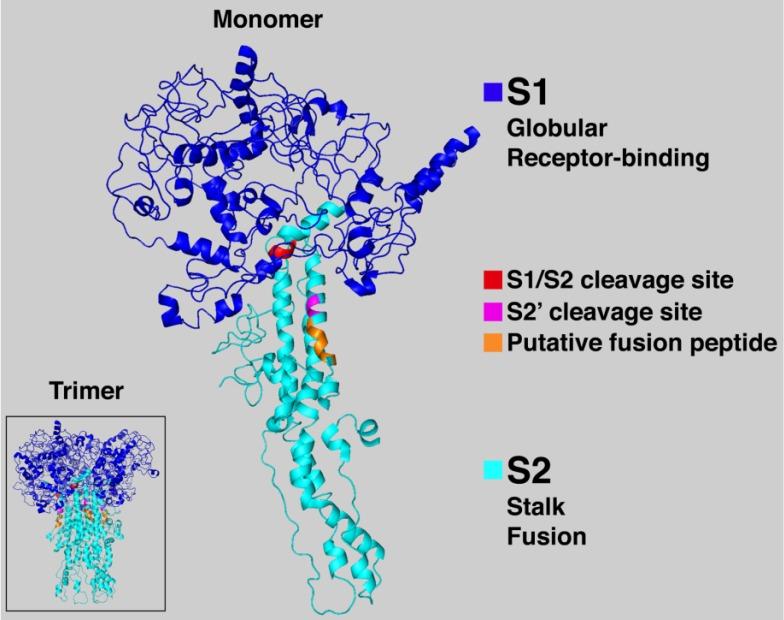
Coronaviruses are enveloped positive-stranded RNA viruses that replicate in the cytoplasm. To deliver their nucleocapsid into the host cell, they rely on the fusion of their envelope with the host cell membrane. The spike glycoprotein (S) mediates virus entry and is a primary determinant of cell tropism and pathogenesis. It is classified as a class I fusion protein, and is responsible for binding to the receptor on the host cell as well as mediating the fusion of host and viral membranes-A process driven by major conformational changes of the S protein. This review discusses coronavirus entry mechanisms focusing on the different triggers used by coronaviruses to initiate the conformational change of the S protein: receptor binding, low pH exposure and proteolytic activation. We also highlight commonalities between coronavirus S proteins and other class I viral fusion proteins, as well as distinctive features that confer distinct tropism, pathogenicity and host interspecies transmission characteristics to coronaviruses.
冠状病毒是包膜的正链 RNA 病毒,在细胞质中复制。为了将其核衣壳递送至宿主细胞内,它们依赖于包膜与宿主细胞膜的融合。刺突糖蛋白(S)介导病毒进入,是决定细胞嗜性和发病机制的主要决定因素。它被归类为 I 类融合蛋白,负责与宿主细胞上的受体结合以及介导宿主和病毒膜的融合——这一过程由 S 蛋白的主要构象变化驱动。本文综述了冠状病毒进入宿主细胞的机制,重点讨论了冠状病毒用于启动 S 蛋白构象变化的不同触发因素:受体结合、低 pH 暴露和蛋白水解激活。我们还强调了冠状病毒 S 蛋白与其他 I 类病毒融合蛋白之间的共性,以及赋予冠状病毒不同嗜性、致病性和宿主种间传播特征的独特特征。


 Zotero 插件