
黑色素瘤脯氨酸生物合成的功能特化。
Functional specialization in proline biosynthesis of melanoma.
机构信息
Sanford|Burnham Medical Research Institute, La Jolla, California, United States of America.
出版信息
PLoS One. 2012;7(9):e45190. doi: 10.1371/journal.pone.0045190. Epub 2012 Sep 14.
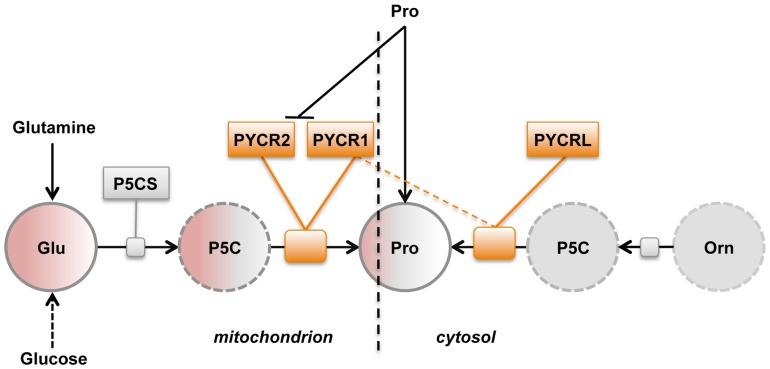
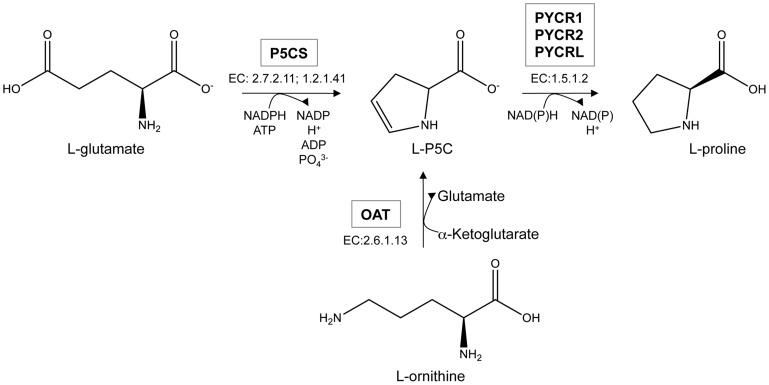
Proline metabolism is linked to hyperprolinemia, schizophrenia, cutis laxa, and cancer. In the latter case, tumor cells tend to rely on proline biosynthesis rather than salvage. Proline is synthesized from either glutamate or ornithine; both are converted to pyrroline-5-carboxylate (P5C), and then to proline via pyrroline-5-carboxylate reductases (PYCRs). Here, the role of three isozymic versions of PYCR was addressed in human melanoma cells by tracking the fate of (13)C-labeled precursors. Based on these studies we conclude that PYCR1 and PYCR2, which are localized in the mitochondria, are primarily involved in conversion of glutamate to proline. PYCRL, localized in the cytosol, is exclusively linked to the conversion of ornithine to proline. This analysis provides the first clarification of the role of PYCRs to proline biosynthesis.
脯氨酸代谢与高脯氨酸血症、精神分裂症、皮肤松弛症和癌症有关。在后一种情况下,肿瘤细胞往往依赖脯氨酸的生物合成而不是补救。脯氨酸可以由谷氨酸或鸟氨酸合成;两者都转化为吡咯啉-5-羧酸(P5C),然后通过吡咯啉-5-羧酸还原酶(PYCR)转化为脯氨酸。在这里,通过追踪(13)C 标记前体的命运,研究了三种同工型的 PYCR 在人黑色素瘤细胞中的作用。基于这些研究,我们得出结论,定位于线粒体中的 PYCR1 和 PYCR2 主要参与将谷氨酸转化为脯氨酸。定位于细胞质中的 PYCRL 仅与鸟氨酸转化为脯氨酸有关。这项分析首次阐明了 PYCR 在脯氨酸生物合成中的作用。


 Zotero 插件