
脊髓性肌萎缩症小鼠模型中的早期肌肉无力和肌肉蛋白紊乱。
Early onset muscle weakness and disruption of muscle proteins in mouse models of spinal muscular atrophy.
机构信息
Ottawa Hospital Research Institute, Regenerative Medicine Program, 501 Smyth Road, Ottawa, ON K1H 8L6, Canada.
出版信息
Skelet Muscle. 2013 Oct 11;3(1):24. doi: 10.1186/2044-5040-3-24.
BACKGROUND
The childhood neuromuscular disease spinal muscular atrophy (SMA) is caused by mutations or deletions of the survival motor neuron (SMN1) gene. Although SMA has traditionally been considered a motor neuron disease, the muscle-specific requirement for SMN has never been fully defined. Therefore, the purpose of this study was to investigate muscle defects in mouse models of SMA.
METHODS
We have taken advantage of two different mouse models of SMA, the severe Smn-/-;SMN2 mice and the less severe Smn2B/- mice. We have measured the maximal force produced from control muscles and those of SMA model mice by direct stimulation using an ex vivo apparatus. Immunofluorescence and immunoblot experiments were performed to uncover muscle defects in mouse models of SMA. Means from control and SMA model mice samples were compared using an analysis of variance test and Student's t tests.
RESULTS
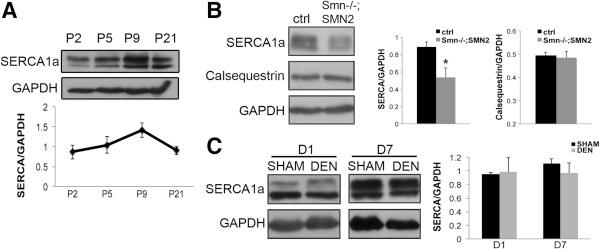
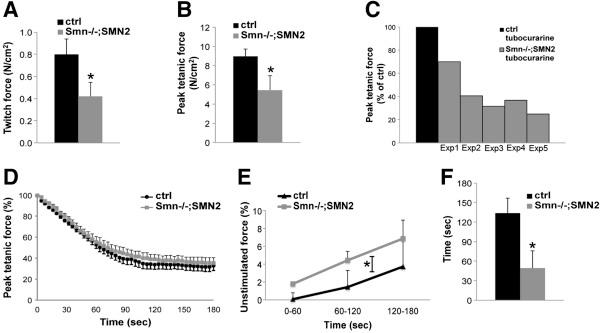
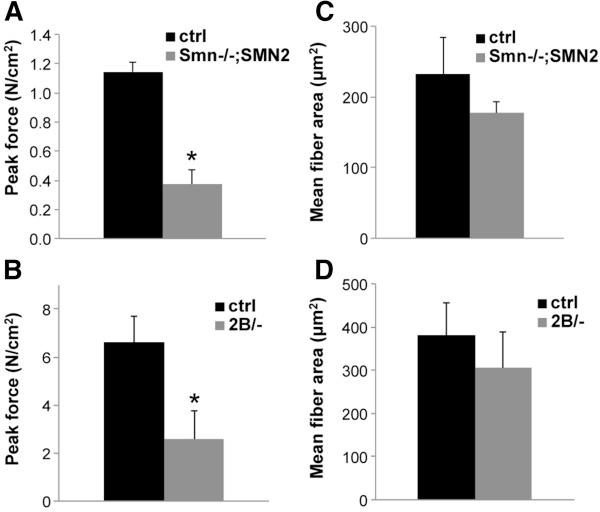
We report that tibialis anterior (TA) muscles of phenotype stage Smn-/-;SMN2 mice generate 39% less maximal force than muscles from control mice, independently of aberrant motor neuron signal transmission. In addition, during muscle fatigue, the Smn-/-;SMN2 muscle shows early onset and increased unstimulated force compared with controls. Moreover, we demonstrate a significant decrease in force production in muscles from pre-symptomatic Smn-/-;SMN2 and Smn2B/- mice, indicating that muscle weakness is an early event occurring prior to any overt motor neuron loss and muscle denervation. Muscle weakness in mouse models of SMA was associated with a delay in the transition from neonatal to adult isoforms of proteins important for proper muscle contractions, such as ryanodine receptors and sodium channels. Immunoblot analyses of extracts from hindlimb skeletal muscle revealed aberrant levels of the sarcoplasmic reticulum Ca2+ ATPase.
CONCLUSIONS
The findings from this study reveal a delay in the appearance of mature isoforms of proteins important for muscle contractions, as well as muscle weakness early in the disease etiology, thus highlighting the contributions of skeletal muscle defects to the SMA phenotype.
背景
儿童神经肌肉疾病脊髓性肌萎缩症(SMA)是由生存运动神经元(SMN1)基因的突变或缺失引起的。尽管 SMA 传统上被认为是一种运动神经元疾病,但 SMN 对肌肉的特异性需求从未得到充分定义。因此,本研究的目的是研究 SMA 小鼠模型中的肌肉缺陷。
方法
我们利用两种不同的 SMA 小鼠模型,即严重的 Smn-/-;SMN2 小鼠和稍轻的 Smn2B/- 小鼠。我们通过使用离体仪器直接刺激来测量对照肌肉和 SMA 模型小鼠的最大力。进行免疫荧光和免疫印迹实验以揭示 SMA 小鼠模型中的肌肉缺陷。使用方差分析检验和学生 t 检验比较对照和 SMA 模型小鼠样本的平均值。
结果
我们报告说,表型阶段 Smn-/-;SMN2 小鼠的胫骨前肌(TA)产生的最大力比对照小鼠的肌肉少 39%,而与异常运动神经元信号传递无关。此外,在肌肉疲劳期间,Smn-/-;SMN2 肌肉与对照相比,早期出现并增加了未刺激的力。此外,我们在具有症状前的 Smn-/-;SMN2 和 Smn2B/- 小鼠的肌肉中证明了力产生的显着下降,表明肌肉无力是发生在任何明显的运动神经元丧失和肌肉去神经之前的早期事件。SMA 小鼠模型中的肌肉无力与参与适当肌肉收缩的重要蛋白质的新生儿到成人同工型的出现延迟有关,例如兰尼碱受体和钠离子通道。后肢骨骼肌提取物的免疫印迹分析显示肌浆网 Ca2+ATP 酶的异常水平。
结论
这项研究的结果揭示了对于肌肉收缩很重要的蛋白质的成熟同工型出现延迟,以及疾病发病早期的肌肉无力,从而突出了骨骼肌缺陷对 SMA 表型的贡献。



 Zotero 插件