
抗精神病药物硫利达嗪通过活性氧介导的Akt信号抑制以及Mcl-1和c-FLIP(L)的下调,使肾癌Caki细胞对TRAIL诱导的凋亡敏感。
Antipsychotic agent thioridazine sensitizes renal carcinoma Caki cells to TRAIL-induced apoptosis through reactive oxygen species-mediated inhibition of Akt signaling and downregulation of Mcl-1 and c-FLIP(L).
作者信息
Min K-j, Seo B R, Bae Y C, Yoo Y H, Kwon T K
机构信息
Department of Immunology, School of Medicine, Keimyung University, Daegu 704-701, South Korea.
Department of Anatomy and Neurobiology, School of Dentistry, Kyungpook National University, Daegu 700-412, South Korea.
出版信息
Cell Death Dis. 2014 Feb 20;5(2):e1063. doi: 10.1038/cddis.2014.35.
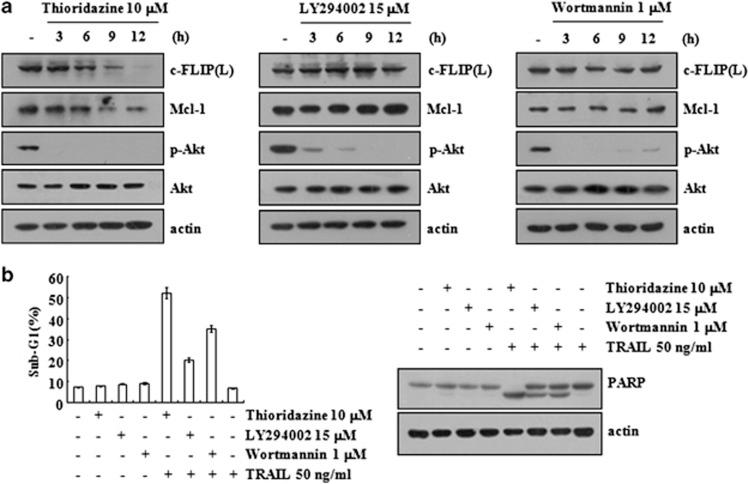
Thioridazine has been known as an antipsychotic agent, but it also has anticancer activity. However, the effect of thioridazine on tumor necrosis factor-related apoptosis-inducing ligand (TRAIL) sensitization has not yet been studied. Here, we investigated the ability of thioridazine to sensitize TRAIL-mediated apoptosis. Combined treatment with thioridazine and TRAIL markedly induced apoptosis in various human carcinoma cells, including renal carcinoma (Caki, ACHN, and A498), breast carcinoma (MDA-MB231), and glioma (U251MG) cells, but not in normal mouse kidney cells (TMCK-1) and human normal mesangial cells. We found that thioridazine downregulated c-FLIP(L) and Mcl-1 expression at the post-translational level via an increase in proteasome activity. The overexpression of c-FLIP(L) and Mcl-1 overcame thioridazine plus TRAIL-induced apoptosis. We further observed that thioridazine inhibited the Akt signaling pathway. In contrast, although other phosphatidylinositol-3-kinase/Akt inhibitors (LY294002 and wortmannin) sensitized TRAIL-mediated apoptosis, c-FLIP(L) and Mcl-1 expressions were not altered. Furthermore, thioridazine increased the production of reactive oxygen species (ROS) in Caki cells, and ROS scavengers (N-acetylcysteine, glutathione ethyl ester, and trolox) inhibited thioridazine plus TRAIL-induced apoptosis, as well as Akt inhibition and the downregulation of c-FLIP(L) and Mcl-1. Collectively, our study demonstrates that thioridazine enhances TRAIL-mediated apoptosis via the ROS-mediated inhibition of Akt signaling and the downregulation of c-FLIP(L) and Mcl-1 at the post-translational level.
硫利达嗪一直被认为是一种抗精神病药物,但它也具有抗癌活性。然而,硫利达嗪对肿瘤坏死因子相关凋亡诱导配体(TRAIL)致敏作用的影响尚未得到研究。在此,我们研究了硫利达嗪使TRAIL介导的凋亡致敏的能力。硫利达嗪与TRAIL联合处理显著诱导了多种人类癌细胞的凋亡,包括肾癌细胞(Caki、ACHN和A498)、乳腺癌细胞(MDA-MB231)和胶质瘤细胞(U251MG),但对正常小鼠肾细胞(TMCK-1)和人类正常系膜细胞没有作用。我们发现硫利达嗪通过增加蛋白酶体活性在翻译后水平下调c-FLIP(L)和Mcl-1的表达。c-FLIP(L)和Mcl-1的过表达克服了硫利达嗪加TRAIL诱导的凋亡。我们进一步观察到硫利达嗪抑制Akt信号通路。相比之下,尽管其他磷脂酰肌醇-3-激酶/Akt抑制剂(LY294002和渥曼青霉素)使TRAIL介导的凋亡致敏,但c-FLIP(L)和Mcl-1的表达没有改变。此外,硫利达嗪增加了Caki细胞中活性氧(ROS)的产生,并且ROS清除剂(N-乙酰半胱氨酸、谷胱甘肽乙酯和曲洛克斯)抑制了硫利达嗪加TRAIL诱导的凋亡,以及Akt抑制和c-FLIP(L)和Mcl-1的下调。总的来说,我们的研究表明硫利达嗪通过ROS介导抑制Akt信号通路以及在翻译后水平下调c-FLIP(L)和Mcl-1来增强TRAIL介导的凋亡。


 Zotero 插件