
白细胞介素-8的表达作为散发性结肠癌播散的独立预后因素。
Expression of interleukine-8 as an independent prognostic factor for sporadic colon cancer dissemination.
作者信息
Nastase A, Paslaru L, Herlea V, Ionescu M, Tomescu D, Bacalbasa N, Dima S, Popescu I
机构信息
Fundeni Clinical Institute, Bucharest, Romania The two authors had an equal contribution in the article.
出版信息
J Med Life. 2014 Jun 15;7(2):215-9. Epub 2014 Jun 25.
AIM
The aim of our study was to investigate the gene and serum protein expression profiles of IL-8 in colon cancer and associated hepatic metastasis and to correlate these results with clinicopathologic variables of the patients.
MATERIALS AND METHODS
IL-8 was evaluated by qPCR and ELISA in a total number of 62 colon cancer patients (n=42 by qPCR and n=20 by ELISA) in normal and tumoral tissue specimens and serum samples respectively. Additionally synchronous metastasis from 5 of these patients were also collected at the time of surgery and analyzed by qPCR.
RESULTS
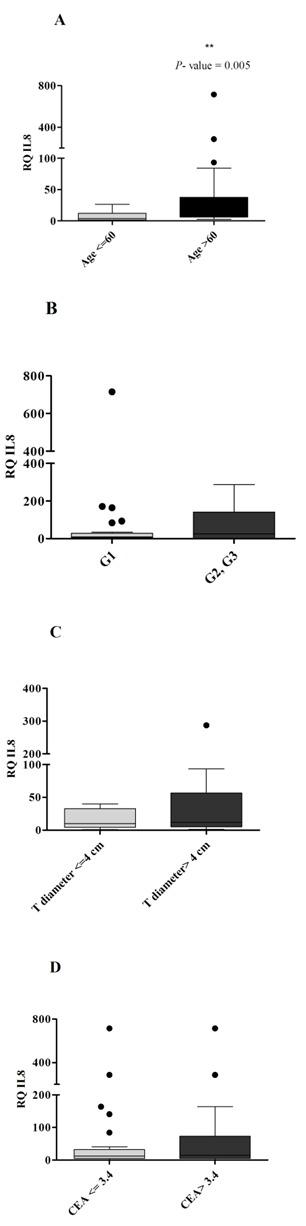
IL-8 was up regulated in all analyzed tumoral samples compared with normal tissue (P-value = 0.01) and higher expressed in metastatic tissues compared with tumoral tissues (P -value= 0.03). The median expression of IL-8 in patients over 60 years old was found to be higher compared with the median expression of IL8 in patients less than 60 years old (3.89 compared with 14.69, P -value= 0.005). According to tumor grading, we found that IL-8 in tumors with well differentiated adenocarcinoma have a median mRNA expression of 9.78 compared with a median mRNA IL8 expression of 26.63 in moderate or poor differentiated adenocarcinoma. Levels of IL-8 determined in serum were statistically significant correlated with preoperative carcinoembryonic antigen level (P -value= 0.003, R=0.57) and with distant metastasis (P-value =0.008). Serum level of IL-8 increased proportionally along with TNM tumor stage and was found to be statistically significant correlated with C-reactive protein (P -value, R=0.64). Colon cancer patients had higher IL-8 levels as determined by ELISA (median value= 29.64 pg/ml) compared with healthy controls (median value= 4.86 pg/ml).
DISCUSSIONS
Our results provide additional support for the role of inflammation in colon cancer and indicate that IL-8 could be further validated in association with other already used markers for prognostic and diagnostic of evolutional disease in colon cancer patients.
目的
本研究旨在调查白细胞介素-8(IL-8)在结肠癌及其相关肝转移中的基因和血清蛋白表达谱,并将这些结果与患者的临床病理变量相关联。
材料与方法
分别通过定量聚合酶链反应(qPCR)和酶联免疫吸附测定(ELISA)对62例结肠癌患者(qPCR检测42例,ELISA检测20例)的正常组织、肿瘤组织标本及血清样本中的IL-8进行评估。另外,在手术时收集了其中5例患者的同步转移灶,并通过qPCR进行分析。
结果
与正常组织相比,所有分析的肿瘤样本中IL-8均上调(P值=0.01),与肿瘤组织相比,转移组织中IL-8表达更高(P值=0.03)。发现60岁以上患者IL-8的中位表达高于60岁以下患者IL-8的中位表达(分别为3.89和14.69,P值=0.005)。根据肿瘤分级,我们发现高分化腺癌肿瘤中IL-8的中位mRNA表达为9.78,而中分化或低分化腺癌中IL-8的中位mRNA表达为26.63。血清中测定的IL-8水平与术前癌胚抗原水平具有统计学显著相关性(P值=0.003,R=0.57),与远处转移也具有相关性(P值=0.008)。IL-8血清水平随TNM肿瘤分期成比例增加,并且发现与C反应蛋白具有统计学显著相关性(P值,R=0.64)。与健康对照(中位值=4.86 pg/ml)相比,通过ELISA测定,结肠癌患者的IL-8水平更高(中位值=29.64 pg/ml)。
讨论
我们的结果为炎症在结肠癌中的作用提供了更多支持,并表明IL-8可与其他已用于结肠癌患者疾病进展预后和诊断的标志物联合进一步验证。


 Zotero 插件