
中国马萨诸塞基因型传染性支气管炎冠状病毒的分子和抗原特性
Molecular and antigenic characteristics of Massachusetts genotype infectious bronchitis coronavirus in China.
作者信息
Chen Lingfeng, Zhang Tingting, Han Zongxi, Liang Shuling, Xu Yang, Xu Qianqian, Chen Yuqiu, Zhao Yan, Shao Yuhao, Li Huixin, Wang Kexiong, Kong Xiangang, Liu Shengwang
机构信息
Division of Avian Infectious Diseases, State Key Laboratory of Veterinary Biotechnology, Harbin Veterinary Research Institute, The Chinese Academy of Agricultural Sciences, Harbin 150001, People's Republic of China.
Division of Avian Infectious Diseases, State Key Laboratory of Veterinary Biotechnology, Harbin Veterinary Research Institute, The Chinese Academy of Agricultural Sciences, Harbin 150001, People's Republic of China.
出版信息
Vet Microbiol. 2015 Dec 31;181(3-4):241-51. doi: 10.1016/j.vetmic.2015.10.003. Epub 2015 Oct 21.
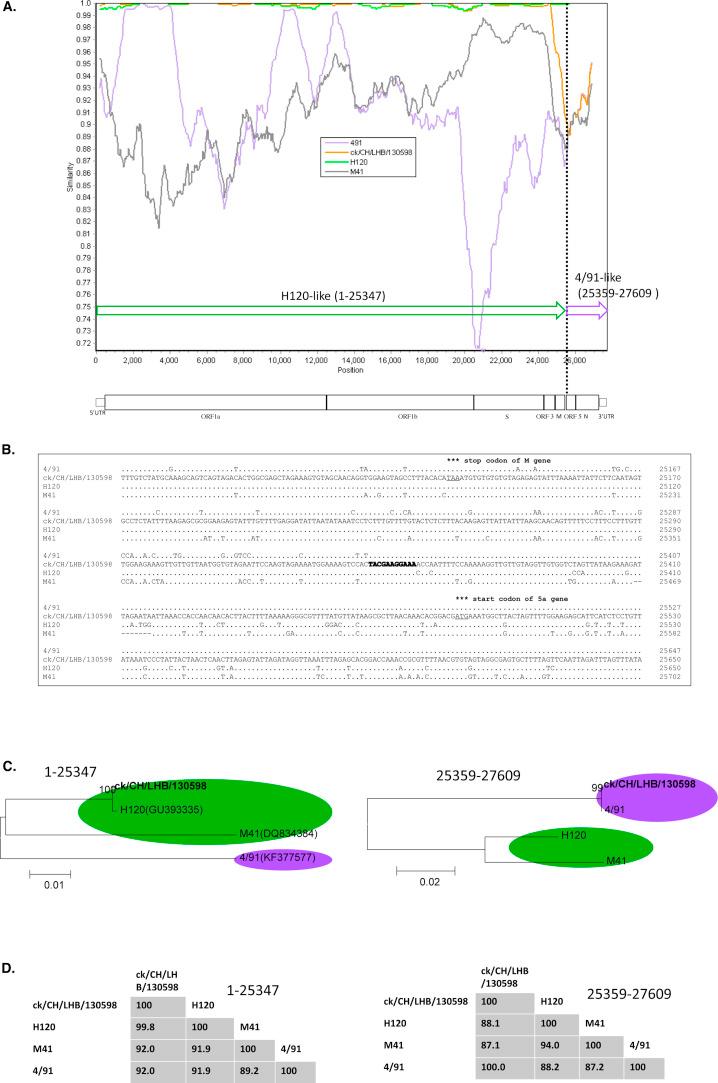
In this study, 418 IBVs were isolated in samples from 1717 chicken flocks. Twenty-nine of the isolates were classified as the Massachusetts genotype. These 29 isolates, as well as two previously isolated Massachusetts genotype IBV strains, were studied further. Of the 31 strains, 24 were H120-like and two were M41-like isolates as determined by complete genomic sequence analysis, indicating that most of the IBV isolates were likely the reisolated vaccine virus. The remaining five IBV isolates, ck/CH/LHB/111172, ck/CH/LSD/111219, ck/CH/LHB/130598, ck/CH/LDL/110931, and ck/CH/LHB/130573, were shown to have originated from natural recombination events between an H120-like vaccine strain and other types of viruses. The virus cross-neutralization test found that the antigenicity of ck/CH/LHB/111172, ck/CH/LSD/111219, and ck/CH/LHB/130598 was similar to that of H120. Vaccination with the H120 vaccine offered complete protection against challenge with these isolates. However, isolates ck/CH/LDL/110931 and ck/CH/LHB/130573 were serotypically different from their parental viruses and from other serotypes in this study. Furthermore, vaccination with the H120 vaccine did not provide protection against challenge with these two isolates. The results of this study demonstrated that recombination is the mechanism that is responsible for the emergence of new serotype strains, and it has the ability to alter virus serotypes. Therefore, IBV surveillance of chicken flocks vaccinated with IBV live vaccines, as well as the consideration of new strategies to effectively control IBV infection using inactivated or/and genetically engineered vaccines, is of great importance.
在本研究中,从1717个鸡群的样本中分离出418株传染性支气管炎病毒(IBV)。其中29株分离株被归类为马萨诸塞基因型。对这29株分离株以及之前分离的两株马萨诸塞基因型IBV毒株进行了进一步研究。通过全基因组序列分析确定,在这31株毒株中,24株为H120样毒株,2株为M41样分离株,这表明大多数IBV分离株可能是重新分离的疫苗病毒。其余5株IBV分离株,即ck/CH/LHB/111172、ck/CH/LSD/111219、ck/CH/LHB/130598、ck/CH/LDL/110931和ck/CH/LHB/130573,被证明起源于H120样疫苗株与其他类型病毒之间的自然重组事件。病毒交叉中和试验发现,ck/CH/LHB/111172、ck/CH/LSD/111219和ck/CH/LHB/130598的抗原性与H120相似。用H120疫苗接种可提供针对这些分离株攻毒的完全保护。然而,分离株ck/CH/LDL/110931和ck/CH/LHB/130573在血清型上与其亲本病毒以及本研究中的其他血清型不同。此外,用H120疫苗接种不能提供针对这两株分离株攻毒的保护。本研究结果表明,重组是导致新血清型毒株出现的机制,并且它有能力改变病毒血清型。因此,对接种IBV活疫苗的鸡群进行IBV监测,以及考虑使用灭活疫苗或/和基因工程疫苗有效控制IBV感染的新策略,具有重要意义。



 Zotero 插件