
病毒作为儿童严重急性呼吸道感染的唯一致病原
Viruses as Sole Causative Agents of Severe Acute Respiratory Tract Infections in Children.
作者信息
Moesker Fleur M, van Kampen Jeroen J A, van Rossum Annemarie M C, de Hoog Matthijs, Koopmans Marion P G, Osterhaus Albert D M E, Fraaij Pieter L A
机构信息
Department of Viroscience, Erasmus MC, Rotterdam, the Netherlands.
Department of Paediatrics, Erasmus MC - Sophia, Rotterdam, the Netherlands.
出版信息
PLoS One. 2016 Mar 10;11(3):e0150776. doi: 10.1371/journal.pone.0150776. eCollection 2016.
BACKGROUND
Respiratory syncytial virus (RSV) and influenza A viruses are known to cause severe acute respiratory tract infections (SARIs) in children. For other viruses like human rhinoviruses (HRVs) this is less well established. Viral or bacterial co-infections are often considered essential for severe manifestations of these virus infections.
OBJECTIVE
The study aims at identifying viruses that may cause SARI in children in the absence of viral and bacterial co-infections, at identifying disease characteristics associated with these single virus infections, and at identifying a possible correlation between viral loads and disease severities.
STUDY DESIGN
Between April 2007 and March 2012, we identified children (<18 year) with or without a medical history, admitted to our paediatric intensive care unit (PICU) with SARI or to the medium care (MC) with an acute respiratory tract infection (ARTI) (controls). Data were extracted from the clinical and laboratory databases of our tertiary care paediatric hospital. Patient specimens were tested for fifteen respiratory viruses with real-time reverse transcriptase PCR assays and we selected patients with a single virus infection only. Typical bacterial co-infections were considered unlikely to have contributed to the PICU or MC admission based on C-reactive protein-levels or bacteriological test results if performed.
RESULTS
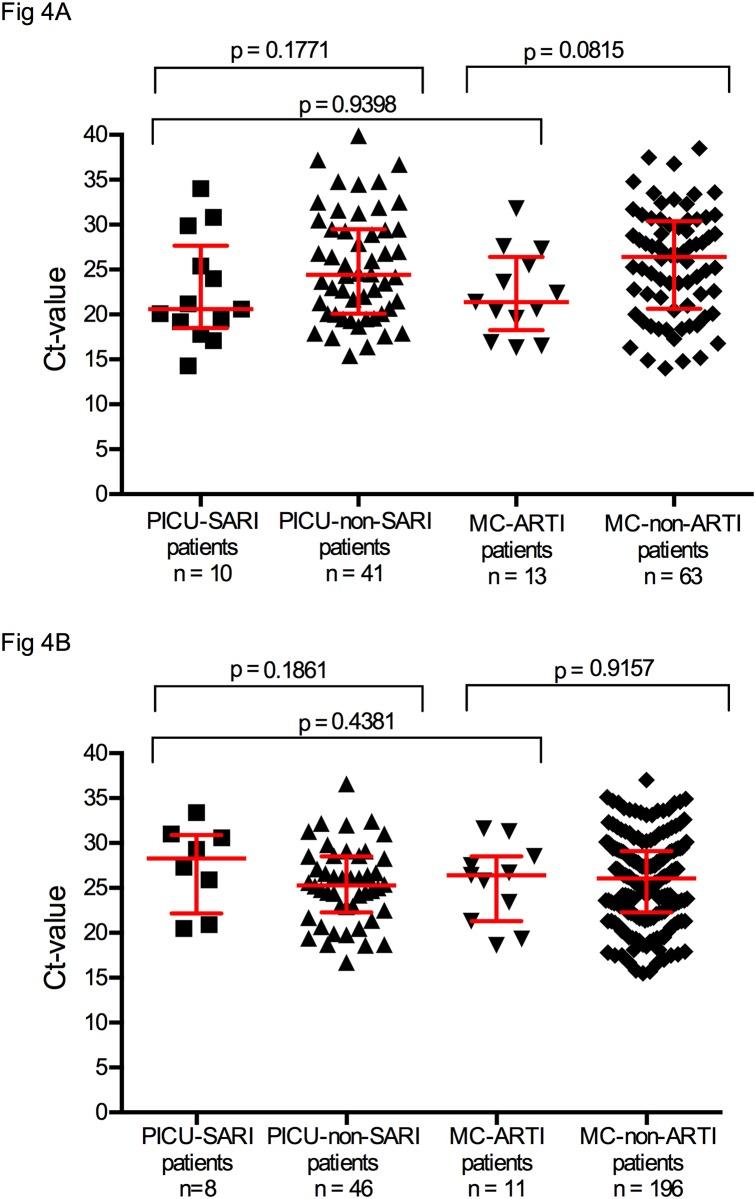
We identified 44 patients admitted to PICU with SARI and 40 patients admitted to MC with ARTI. Twelve viruses were associated with SARI, ten of which were also associated with ARTI in the absence of typical bacterial and viral co-infections, with RSV and HRV being the most frequent causes. Viral loads were not different between PICU-SARI patients and MC-ARTI patients.
CONCLUSION
Both SARI and ARTI may be caused by single viral pathogens in previously healthy children as well as in children with a medical history. No relationship between viral load and disease severity was identified.
背景
呼吸道合胞病毒(RSV)和甲型流感病毒已知可导致儿童严重急性呼吸道感染(SARI)。对于其他病毒,如人鼻病毒(HRV),这一点尚不明确。病毒或细菌合并感染通常被认为是这些病毒感染出现严重症状的必要条件。
目的
本研究旨在确定在不存在病毒和细菌合并感染的情况下可能导致儿童SARI的病毒,确定与这些单一病毒感染相关的疾病特征,并确定病毒载量与疾病严重程度之间的可能相关性。
研究设计
在2007年4月至2012年3月期间,我们确定了入住我们儿科重症监护病房(PICU)患有SARI或入住中级护理病房(MC)患有急性呼吸道感染(ARTI)(对照组)的有或无病史的儿童(<18岁)。数据从我们三级护理儿科医院的临床和实验室数据库中提取。用实时逆转录聚合酶链反应检测患者标本中的15种呼吸道病毒,我们仅选择单一病毒感染的患者。如果进行了检测,根据C反应蛋白水平或细菌学检测结果,典型的细菌合并感染不太可能导致入住PICU或MC。
结果
我们确定了44例入住PICU患有SARI的患者和40例入住MC患有ARTI的患者。12种病毒与SARI相关,其中10种在不存在典型细菌和病毒合并感染的情况下也与ARTI相关,RSV和HRV是最常见的病因。PICU-SARI患者和MC-ARTI患者的病毒载量没有差异。
结论
在既往健康的儿童以及有病史的儿童中,SARI和ARTI都可能由单一病毒病原体引起。未发现病毒载量与疾病严重程度之间的关系。


 Zotero 插件