
肿瘤内 、 和 的表达水平以及寡克隆T细胞扩增与转移性黑色素瘤患者对纳武单抗的反应相关。
Intratumoral expression levels of , , and along with oligoclonal T cell expansion associate with response to nivolumab in metastatic melanoma.
作者信息
Inoue Hiroyuki, Park Jae-Hyun, Kiyotani Kazuma, Zewde Makda, Miyashita Azusa, Jinnin Masatoshi, Kiniwa Yukiko, Okuyama Ryuhei, Tanaka Ryota, Fujisawa Yasuhiro, Kato Hiroshi, Morita Akimichi, Asai Jun, Katoh Norito, Yokota Kenji, Akiyama Masashi, Ihn Hironobu, Fukushima Satoshi, Nakamura Yusuke
机构信息
Department of Medicine, The University of Chicago , Chicago, IL, USA.
Department of Dermatology and Plastic Surgery, Faculty of Life Sciences, Kumamoto University , Kumamoto, Japan.
出版信息
Oncoimmunology. 2016 Jun 30;5(9):e1204507. doi: 10.1080/2162402X.2016.1204507. eCollection 2016.
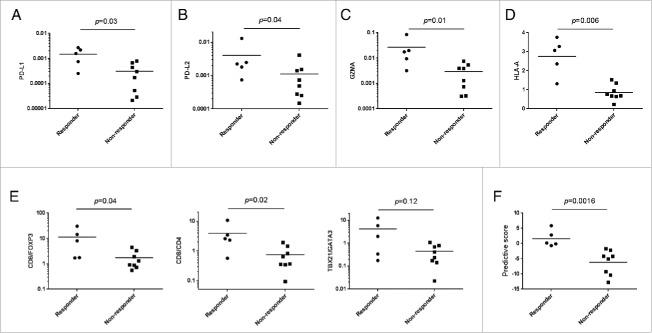
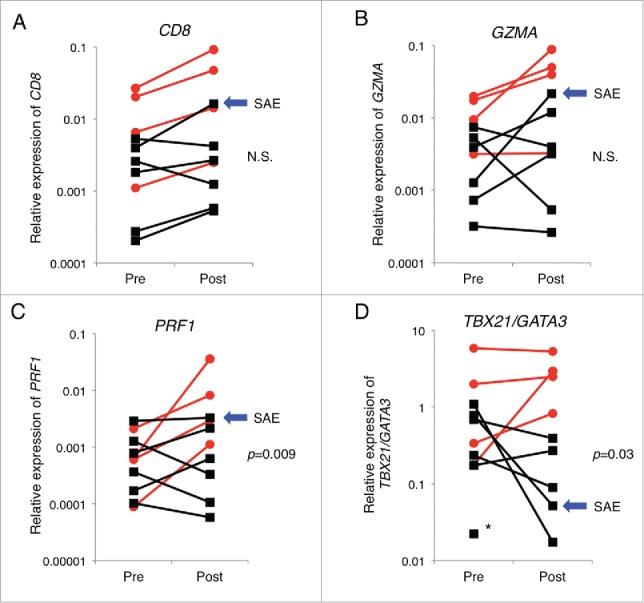
Immune checkpoint inhibitors blocking the interaction between programmed death-1 (PD-1) and PD-1 ligand-1 (PD-L1) are revolutionizing the cancer immunotherapies with durable clinical responses. Although high expression of PD-L1 in tumor tissues has been implicated to correlate with the better response to the anti-PD-1 therapies, this association has been controversial. In this study, to characterize immune microenvironment in tumors, we examined mRNA levels of immune-related genes and characterized T cell repertoire in the tumors of 13 melanoma patients before and after nivolumab treatment. We found that, in addition to the ( = 0.03), expression levels of PD-1 ligand-2 (), granzyme A () and human leukocyte antigen-A () in the pre-treatment tumors were significantly higher ( = 0.04, = 0.01 and = 0.006, respectively) in responders (n = 5) than in non-responders (n = 8). With nivolumab treatment, tumors in responders exhibited a substantial increase of , and perforin 1 () expression levels as well as increased ratio of , suggesting dominancy of helper T cell type 1 (Th1) response to type 2 (Th2) response. T cell receptor β (TCR-β) repertoire analysis revealed oligoclonal expansion of tumor-infiltrating T lymphocytes (TILs) in the tumor tissues of the responders. Our findings suggest that melanoma harboring high PD-1 ligands ( and and expression may respond preferentially to nivolumab treatment, which can enhance Th1-skewed cellular immunity with oligoclonal expansion of TILs.
阻断程序性死亡蛋白1(PD-1)与PD-1配体1(PD-L1)之间相互作用的免疫检查点抑制剂正在彻底改变癌症免疫疗法,并带来持久的临床反应。尽管肿瘤组织中PD-L1的高表达被认为与对抗PD-1疗法的更好反应相关,但这种关联一直存在争议。在本研究中,为了表征肿瘤中的免疫微环境,我们检测了13例黑色素瘤患者在接受纳武单抗治疗前后肿瘤中免疫相关基因的mRNA水平,并对T细胞库进行了表征。我们发现,除了(=0.03)之外,治疗前肿瘤中PD-1配体2()、颗粒酶A()和人类白细胞抗原-A()的表达水平在反应者(n = 5)中显著高于无反应者(n = 8)(分别为=0.04、=0.01和=0.006)。接受纳武单抗治疗后,反应者的肿瘤中、和穿孔素1()的表达水平大幅增加,且的比例也增加,表明辅助性T细胞1型(Th1)反应相对于2型(Th2)反应占主导地位。T细胞受体β(TCR-β)库分析显示,反应者肿瘤组织中肿瘤浸润性T淋巴细胞(TILs)出现寡克隆扩增。我们的研究结果表明,高表达PD-1配体(、和)的黑色素瘤可能对纳武单抗治疗有优先反应,这可以通过TILs的寡克隆扩增增强Th1偏向的细胞免疫。

 Zotero 插件