
多不饱和脂肪酸通过氧化还原-端粒-抑癌基因轴改善衰老。
Polyunsaturated fatty acids ameliorate aging via redox-telomere-antioncogene axis.
作者信息
Chen Jingnan, Wei Yan, Chen Xinyu, Jiao Jingjing, Zhang Yu
机构信息
Department of Food Science and Nutrition, College of Biosystems Engineering and Food Science, Zhejiang University, Hangzhou, Zhejiang, China.
Department of Nutrition, School of Public Health, Zhejiang University School of Medicine, Hangzhou, Zhejiang, China.
出版信息
Oncotarget. 2017 Jan 31;8(5):7301-7314. doi: 10.18632/oncotarget.14236.
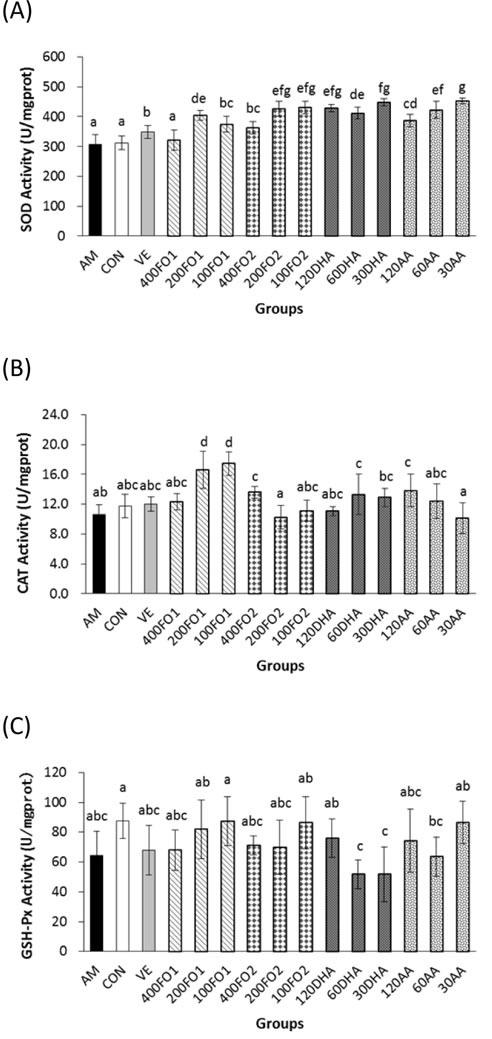
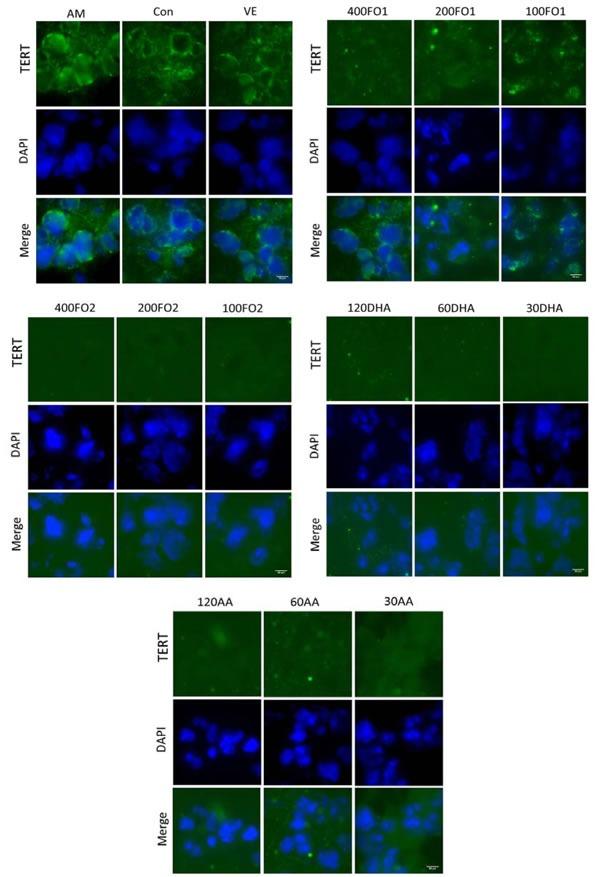
Polyunsaturated fatty acids (PUFA), a group of nourishing and health-promoting nutrients, ameliorate age-related chronic diseases. However, how PUFA especially n-3 PUFA exert anti-aging functions remains poorly understood. Here we link fish oil, docosahexaenoic acid (DHA) and arachidonic acid (AA) to the aging etiology via a redox-telomere-antioncogene axis based on D-galactose-induced aging mice. Both fish oil and PUFA enhanced hepatic superoxide dismutase (SOD) and catalase activities and cardiac SOD activities within the range of 18%-46%, 26%-65% and 19%-58%, respectively, whereas reduced cerebral monoamine oxidase activity, plasma F2-isoprostane level and cerebral lipid peroxidation level by 56%-90%, 20%-79% and 16%-54%, respectively. Thus, PUFA improve the in vivo redox and oxidative stress induced aging process, which however does not exhibit a dose-dependent manner. Notably, both PUFA and fish oil effectively inactivated testicular telomerase and inhibited c-Myc-mediated telomerase reverse transcriptase expression, whereas n-3 PUFA rather than n-6 PUFA protected liver and testes against telomere shortening within the range of 13%-25% and 25%-27%, respectively. Therefore, n-3 PUFA may be better at inhibiting the DNA damage induced aging process. Surprisingly, only DHA significantly suppressed cellular senescence pathway evidenced by testicular antioncogene p16 and p53 expression. This work provides evident support for the crosstalk between PUFA especially n-3 PUFA and the aging process via maintaining the in vivo redox homeostasis, rescuing age-related telomere attrition and down-regulating the antioncogene expression.
多不饱和脂肪酸(PUFA)是一类具有营养和促进健康作用的营养素,可改善与年龄相关的慢性疾病。然而,PUFA尤其是n-3多不饱和脂肪酸如何发挥抗衰老功能仍知之甚少。在此,我们基于D-半乳糖诱导的衰老小鼠,通过氧化还原-端粒-抑癌基因轴将鱼油、二十二碳六烯酸(DHA)和花生四烯酸(AA)与衰老病因联系起来。鱼油和PUFA均可提高肝脏超氧化物歧化酶(SOD)和过氧化氢酶活性以及心脏SOD活性,增幅分别在18%-46%、26%-65%和19%-58%之间,而脑单胺氧化酶活性、血浆F2-异前列腺素水平和脑脂质过氧化水平分别降低56%-90%、20%-79%和16%-54%。因此,PUFA可改善体内氧化还原和氧化应激诱导的衰老过程,但不呈现剂量依赖性。值得注意的是,PUFA和鱼油均可有效使睾丸端粒酶失活,并抑制c-Myc介导的端粒酶逆转录酶表达,而n-3多不饱和脂肪酸而非n-6多不饱和脂肪酸可分别在13%-25%和25%-27%的范围内保护肝脏和睾丸免受端粒缩短的影响。因此,n-3多不饱和脂肪酸可能更善于抑制DNA损伤诱导的衰老过程。令人惊讶的是,只有DHA能显著抑制细胞衰老途径,这可通过睾丸抑癌基因p16和p53的表达得到证明。这项工作为PUFA尤其是n-3多不饱和脂肪酸与衰老过程之间通过维持体内氧化还原稳态、挽救与年龄相关的端粒损耗以及下调抑癌基因表达的相互作用提供了有力支持。



 Zotero 插件