
饮食、运动、教育和生活方式因素的表观遗传时钟分析。
Epigenetic clock analysis of diet, exercise, education, and lifestyle factors.
作者信息
Quach Austin, Levine Morgan E, Tanaka Toshiko, Lu Ake T, Chen Brian H, Ferrucci Luigi, Ritz Beate, Bandinelli Stefania, Neuhouser Marian L, Beasley Jeannette M, Snetselaar Linda, Wallace Robert B, Tsao Philip S, Absher Devin, Assimes Themistocles L, Stewart James D, Li Yun, Hou Lifang, Baccarelli Andrea A, Whitsel Eric A, Horvath Steve
机构信息
Department of Human Genetics, David Geffen School of Medicine, University of California Los Angeles, Los Angeles, CA 90095, USA.
Longitudinal Studies Section, Translational Gerontology Branch, National Institute on Aging, National Institutes of Health, USA. Baltimore, MD 21224, USA.
出版信息
Aging (Albany NY). 2017 Feb 14;9(2):419-446. doi: 10.18632/aging.101168.
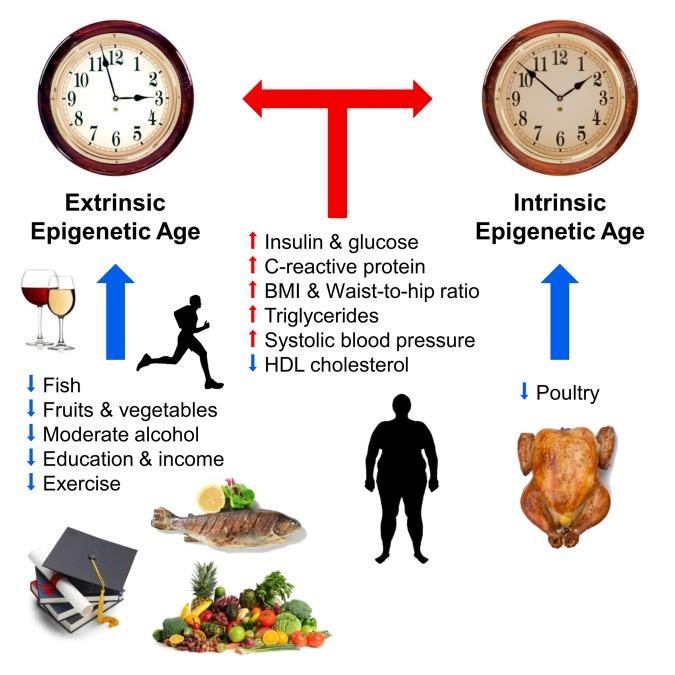
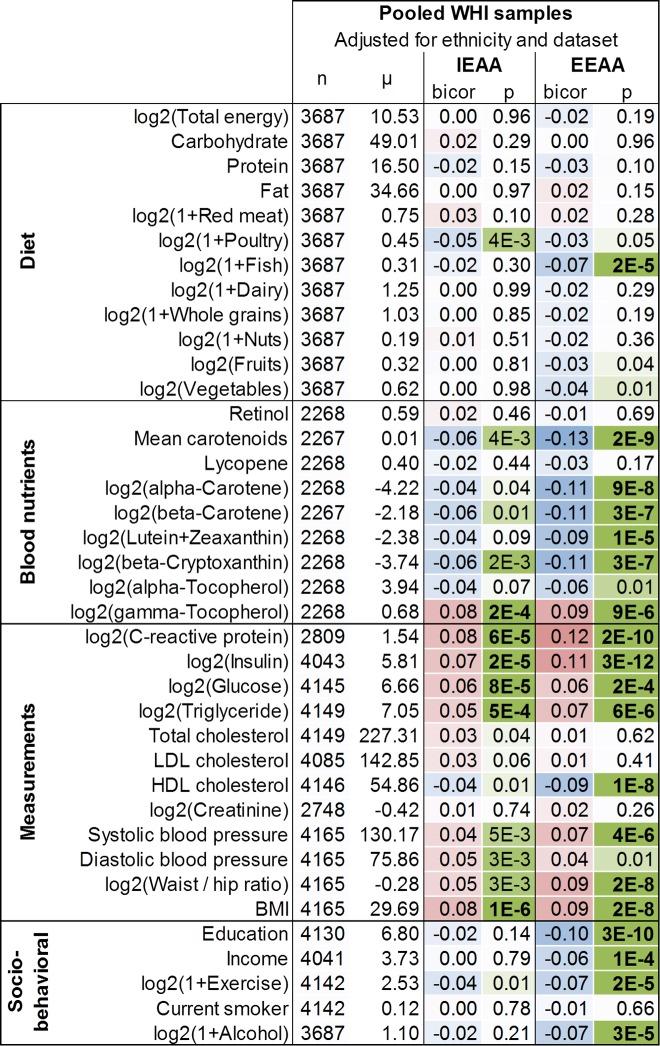
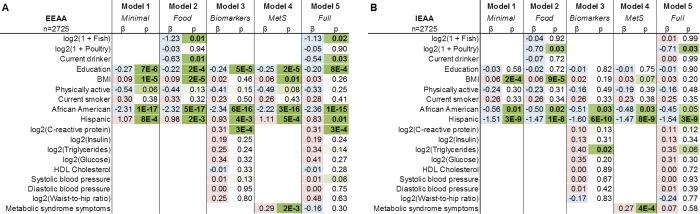
Behavioral and lifestyle factors have been shown to relate to a number of health-related outcomes, yet there is a need for studies that examine their relationship to molecular aging rates. Toward this end, we use recent epigenetic biomarkers of age that have previously been shown to predict all-cause mortality, chronic conditions, and age-related functional decline. We analyze cross-sectional data from 4,173 postmenopausal female participants from the Women's Health Initiative, as well as 402 male and female participants from the Italian cohort study, Invecchiare nel Chianti.Extrinsic epigenetic age acceleration (EEAA) exhibits significant associations with fish intake (p=0.02), moderate alcohol consumption (p=0.01), education (p=3x10), BMI (p=0.01), and blood carotenoid levels (p=1x10)-an indicator of fruit and vegetable consumption, whereas intrinsic epigenetic age acceleration (IEAA) is associated with poultry intake (p=0.03) and BMI (p=0.05). Both EEAA and IEAA were also found to relate to indicators of metabolic syndrome, which appear to mediate their associations with BMI. Metformin-the first-line medication for the treatment of type 2 diabetes-does not delay epigenetic aging in this observational study. Finally, longitudinal data suggests that an increase in BMI is associated with increase in both EEAA and IEAA.Overall, the epigenetic age analysis of blood confirms the conventional wisdom regarding the benefits of eating a high plant diet with lean meats, moderate alcohol consumption, physical activity, and education, as well as the health risks of obesity and metabolic syndrome.
行为和生活方式因素已被证明与许多健康相关结果有关,但仍需要研究来检验它们与分子衰老速率的关系。为此,我们使用了最近的表观遗传年龄生物标志物,这些标志物先前已被证明可以预测全因死亡率、慢性病和与年龄相关的功能衰退。我们分析了来自女性健康倡议的4173名绝经后女性参与者以及来自意大利基安蒂衰老队列研究的402名男性和女性参与者的横断面数据。外在表观遗传年龄加速(EEAA)与鱼类摄入量(p = 0.02)、适度饮酒(p = 0.01)、教育程度(p = 3×10⁻⁴)、体重指数(BMI)(p = 0.01)和血液类胡萝卜素水平(p = 1×10⁻⁴,水果和蔬菜消费的一个指标)显著相关,而内在表观遗传年龄加速(IEAA)与家禽摄入量(p = 0.03)和BMI(p = 0.05)相关。还发现EEAA和IEAA均与代谢综合征指标有关,这些指标似乎介导了它们与BMI的关联。在这项观察性研究中,2型糖尿病的一线治疗药物二甲双胍并不能延缓表观遗传衰老。最后,纵向数据表明BMI的增加与EEAA和IEAA的增加有关。总体而言,血液的表观遗传年龄分析证实了关于食用富含瘦肉的高植物性饮食、适度饮酒、体育锻炼和接受教育的益处,以及肥胖和代谢综合征的健康风险的传统观点。

 Zotero 插件