
教育和生活方式因素与老年非裔美国人的 DNA 甲基化时钟相关。
Education and Lifestyle Factors Are Associated with DNA Methylation Clocks in Older African Americans.
机构信息
Department of Epidemiology, School of Public Health, University of Michigan, Ann Arbor, MI 48109, USA.
Department of Epidemiology, Harvard T.H. Chan School of Public Health, Boston, MA 02115, USA.
出版信息
Int J Environ Res Public Health. 2019 Aug 28;16(17):3141. doi: 10.3390/ijerph16173141.
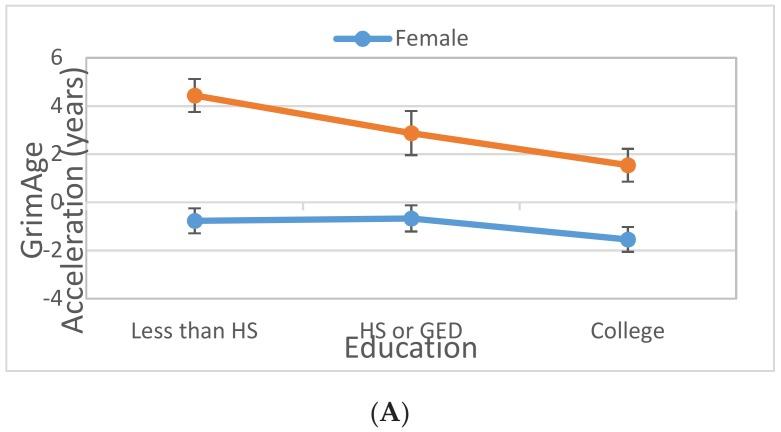
DNA methylation (DNAm) clocks are important biomarkers of cellular aging and are associated with a variety of age-related chronic diseases and all-cause mortality. Examining the relationship between education and lifestyle risk factors for age-related diseases and multiple DNAm clocks can increase the understanding of how risk factors contribute to aging at the cellular level. This study explored the association between education or lifestyle risk factors for age-related diseases and the acceleration of four DNAm clocks, including intrinsic (IEAA) and extrinsic epigenetic age acceleration (EEAA), PhenoAge acceleration (PhenoAA), and GrimAge acceleration (GrimAA) in the African American participants of the Genetic Epidemiology Network of Arteriopathy. We performed both cross-sectional and longitudinal analyses. In cross-sectional analyses, gender, education, BMI, smoking, and alcohol consumption were all independently associated with GrimAA, whereas only some of them were associated with other clocks. The effect of smoking and education on GrimAA varied by gender. Longitudinal analyses suggest that age and BMI continued to increase GrimAA, and that age and current smoking continued to increase PhenoAA after controlling DNAm clocks at baseline. In conclusion, education and common lifestyle risk factors were associated with multiple DNAm clocks. However, the association with each risk factor varied by clock, which suggests that different clocks may capture adverse effects from different environmental stimuli.
DNA 甲基化(DNAm)时钟是细胞衰老的重要生物标志物,与多种与年龄相关的慢性疾病和全因死亡率有关。研究教育和与年龄相关疾病相关的生活方式风险因素与多个 DNAm 时钟之间的关系,可以增加对风险因素如何在细胞水平上导致衰老的理解。本研究探讨了教育或与年龄相关疾病相关的生活方式风险因素与四个 DNAm 时钟加速之间的关联,包括内在(IEAA)和外在表观遗传年龄加速(EEAA)、表型年龄加速(PhenoAA)和 GrimAge 加速(GrimAA),在动脉粥样硬化遗传流行病学网络的非裔美国参与者中。我们进行了横断面和纵向分析。在横断面分析中,性别、教育、BMI、吸烟和饮酒与 GrimAA 均独立相关,而其他一些因素则与其他时钟相关。吸烟和教育对 GrimAA 的影响因性别而异。纵向分析表明,在控制基线时的 DNAm 时钟后,年龄和 BMI 继续增加 GrimAA,年龄和当前吸烟继续增加 PhenoAA。总之,教育和常见的生活方式风险因素与多个 DNAm 时钟有关。然而,每个风险因素与每个时钟的关联因时钟而异,这表明不同的时钟可能会捕捉到来自不同环境刺激的不同不利影响。
 Zotero 插件