
接种疫苗后,感染人巨细胞病毒的非洲人细胞因子驱动的自然杀伤细胞干扰素-γ产生增强。
Enhancement of cytokine-driven NK cell IFN-γ production after vaccination of HCMV infected Africans.
作者信息
Darboe Alansana, Danso Ebrima, Clarke Ed, Umesi Ama, Touray Ebrima, Wegmuller Rita, Moore Sophie E, Riley Eleanor M, Goodier Martin R
机构信息
Department of Immunology and Infection, London School of Hygiene and Tropical Medicine, London, UK.
MRC International Nutrition Group, Nutrition Theme, MRC Keneba, Cambridge, UK.
出版信息
Eur J Immunol. 2017 Jun;47(6):1040-1050. doi: 10.1002/eji.201746974. Epub 2017 Apr 24.
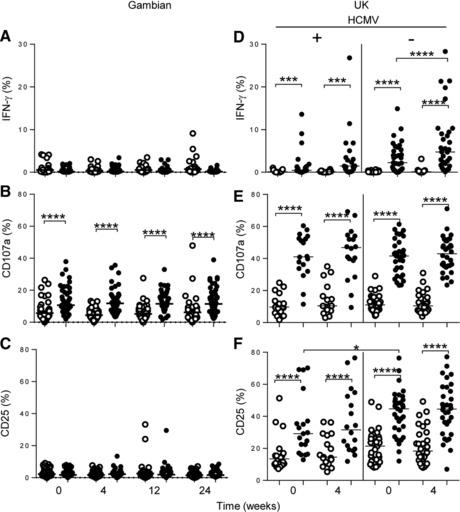
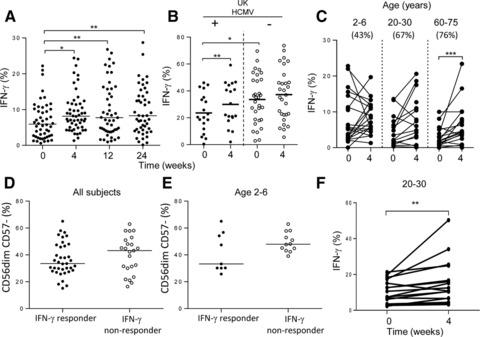
Human cytomegalovirus (HCMV) infection drives the phenotypic and functional differentiation of NK cells, thereby influencing the responses of these cells after vaccination. NK cell functional differentiation is particularly advanced in African populations with universal exposure to HCMV. To investigate the impact of advanced differentiation on vaccine-induced responses, we studied NK-cell function before and after vaccination with Trivalent Influenza Vaccine (TIV) or diphtheria, tetanus, pertussis, inactivated poliovirus vaccine (DTPiP) in Africans with universal, lifelong HCMV exposure. In contrast to populations with lower prevalence of HCMV infection, no significant enhancement of NK-cell responses (IFN-γ, CD107a, CD25) occurred after in vitro re-stimulation of post-vaccination NK cells with TIV or DTPiP antigens compared to pre-vaccination baseline cells. However, both vaccinations resulted in higher frequencies of NK cells producing IFN-γ in response to exogenous IL-12 with IL-18, which persisted for up to 6 months. Enhanced cytokine responsiveness was restricted to less differentiated NK cells, with increased frequencies of IFN-γ cells observed within CD56 CD57 , CD56 CD57 NKG2C and CD56 CD57 NKG2C NK-cell subsets. These data suggest a common mechanism whereby different vaccines enhance NK cell IFN-γ function in HCMV infected donors and raise the potential for further exploitation of NK cell "pre-activation" to improve vaccine effectiveness.
人类巨细胞病毒(HCMV)感染驱动自然杀伤细胞(NK细胞)的表型和功能分化,从而影响这些细胞在接种疫苗后的反应。在普遍暴露于HCMV的非洲人群中,NK细胞的功能分化尤为显著。为了研究这种高度分化对疫苗诱导反应的影响,我们对普遍终身暴露于HCMV的非洲人接种三价流感疫苗(TIV)或白喉、破伤风、百日咳、灭活脊髓灰质炎疫苗(DTPiP)前后的NK细胞功能进行了研究。与HCMV感染患病率较低的人群不同,与接种疫苗前的基线细胞相比,用TIV或DTPiP抗原体外再刺激接种疫苗后的NK细胞后,NK细胞反应(IFN-γ、CD107a、CD25)没有显著增强。然而,两种疫苗接种后,对外源性IL-12与IL-18产生反应的产生IFN-γ的NK细胞频率更高,这种情况持续长达6个月。增强的细胞因子反应性仅限于分化程度较低的NK细胞,在CD56⁺CD57⁻、CD56⁺CD57⁻NKG2C⁺和CD56⁺CD57⁻NKG2C⁺NK细胞亚群中观察到IFN-γ细胞频率增加。这些数据表明存在一种共同机制,即不同疫苗可增强HCMV感染供体中NK细胞的IFN-γ功能,并提高进一步利用NK细胞“预激活”来提高疫苗效力的可能性。



 Zotero 插件