
葡甲胺锑酸盐与米替福新照顾者直接观察治疗法治疗儿童皮肤利什曼病的成本效益分析
Cost-effectiveness of meglumine antimoniate versus miltefosine caregiver DOT for the treatment of pediatric cutaneous leishmaniasis.
作者信息
Berger Brandon A, Cossio Alexandra, Saravia Nancy Gore, Castro Maria Del Mar, Prada Sergio, Bartlett Allison H, Pho Mai T
机构信息
University of Chicago Pritzker School of Medicine, Chicago, Illinois, United States of America.
Centro Internacional de Entrenamiento e Investigaciones Médicas (CIDEIM), Cali, Valle de Cauca, Colombia.
出版信息
PLoS Negl Trop Dis. 2017 Apr 6;11(4):e0005459. doi: 10.1371/journal.pntd.0005459. eCollection 2017 Apr.
BACKGROUND
Oral miltefosine has been shown to be non-inferior to first-line, injectable meglumine antimoniate (MA) for the treatment of cutaneous leishmaniasis (CL) in children. Miltefosine may be administered via in-home caregiver Directly Observed Therapy (cDOT), while patients must travel to clinics to receive MA. We performed a cost-effectiveness analysis comparing miltefosine by cDOT versus MA for pediatric CL in southwest Colombia.
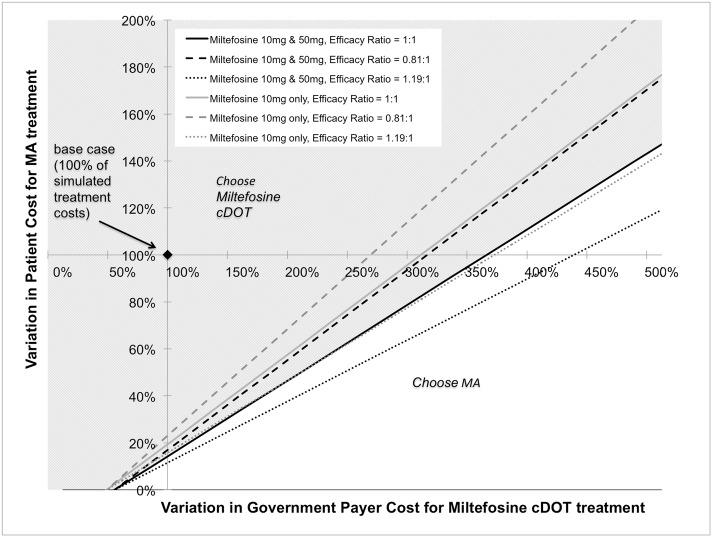
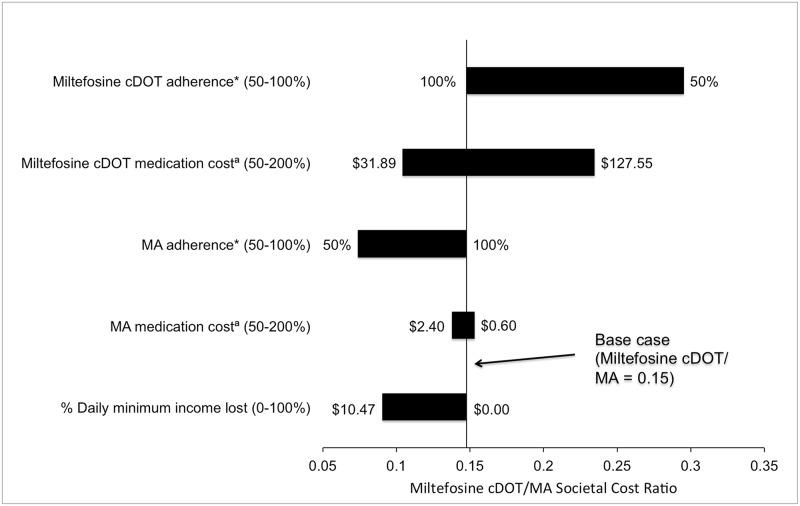
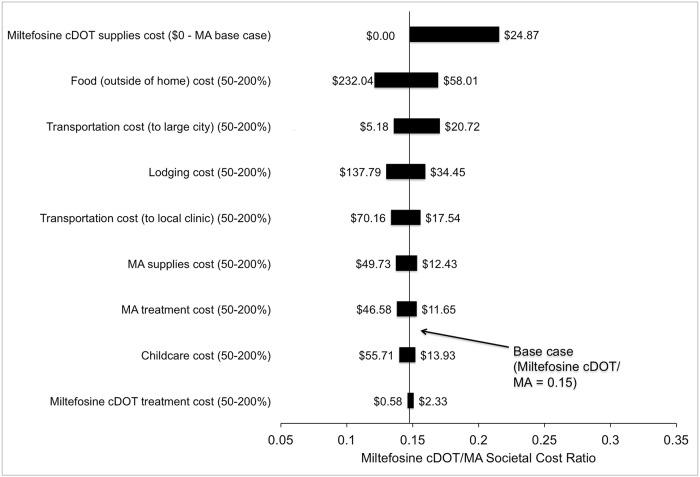
METHODOLOGY/PRINCIPLE FINDINGS: We developed a Monte Carlo model comparing the cost-per-cure of miltefosine by cDOT compared to MA from patient, government payer, and societal perspectives (societal = sum of patient and government payer perspective costs). Drug effectiveness and adverse events were estimated from clinical trials. Healthcare utilization and costs of travel were obtained from surveys of providers and published sources. The primary outcome was cost-per-cure reported in 2015 USD. Treatment efficacy, costs, and adherence were varied in sensitivity analysis to assess robustness of results. Treatment with miltefosine resulted in substantially lower cost-per-cure from a societal and patient perspective, and slightly higher cost-per-cure from a government payer perspective compared to MA. Mean societal cost-per-cure were $531 (SD±$239) for MA and $188 (SD±$100) for miltefosine, a mean cost-per-cure difference of +$343. Mean cost-per-cure from a patient perspective were $442 (SD ±$233) for MA and $30 (SD±$16) for miltefosine, a mean difference of +$412. Mean cost-per-cure from a government perspective were $89 (SD±$55) for MA and $158 (SD±$98) for miltefosine, with a mean difference of -$69. Results were robust across a variety of assumptions in univariate and multi-way analysis.
CONCLUSIONS/SIGNIFICANCE: Treatment of pediatric cutaneous leishmaniasis with miltefosine via cDOT is cost saving from patient and societal perspectives, and moderately more costly from the government payer perspective compared to treatment with MA. Results were robust over a range of sensitivity analyses. Lower drug price for miltefosine could result in cost saving from a government perspective.
背景
口服米替福新已被证明在治疗儿童皮肤利什曼病(CL)方面不劣于一线注射用葡甲胺锑酸盐(MA)。米替福新可通过家庭护理人员直接观察治疗(cDOT)给药,而患者必须前往诊所接受MA治疗。我们进行了一项成本效益分析,比较了哥伦比亚西南部儿童CL采用cDOT使用米替福新与使用MA的情况。
方法/主要发现:我们开发了一个蒙特卡洛模型,从患者、政府支付方和社会角度(社会角度=患者和政府支付方角度成本之和)比较cDOT使用米替福新与MA的每治愈一例的成本。药物有效性和不良事件通过临床试验进行估计。医疗保健利用率和旅行成本通过对医疗服务提供者的调查和已发表的资料获得。主要结果是以2015年美元报告的每治愈一例的成本。在敏感性分析中,对治疗效果、成本和依从性进行了变化,以评估结果的稳健性。与MA相比,从社会和患者角度来看,使用米替福新治疗导致每治愈一例的成本大幅降低,从政府支付方角度来看,每治愈一例的成本略高。MA的平均社会每治愈一例成本为531美元(标准差±239美元),米替福新为188美元(标准差±100美元),每治愈一例的平均成本差异为+343美元。从患者角度来看,MA的平均每治愈一例成本为442美元(标准差±233美元),米替福新为30美元(标准差±16美元),平均差异为+412美元。从政府角度来看,MA的平均每治愈一例成本为89美元(标准差±55美元),米替福新为158美元(标准差±98美元),平均差异为-69美元。在单变量和多因素分析的各种假设下,结果都是稳健的。
结论/意义:与使用MA治疗相比,通过cDOT使用米替福新治疗儿童皮肤利什曼病从患者和社会角度来看节省成本,从政府支付方角度来看成本略高。在一系列敏感性分析中结果都是稳健的。米替福新较低的药物价格可能会从政府角度带来成本节约。
 Zotero 插件