
阿奇霉素降低单核细胞中NALP3 mRNA的稳定性,以限制炎性小体依赖性炎症。
Azithromycin decreases NALP3 mRNA stability in monocytes to limit inflammasome-dependent inflammation.
作者信息
Lendermon Elizabeth A, Coon Tiffany A, Bednash Joseph S, Weathington Nathaniel M, McDyer John F, Mallampalli Rama K
机构信息
Pulmonary, Allergy, & Critical Care Medicine, Department of Medicine, University of Pittsburgh, UPMC Montefiore, NW 628, Pittsburgh, PA, 15213, USA.
Acute Lung Injury Center of Excellence, University of Pittsburgh, Pittsburgh, PA, USA.
出版信息
Respir Res. 2017 Jun 28;18(1):131. doi: 10.1186/s12931-017-0608-8.
BACKGROUND
Azithromycin, an antibiotic used for multiple infectious disorders, exhibits anti-inflammatory effects, but the molecular basis for this activity is not well characterized. Azithromycin inhibits IL-1β-mediated inflammation that is dependent, in part, on inflammasome activity. Here, we investigated the effects of azithromycin on the NACHT, LRR, and PYD domains-containing protein 3 (NALP3) protein, which is the sensing component of the NALP3 inflammasome, in human monocytes.
METHODS
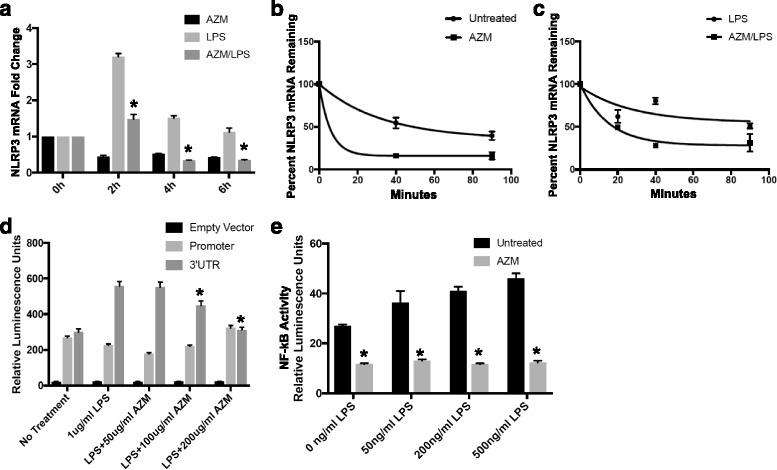
THP-1 cells were treated with azithromycin alone, LPS alone, or both. NALP3 and IL-1β protein levels were determined by immunoblotting. NLRP3 gene (encoding NALP3) transcript levels were determined by quantitative qPCR. In order to measure NLRP3 transcript decay, actinomycin D was used to impair gene transcription. THP-1 Lucia cells which contain an NF-κB responsive luciferase element were used to assess NF-κB activity in response to azithromycin, LPS, and azithromycin/LPS by measuring luminescence. To confirm azithromycin's effects on NLRP3 mRNA and promoter activity conclusively, HEK cells were lipofected with luciferase reporter constructs harboring either the 5' untranslated region (UTR) of the NLRP3 gene which included the promoter, the 3' UTR of the gene, or an empty plasmid prior to treatment with azithromycin and/or LPS, and luminescence was measured.
RESULTS
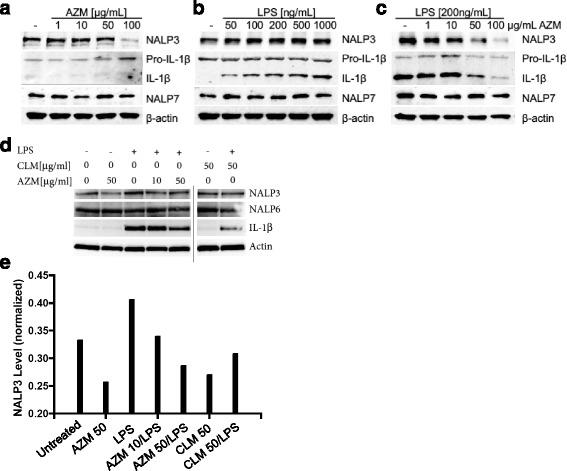
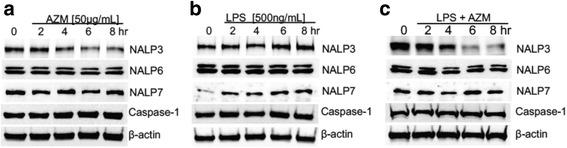
Azithromycin decreased IL-1β levels and reduced NALP3 protein levels in LPS-stimulated THP-1 monocytes through a mechanism involving decreased mRNA stability of the NALP3 - coding NLRP3 gene transcript as well as by decreasing NF-κB activity. Azithromycin accelerated NLRP3 transcript decay confirmed by mRNA stability and 3'UTR luciferase reporter assays, and yet the antibiotic had no effect on NLRP3 promoter activity in cells containing a 5' UTR reporter.
CONCLUSIONS
These studies provide a unique mechanism whereby azithromycin exerts immunomodulatory actions in monocytes by destabilizing mRNA levels for a key inflammasome component, NALP3, leading to decreased IL-1β-mediated inflammation.
背景
阿奇霉素是一种用于多种感染性疾病的抗生素,具有抗炎作用,但其这种活性的分子基础尚未得到充分表征。阿奇霉素可抑制部分依赖炎性小体活性的白细胞介素-1β(IL-1β)介导的炎症反应。在此,我们研究了阿奇霉素对含NACHT、LRR和PYD结构域蛋白3(NALP3)的影响,该蛋白是人类单核细胞中NALP3炎性小体的传感成分。
方法
THP-1细胞分别单独用阿奇霉素、单独用脂多糖(LPS)或两者同时处理。通过免疫印迹法测定NALP3和IL-1β蛋白水平。通过定量qPCR测定NLRP3基因(编码NALP3)转录水平。为了测量NLRP3转录本衰减,使用放线菌素D来损害基因转录。通过测量发光,利用含有NF-κB反应性荧光素酶元件的THP-1 Lucia细胞来评估对阿奇霉素、LPS及阿奇霉素/LPS反应时的NF-κB活性。为了最终确认阿奇霉素对NLRP3 mRNA和启动子活性的影响,在用阿奇霉素和/或LPS处理之前,将人胚肾(HEK)细胞用携带NLRP3基因5'非翻译区(UTR)(包括启动子)、该基因3'UTR或空质粒的荧光素酶报告构建体进行脂质转染,并测量发光情况。
结果
阿奇霉素通过降低编码NALP3的NLRP3基因转录本的mRNA稳定性以及降低NF-κB活性的机制,降低了LPS刺激的THP-1单核细胞中IL-1β水平并降低了NALP3蛋白水平。mRNA稳定性和3'UTR荧光素酶报告分析证实阿奇霉素加速了NLRP3转录本衰减,但该抗生素对含有5'UTR报告基因的细胞中的NLRP3启动子活性没有影响。
结论
这些研究提供了一种独特的机制,即阿奇霉素通过使关键炎性小体成分NALP3的mRNA水平不稳定,在单核细胞中发挥免疫调节作用,导致IL-1β介导的炎症反应减弱。
 Zotero 插件