
网络游戏障碍背景下理论模型与治疗方法的融合:个人观点
Merging Theoretical Models and Therapy Approaches in the Context of Internet Gaming Disorder: A Personal Perspective.
作者信息
Young Kimberly S, Brand Matthias
机构信息
Center for Internet Addiction, Russell J. Jandoli School of Journalism and Mass Communication, St. Bonaventure University, Olean, NY, United States.
General Psychology: Cognition and Center for Behavioral Addiction Research, University of Duisburg-Essen, Essen, Germany.
出版信息
Front Psychol. 2017 Oct 20;8:1853. doi: 10.3389/fpsyg.2017.01853. eCollection 2017.
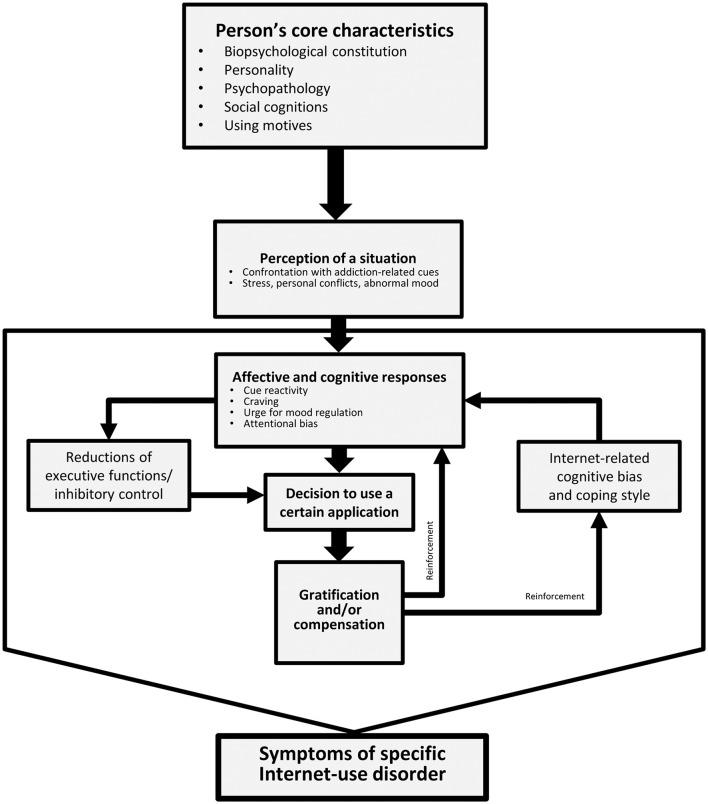
Although, it is not yet officially recognized as a clinical entity which is diagnosable, Internet Gaming Disorder (IGD) has been included in section III for further study in the DSM-5 by the American Psychiatric Association (APA, 2013). This is important because there is increasing evidence that people of all ages, in particular teens and young adults, are facing very real and sometimes very severe consequences in daily life resulting from an addictive use of online games. This article summarizes general aspects of IGD including diagnostic criteria and arguments for the classification as an addictive disorder including evidence from neurobiological studies. Based on previous theoretical considerations and empirical findings, this paper examines the use of one recently proposed model, the Interaction of Person-Affect-Cognition-Execution (I-PACE) model, for inspiring future research and for developing new treatment protocols for IGD. The I-PACE model is a theoretical framework that explains symptoms of Internet addiction by looking at interactions between predisposing factors, moderators, and mediators in combination with reduced executive functioning and diminished decision making. Finally, the paper discusses how current treatment protocols focusing on Cognitive-Behavioral Therapy for Internet addiction (CBT-IA) fit with the processes hypothesized in the I-PACE model.
尽管网络成瘾障碍(IGD)尚未被正式认定为一种可诊断的临床实体,但美国精神病学协会(APA,2013)已将其纳入《精神疾病诊断与统计手册》第5版(DSM - 5)的第三部分以作进一步研究。这一点很重要,因为越来越多的证据表明,所有年龄段的人,尤其是青少年和年轻人,因沉迷网络游戏而在日常生活中面临非常真实且有时非常严重的后果。本文总结了网络成瘾障碍的一般方面,包括诊断标准以及将其归类为成瘾性障碍的依据,包括来自神经生物学研究的证据。基于先前的理论思考和实证研究结果,本文探讨了最近提出的一种模型——人 - 情感 - 认知 - 执行交互(I - PACE)模型在启发未来研究以及为网络成瘾障碍制定新治疗方案方面的应用。I - PACE模型是一个理论框架,它通过考察易患因素、调节因素和中介因素之间的相互作用,结合执行功能降低和决策能力减弱来解释网络成瘾的症状。最后,本文讨论了当前针对网络成瘾的认知行为疗法(CBT - IA)治疗方案如何与I - PACE模型中假设的过程相契合。


 Zotero 插件