
线粒体功能障碍:癌症中上皮-间充质转化的一种新型潜在驱动因素
Mitochondrial Dysfunction: A Novel Potential Driver of Epithelial-to-Mesenchymal Transition in Cancer.
作者信息
Guerra Flora, Guaragnella Nicoletta, Arbini Arnaldo A, Bucci Cecilia, Giannattasio Sergio, Moro Loredana
机构信息
Department of Biological and Environmental Sciences and Technologies (DiSTeBA), Università del Salento, Lecce, Italy.
Institute of Biomembranes, Bioenergetics and Molecular Biotechnologies, National Research Council, Bari, Italy.
出版信息
Front Oncol. 2017 Dec 1;7:295. doi: 10.3389/fonc.2017.00295. eCollection 2017.
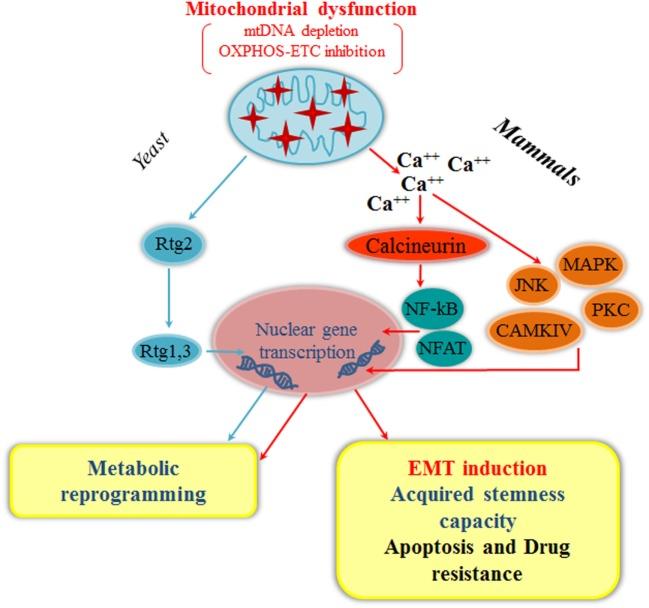
Epithelial-to-mesenchymal transition (EMT) allows epithelial cancer cells to assume mesenchymal features, endowing them with enhanced motility and invasiveness, thus enabling cancer dissemination and metastatic spread. The induction of EMT is orchestrated by EMT-inducing transcription factors that switch on the expression of "mesenchymal" genes and switch off the expression of "epithelial" genes. Mitochondrial dysfunction is a hallmark of cancer and has been associated with progression to a metastatic and drug-resistant phenotype. The mechanistic link between metastasis and mitochondrial dysfunction is gradually emerging. The discovery that mitochondrial dysfunction owing to deregulated mitophagy, depletion of the mitochondrial genome (mitochondrial DNA) or mutations in Krebs' cycle enzymes, such as succinate dehydrogenase, fumarate hydratase, and isocitrate dehydrogenase, activate the EMT gene signature has provided evidence that mitochondrial dysfunction and EMT are interconnected. In this review, we provide an overview of the current knowledge on the role of different types of mitochondrial dysfunction in inducing EMT in cancer cells. We place emphasis on recent advances in the identification of signaling components in the mito-nuclear communication network initiated by dysfunctional mitochondria that promote cellular remodeling and EMT activation in cancer cells.
上皮-间质转化(EMT)使上皮癌细胞具备间质特征,赋予它们更强的运动能力和侵袭性,从而促使癌症扩散和转移。EMT的诱导由诱导EMT的转录因子精心调控,这些转录因子开启“间质”基因的表达,关闭“上皮”基因的表达。线粒体功能障碍是癌症的一个标志,并且与癌症进展为转移和耐药表型有关。转移与线粒体功能障碍之间的机制联系正逐渐显现。由于线粒体自噬失调、线粒体基因组(线粒体DNA)耗竭或三羧酸循环酶(如琥珀酸脱氢酶、延胡索酸水合酶和异柠檬酸脱氢酶)发生突变而导致的线粒体功能障碍会激活EMT基因特征,这一发现为线粒体功能障碍与EMT相互关联提供了证据。在这篇综述中,我们概述了目前关于不同类型线粒体功能障碍在诱导癌细胞EMT中作用的相关知识。我们重点介绍了在由功能失调的线粒体引发的线粒体-细胞核通讯网络中信号成分识别方面的最新进展,该网络促进癌细胞中的细胞重塑和EMT激活。

 Zotero 插件