
肯尼亚西部与侵袭性疾病相关的多药耐药性非伤寒沙门氏菌。
Multi-drug resistant non-typhoidal Salmonella associated with invasive disease in western Kenya.
机构信息
Institute for Disease Modeling, Global Good Fund, Bellevue, Washington, United States of America.
Department of Global Health, University of Washington, Seattle, WA, United States of America.
出版信息
PLoS Negl Trop Dis. 2018 Jan 12;12(1):e0006156. doi: 10.1371/journal.pntd.0006156. eCollection 2018 Jan.
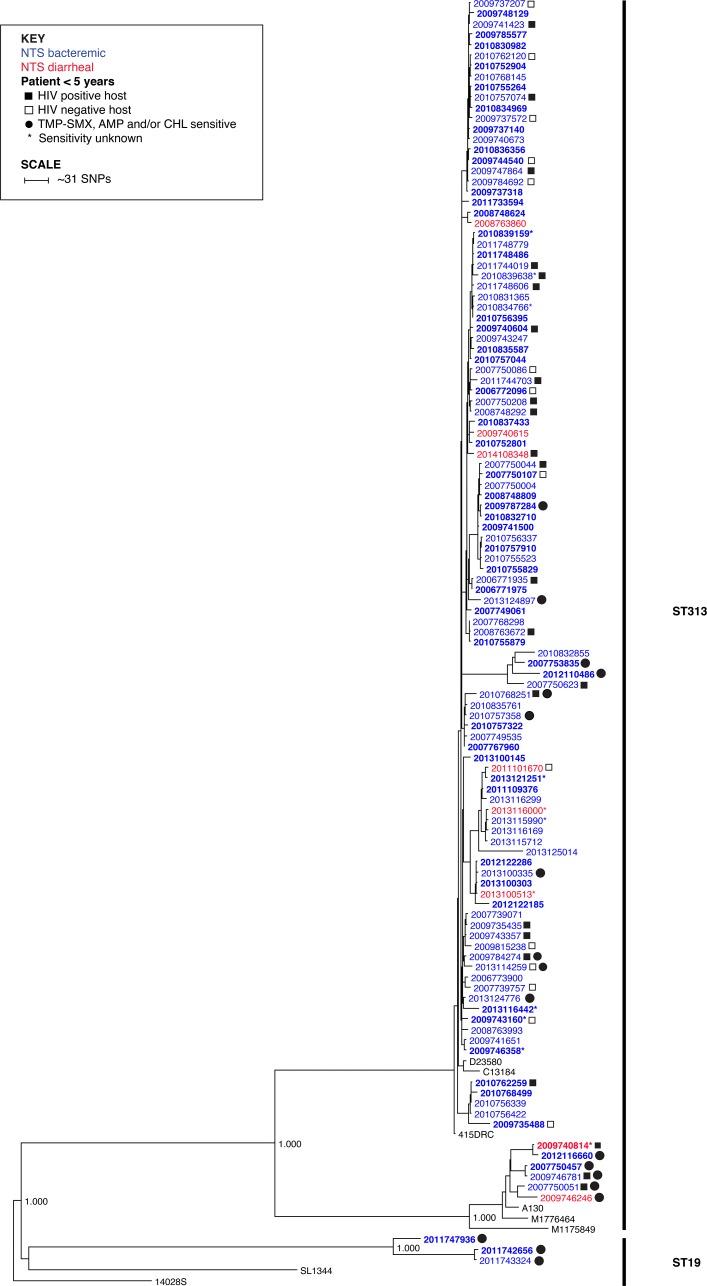
Non-typhoidal Salmonella (NTS) is a leading cause of bloodstream infections in Africa, but the various contributions of host susceptibility versus unique pathogen virulence factors are unclear. We used data from a population-based surveillance platform (population ~25,000) between 2007-2014 and NTS genome-sequencing to compare host and pathogen-specific factors between individuals presenting with NTS bacteremia and those presenting with NTS diarrhea. Salmonella Typhimurium ST313 and Salmonella Enteritidis ST11 were the most common isolates. Multi-drug resistant strains of NTS were more commonly isolated from patients presenting with NTS bacteremia compared to NTS diarrhea. This relationship was observed in patients under age five [aOR = 15.16, 95% CI (2.84-81.05), P = 0.001], in patients five years and older, [aOR = 6.70 95% CI (2.25-19.89), P = 0.001], in HIV-uninfected patients, [aOR = 21.61, 95% CI (2.53-185.0), P = 0.005], and in patients infected with Salmonella serogroup B [aOR = 5.96, 95% CI (2.28-15.56), P < 0.001] and serogroup D [aOR = 14.15, 95% CI (1.10-182.7), P = 0.042]. Thus, multi-drug-resistant NTS was strongly associated with bacteremia compared to diarrhea among children and adults. This association was seen in HIV-uninfected individuals infected with either S. Typhimurium or S. Enteritidis. Risk of developing bacteremia from NTS infection may be driven by virulence properties of the Salmonella pathogen.
非伤寒沙门氏菌(NTS)是非洲血流感染的主要原因,但宿主易感性与独特病原体毒力因素的各种贡献尚不清楚。我们使用了 2007-2014 年期间基于人群的监测平台(人群约 25000 人)的数据和 NTS 基因组测序来比较出现 NTS 菌血症和出现 NTS 腹泻的个体之间的宿主和病原体特异性因素。肠炎沙门氏菌 ST313 和肠炎沙门氏菌 ST11 是最常见的分离株。与出现 NTS 腹泻的患者相比,出现 NTS 菌血症的患者中更常分离到 NTS 多药耐药株。这一关系在五岁以下的患者中观察到 [aOR = 15.16, 95% CI (2.84-81.05), P = 0.001],在五岁及以上的患者中 [aOR = 6.70 95% CI (2.25-19.89), P = 0.001],在 HIV 未感染者中 [aOR = 21.61, 95% CI (2.53-185.0), P = 0.005],以及感染沙门氏菌血清群 B [aOR = 5.96, 95% CI (2.28-15.56), P < 0.001] 和血清群 D [aOR = 14.15, 95% CI (1.10-182.7), P = 0.042] 的患者中。因此,与腹泻相比,多药耐药 NTS 与儿童和成人的菌血症强烈相关。这种关联在感染 S. Typhimurium 或 S. Enteritidis 的 HIV 未感染者中可见。从 NTS 感染发展为菌血症的风险可能是由沙门氏菌病原体的毒力特性驱动的。

 Zotero 插件