
由胺修饰聚苯乙烯纳米颗粒诱导的溶酶体依赖性细胞死亡和自噬失调。
Lysosome-dependent cell death and deregulated autophagy induced by amine-modified polystyrene nanoparticles.
机构信息
Center for BioNano Interactions, School of Chemistry and Chemical Biology, University College Dublin, Belfield, Dublin 4, Ireland.
CNRS-University of Strasbourg, Biotechnology and cell signaling, France/Laboratory of excellence Medalis, Illkirch, France.
出版信息
Open Biol. 2018 Apr;8(4). doi: 10.1098/rsob.170271.
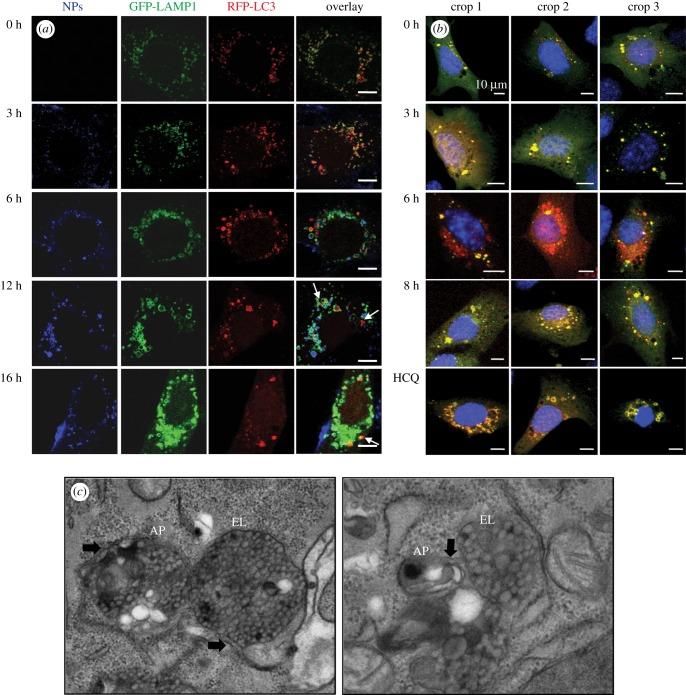
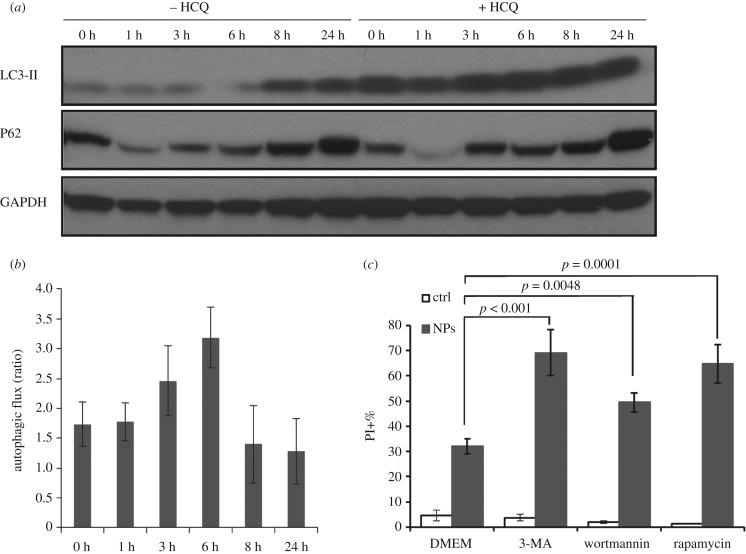
Nanoparticles (NPs) typically accumulate in lysosomes. However, their impact on lysosomal function, as well as autophagy, a lysosomal degradative pathway, is still not well known. We have previously reported in the 1321N1 cell line that amine-modified polystyrene (NH-PS) NPs induce apoptosis through damage initiated in the lysosomes leading ultimately to release of lysosomal content in the cytosol, followed by apoptosis. Here, by using a combination of biochemical and cell biological approaches, we have characterized in a mouse embryonic fibroblast cell line that the lysosomal alterations induced by NH-PS NPs is progressive, initiating from mild lysosomal membrane permeabilization (LMP), to expansion of lysosomal volume and intensive LMP before the summit of cell death. Though the cells initially seem to induce autophagy as a surviving mechanism, the damage of NH-PS NPs to lysosomes probably results in lysosomal dysfunctions, leading to blockage of autophagic flux at the level of lysosomes and the eventual cell death.
纳米粒子(NPs)通常会在溶酶体中积累。然而,它们对溶酶体功能以及溶酶体降解途径自噬的影响尚不清楚。我们之前曾在 1321N1 细胞系中报道,胺修饰的聚苯乙烯(NH-PS)纳米颗粒通过溶酶体起始的损伤诱导细胞凋亡,最终导致溶酶体内容物在细胞质中的释放,随后发生细胞凋亡。在这里,我们通过结合生化和细胞生物学方法,在小鼠胚胎成纤维细胞系中表征了 NH-PS NPs 诱导的溶酶体改变是渐进的,从轻度溶酶体膜通透性(LMP)开始,到溶酶体体积扩大和 LMP 加剧,然后达到细胞死亡的高峰。尽管细胞最初似乎通过自噬作为一种存活机制来诱导,但 NH-PS NPs 对溶酶体的损伤可能导致溶酶体功能障碍,从而在溶酶体水平阻断自噬流,最终导致细胞死亡。


 Zotero 插件