
组蛋白去乙酰化酶 10(HDAC10)在溶酶体胞吐和 DNA 修复中的双重作用促进神经母细胞瘤的化疗耐药性。
Dual role of HDAC10 in lysosomal exocytosis and DNA repair promotes neuroblastoma chemoresistance.
机构信息
Preclinical Program, Hopp Children's Cancer Center at NCT Heidelberg (KiTZ), Heidelberg, Germany.
Clinical Cooperation Unit Pediatric Oncology, German Cancer Research Center (DKFZ), and German Cancer Consortium (DKTK), Im Neuenheimer Feld 280, 69120, Heidelberg, Germany.
出版信息
Sci Rep. 2018 Jul 3;8(1):10039. doi: 10.1038/s41598-018-28265-5.
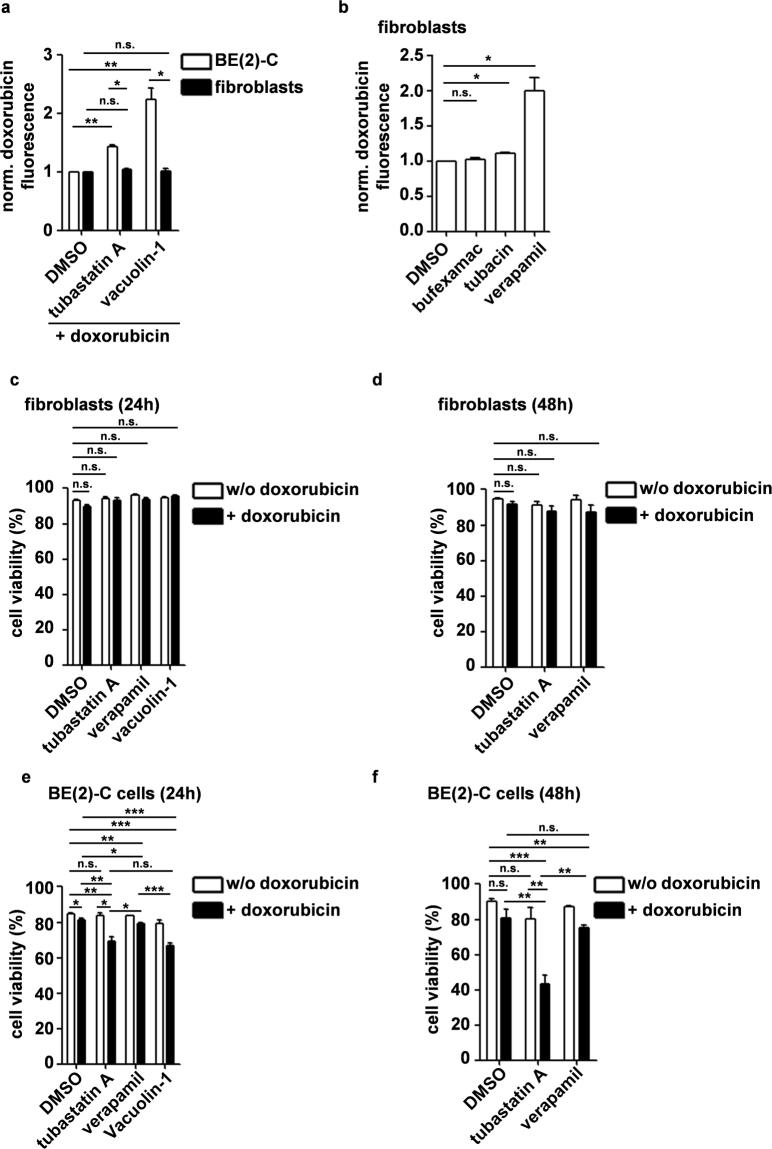
Drug resistance is a leading cause for treatment failure in many cancers, including neuroblastoma, the most common solid extracranial childhood malignancy. Previous studies from our lab indicate that histone deacetylase 10 (HDAC10) is important for the homeostasis of lysosomes, i.e. acidic vesicular organelles involved in the degradation of various biomolecules. Here, we show that depleting or inhibiting HDAC10 results in accumulation of lysosomes in chemotherapy-resistant neuroblastoma cell lines, as well as in the intracellular accumulation of the weakly basic chemotherapeutic doxorubicin within lysosomes. Interference with HDAC10 does not block doxorubicin efflux from cells via P-glycoprotein inhibition, but rather via inhibition of lysosomal exocytosis. In particular, intracellular doxorubicin does not remain trapped in lysosomes but also accumulates in the nucleus, where it promotes neuroblastoma cell death. Our data suggest that lysosomal exocytosis under doxorubicin treatment is important for cell survival and that inhibition of HDAC10 further induces DNA double-strand breaks (DSBs), providing additional mechanisms that sensitize neuroblastoma cells to doxorubicin. Taken together, we demonstrate that HDAC10 inhibition in combination with doxorubicin kills neuroblastoma, but not non-malignant cells, both by impeding drug efflux and enhancing DNA damage, providing a novel opportunity to target chemotherapy resistance.
耐药性是许多癌症(包括神经母细胞瘤)治疗失败的主要原因,神经母细胞瘤是最常见的儿童颅外实体恶性肿瘤。我们实验室的先前研究表明,组蛋白去乙酰化酶 10(HDAC10)对于溶酶体的动态平衡很重要,即参与各种生物分子降解的酸性囊泡细胞器。在这里,我们表明,耗尽或抑制 HDAC10 会导致化疗耐药性神经母细胞瘤细胞系中溶酶体的积累,以及弱碱性化疗药物阿霉素在溶酶体内的细胞内积累。干扰 HDAC10 不会通过抑制 P-糖蛋白来阻止阿霉素从细胞中流出,而是通过抑制溶酶体胞吐作用来阻止。特别是,细胞内的阿霉素不会被困在溶酶体中,而是也会积累在核内,在核内它会促进神经母细胞瘤细胞死亡。我们的数据表明,阿霉素处理下的溶酶体胞吐对于细胞存活很重要,并且抑制 HDAC10 进一步诱导 DNA 双链断裂(DSBs),为神经母细胞瘤细胞对阿霉素敏感提供了额外的机制。总之,我们证明了 HDAC10 抑制与阿霉素联合使用可以杀死神经母细胞瘤,但不会杀死非恶性细胞,这既可以阻止药物外排,又可以增强 DNA 损伤,为靶向化疗耐药性提供了新的机会。


 Zotero 插件