
TFAM 与 mtDNA 损伤热点的结合增加与老年大鼠心脏中线粒体 DNA 丢失有关。
Increased TFAM binding to mtDNA damage hot spots is associated with mtDNA loss in aged rat heart.
机构信息
Department of Biosciences, Biotechnologies and Biopharmaceutics, University of Bari "Aldo Moro", Via Orabona 4, 70125 Bari, Italy.
Department of Geriatrics, Neurosciences and Orthopedics, Catholic University of the Sacred Heart School of Medicine, Teaching Hospital "Agostino Gemelli", Rome, Italy.
出版信息
Free Radic Biol Med. 2018 Aug 20;124:447-453. doi: 10.1016/j.freeradbiomed.2018.06.041. Epub 2018 Jun 30.
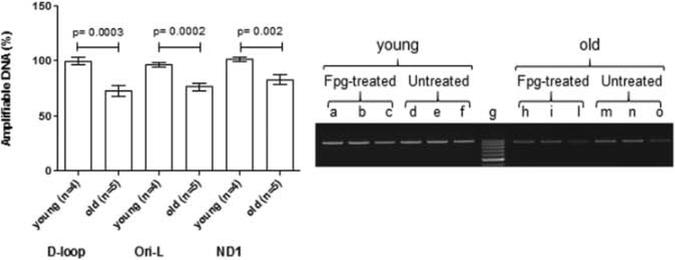
The well-known age-related mitochondrial dysfunction deeply affects heart because of the tissue's large dependence on mitochondrial ATP provision. Our study revealed in aged rat heart a significant 25% decrease in mtDNA relative content, a significant 29% increase in the 4.8 Kb mtDNA deletion relative content, and a significant inverse correlation between such contents as well as a significant 38% decrease in TFAM protein amount. The TFAM-binding activity to specific mtDNA regions increased at those encompassing the mtDNA replication origins, D-loop and Ori-L. The same mtDNA regions were screened for different kinds of oxidative damage, namely Single Strand Breaks (SSBs), Double Strand Breaks (DSBs), abasic sites (AP sites) and oxidized bases as 7,8-dihydro-8-oxoguanine (8oxoG). A marked increase in the relative content of mtDNA strand damage (SSBs, DSBs and AP sites) was found in the D-loop and Ori-L regions in the aged animals, unveiling for the first time in vivo an age-related, non-stochastic accumulation of oxidative lesions in these two regions that appear as hot spots of mtDNA damage. The use of Formamidopyrimidine glycosylase (Fpg) demonstrated also a significant age-related accumulation of oxidized purines particularly in the D-loop and Ori-L regions. The detected increased binding of TFAM to the mtDNA damage hot spots in aged heart suggests a link between TFAM binding to mtDNA and loss of mitochondrial genome likely through hindrance of repair processes.
众所周知,与年龄相关的线粒体功能障碍会严重影响心脏,因为心脏组织对线粒体 ATP 的供应有很大的依赖性。我们的研究表明,在老年大鼠心脏中,mtDNA 相对含量显著下降了 25%,4.8kb 的 mtDNA 缺失相对含量显著增加了 29%,并且这些含量之间呈显著的负相关,TFAM 蛋白含量也显著下降了 38%。TFAM 与特定 mtDNA 区域的结合活性在包含 mtDNA 复制起点、D 环和 Ori-L 的区域增加。对不同类型的氧化损伤,即单链断裂(SSBs)、双链断裂(DSBs)、无碱基位点(AP 位点)和氧化碱基(如 7,8-二氢-8-氧鸟嘌呤(8oxoG))进行了筛选。在老年动物的 D 环和 Ori-L 区域中,mtDNA 链损伤(SSBs、DSBs 和 AP 位点)的相对含量显著增加,首次在体内揭示了这两个区域中与年龄相关的、非随机积累的氧化损伤,这两个区域似乎是 mtDNA 损伤的热点。使用 Formamidopyrimidine glycosylase(Fpg)也证明了在 D 环和 Ori-L 区域中,氧化嘌呤的积累与年龄相关。在老年心脏中,TFAM 与 mtDNA 损伤热点的结合增加表明,TFAM 与 mtDNA 的结合与线粒体基因组的丢失之间存在联系,可能是通过修复过程受阻所致。


 Zotero 插件