
表达不良导电性菌毛的菌株揭示了直接种间电子转移机制的限制。
Strains Expressing Poorly Conductive Pili Reveal Constraints on Direct Interspecies Electron Transfer Mechanisms.
机构信息
Department of Microbiology, University of Massachusetts, Amherst, Massachusetts, USA.
Department of Biology, University of Southern Denmark, Odense, Denmark.
出版信息
mBio. 2018 Jul 10;9(4):e01273-18. doi: 10.1128/mBio.01273-18.
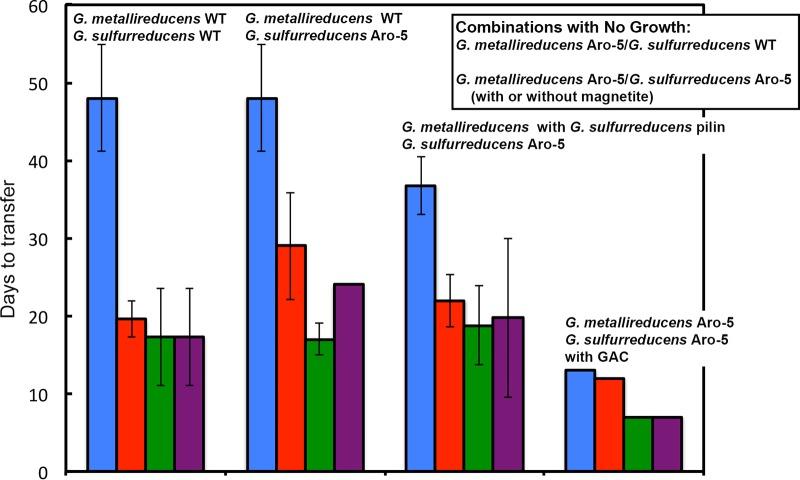
Cytochrome-to-cytochrome electron transfer and electron transfer along conduits of multiple extracellular magnetite grains are often proposed as strategies for direct interspecies electron transfer (DIET) that do not require electrically conductive pili (e-pili). However, physical evidence for these proposed DIET mechanisms has been lacking. To investigate these possibilities further, we constructed strain Aro-5, in which the wild-type pilin gene was replaced with the pilin gene that was previously shown to yield poorly conductive pili in strain Aro-5. strain Aro-5 did not reduce Fe(III) oxide and produced only low current densities, phenotypes consistent with expression of poorly conductive pili. Like strain Aro-5, strain Aro-5 displayed abundant outer surface cytochromes. Cocultures initiated with wild-type as the electron-donating strain and strain Aro-5 as the electron-accepting strain grew via DIET. However, Aro-5/ wild-type cocultures did not. Cocultures initiated with the Aro-5 strains of both species grew only when amended with granular activated carbon (GAC), a conductive material known to be a conduit for DIET. Magnetite could not substitute for GAC. The inability of the two Aro-5 strains to adapt for DIET in the absence of GAC suggests that there are physical constraints on establishing DIET solely through cytochrome-to-cytochrome electron transfer or along chains of magnetite. The finding that DIET is possible with electron-accepting partners that lack highly conductive pili greatly expands the range of potential electron-accepting partners that might participate in DIET. DIET is thought to be an important mechanism for interspecies electron exchange in natural anaerobic soils and sediments in which methane is either produced or consumed, as well as in some photosynthetic mats and anaerobic digesters converting organic wastes to methane. Understanding the potential mechanisms for DIET will not only aid in modeling carbon and electron flow in these geochemically significant environments but will also be helpful for interpreting meta-omic data from as-yet-uncultured microbes in DIET-based communities and for designing strategies to promote DIET in anaerobic digesters. The results demonstrate the need to develop a better understanding of the diversity of types of e-pili in the microbial world to identify potential electron-donating partners for DIET. Novel methods for recovering as-yet-uncultivated microorganisms capable of DIET in culture will be needed to further evaluate whether DIET is possible without e-pili in the absence of conductive materials such as GAC.
细胞色素-细胞色素电子转移和沿着多个细胞外磁铁矿颗粒的导管的电子转移通常被提议作为不需要导电菌毛 (e-pili) 的直接种间电子转移 (DIET) 的策略。然而,这些提议的 DIET 机制的物理证据一直缺乏。为了进一步研究这些可能性,我们构建了 菌株 Aro-5,其中野生型菌毛基因被先前显示在 菌株 Aro-5 中产生导电性差的菌毛的 pilin 基因取代。 菌株 Aro-5 不能还原 Fe(III)氧化物,只产生低电流密度,表型与导电性差的菌毛表达一致。与 菌株 Aro-5 一样, 菌株 Aro-5 显示丰富的外表面细胞色素。以野生型 作为电子供体菌株,以 菌株 Aro-5 作为电子受体菌株启动的共培养物通过 DIET 生长。然而, Aro-5/野生型共培养物没有。当用已知是 DIET 导管的颗粒活性炭 (GAC) 进行修饰时,只有当起始于两种物种的 Aro-5 菌株的共培养物生长。磁铁矿不能替代 GAC。在没有 GAC 的情况下,两种 Aro-5 菌株无法适应 DIET 的事实表明,仅通过细胞色素-细胞色素电子转移或沿着磁铁矿链建立 DIET 存在物理限制。发现缺乏高导电性菌毛的电子受体伙伴也可以进行 DIET,这极大地扩展了可能参与 DIET 的潜在电子受体伙伴的范围。DIET 被认为是在产生或消耗甲烷的天然厌氧土壤和沉积物以及一些光合垫和将有机废物转化为甲烷的厌氧消化器中进行种间电子交换的重要机制。了解 DIET 的潜在机制不仅有助于在这些具有重要地球化学意义的环境中建模碳和电子流动,还有助于解释基于 DIET 的群落中尚未培养的微生物的元组学数据,并有助于设计促进厌氧消化器中 DIET 的策略。结果表明,需要更好地了解微生物世界中 e-pili 的多样性,以确定 DIET 的潜在电子供体伙伴。需要开发新的方法来回收能够在培养物中进行 DIET 的尚未培养的微生物,以进一步评估在没有 GAC 等导电材料的情况下,没有 e-pili 是否可以进行 DIET。




 Zotero 插件