
端粒功能障碍促进人成纤维细胞向肌成纤维细胞的转分化。
Telomere dysfunction promotes transdifferentiation of human fibroblasts into myofibroblasts.
机构信息
New Jersey Medical School, Cancer Institute of New Jersey-Newark, Rutgers Biomedical and Health Sciences, Newark, New Jersey.
Department of Microbiology, Biochemistry and Molecular Genetics, Rutgers Biomedical and Health Sciences, Newark, New Jersey.
出版信息
Aging Cell. 2018 Dec;17(6):e12838. doi: 10.1111/acel.12838. Epub 2018 Sep 22.
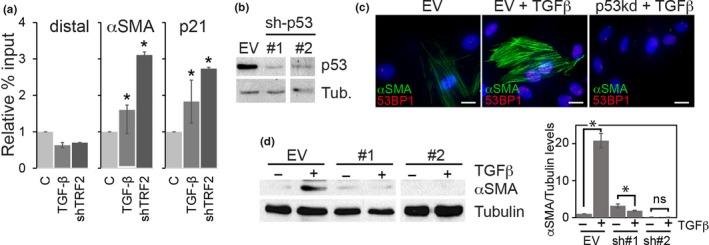
Cells that had undergone telomere dysfunction-induced senescence secrete numerous cytokines and other molecules, collectively called the senescence-associated secretory phenotype (SASP). Although certain SASP factors have been demonstrated to promote cellular senescence in neighboring cells in a paracrine manner, the mechanisms leading to bystander senescence and the functional significance of these effects are currently unclear. Here, we demonstrate that TGF-β1, a component of the SASP, causes telomere dysfunction in normal somatic human fibroblasts in a Smad3/NOX4/ROS-dependent manner. Surprisingly, instead of activating cellular senescence, TGF-β1-induced telomere dysfunction caused fibroblasts to transdifferentiate into α-SMA-expressing myofibroblasts, a mesenchymal and contractile cell type that is critical for wound healing and tissue repair. Despite the presence of dysfunctional telomeres, transdifferentiated cells acquired the ability to contract collagen lattices and displayed a gene expression signature characteristic of functional myofibroblasts. Significantly, the formation of dysfunctional telomeres and downstream p53 signaling was necessary for myofibroblast transdifferentiation, as suppressing telomere dysfunction by expression of hTERT, inhibiting the signaling pathways that lead to stochastic telomere dysfunction, and suppressing p53 function prevented the generation of myofibroblasts in response to TGF-β1 signaling. Furthermore, inducing telomere dysfunction using shRNA against TRF2 also caused cells to develop features that are characteristic of myofibroblasts, even in the absence of exogenous TGF-β1. Overall, our data demonstrate that telomere dysfunction is not only compatible with cell functionality, but they also demonstrate that the generation of dysfunctional telomeres is an essential step for transdifferentiation of human fibroblasts into myofibroblasts.
经历端粒功能障碍诱导衰老的细胞会分泌许多细胞因子和其他分子,统称为衰老相关分泌表型 (SASP)。虽然某些 SASP 因子已被证明以旁分泌方式促进邻近细胞的细胞衰老,但导致旁观者衰老的机制以及这些效应的功能意义目前尚不清楚。在这里,我们证明 SASP 的组成部分 TGF-β1 以 Smad3/NOX4/ROS 依赖的方式导致正常体细胞人成纤维细胞中端粒功能障碍。令人惊讶的是,TGF-β1 诱导的端粒功能障碍并没有激活细胞衰老,而是导致成纤维细胞向表达α-SMA 的肌成纤维细胞转化,肌成纤维细胞是一种间充质和收缩性细胞类型,对于伤口愈合和组织修复至关重要。尽管存在功能失调的端粒,但转化的细胞获得了收缩胶原蛋白格子的能力,并表现出特征性的功能肌成纤维细胞的基因表达特征。重要的是,形成功能失调的端粒和下游 p53 信号对于肌成纤维细胞的转化是必要的,因为通过表达 hTERT 抑制导致随机端粒功能障碍的信号通路以及抑制 p53 功能可防止肌成纤维细胞在 TGF-β1 信号的刺激下产生。此外,使用针对 TRF2 的 shRNA 诱导端粒功能障碍也会导致细胞表现出肌成纤维细胞的特征,即使没有外源性 TGF-β1 也是如此。总的来说,我们的数据表明端粒功能障碍不仅与细胞功能兼容,而且还表明生成功能失调的端粒是人类成纤维细胞向肌成纤维细胞转化的必要步骤。


 Zotero 插件