
小麦茎蜂基因组序列,代表膜翅目早期分支谱系,阐明了膜翅目化感器的进化。
Genome Sequence of the Wheat Stem Sawfly, Cephus cinctus, Representing an Early-Branching Lineage of the Hymenoptera, Illuminates Evolution of Hymenopteran Chemoreceptors.
机构信息
Department of Entomology, University of Illinois at Urbana-Champaign.
Department of Ecology and Evolution, University of Lausanne, Switzerland.
出版信息
Genome Biol Evol. 2018 Nov 1;10(11):2997-3011. doi: 10.1093/gbe/evy232.
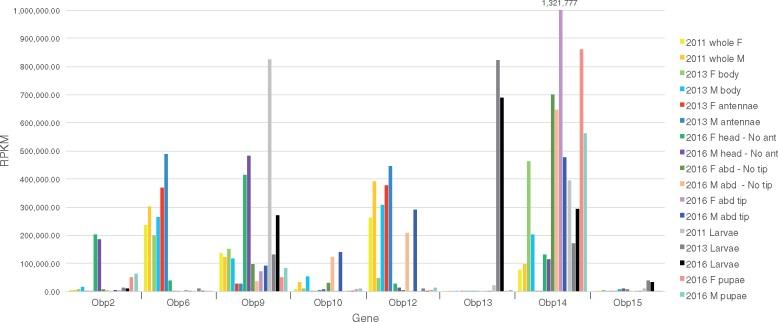
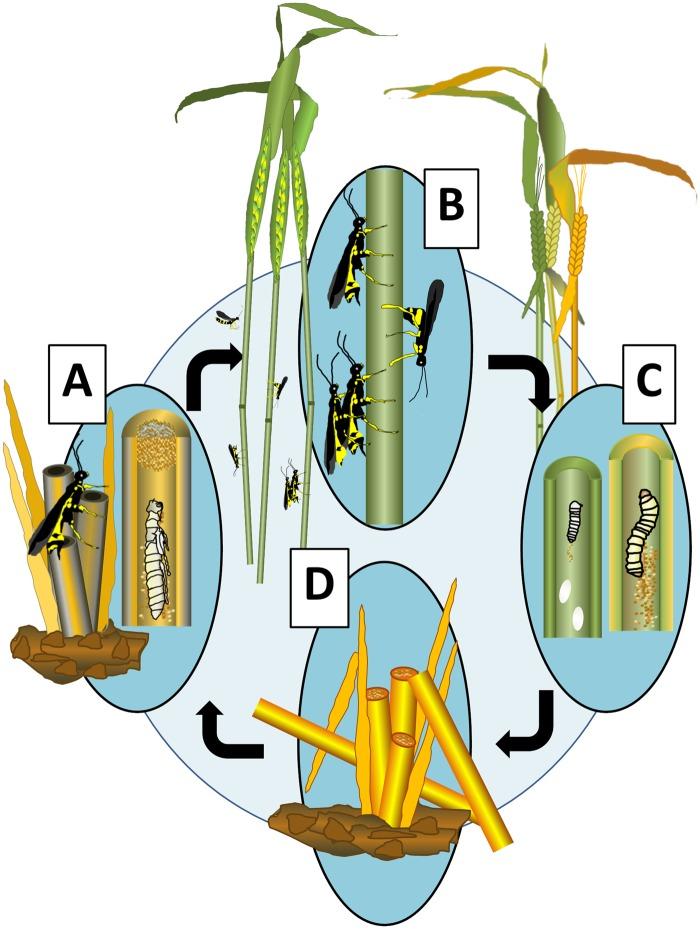
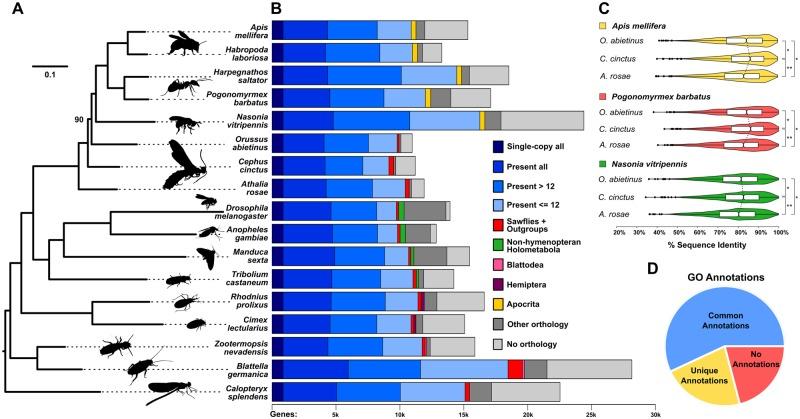
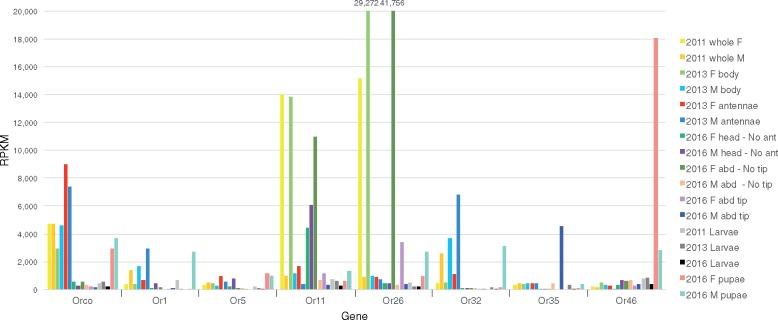
The wheat stem sawfly, Cephus cinctus, is a major pest of wheat and key ecological player in the grasslands of western North America. It also represents the distinctive Cephoidea superfamily of sawflies (Symphyta) that appeared early during the hymenopteran radiation, but after three early-branching eusymphytan superfamilies that form the base of the order Hymenoptera. We present a high-quality draft genome assembly of 162 Mb in 1,976 scaffolds with a scaffold N50 of 622 kb. Automated gene annotation identified 11,210 protein-coding gene models and 1,307 noncoding RNA models. Thirteen percent of the assembly consists of ∼58,000 transposable elements partitioned equally between Class-I and Class-II elements. Orthology analysis reveals that 86% of Cephus proteins have identifiable orthologs in other insects. Phylogenomic analysis of conserved subsets of these proteins supports the placement of the Cephoidea between the Eusymphyta and the parasitic woodwasp superfamily Orussoidea. Manual annotation and phylogenetic analysis of families of odorant, gustatory, and ionotropic receptors, plus odorant-binding proteins, shows that Cephus has representatives for most conserved and expanded gene lineages in the Apocrita (wasps, ants, and bees). Cephus has also maintained several insect gene lineages that have been lost from the Apocrita, most prominently the carbon dioxide receptor subfamily. Furthermore, Cephus encodes a few small lineage-specific chemoreceptor gene family expansions that might be involved in adaptations to new grasses including wheat. These comparative analyses identify gene family members likely to have been present in the hymenopteran ancestor and provide a new perspective on the evolution of the chemosensory gene repertoire.
小麦茎蜂,Cephus cinctus,是小麦的主要害虫,也是北美西部草原的关键生态参与者。它还代表了独特的缨翅目锯蜂超科(Symphyta),该超科在膜翅目昆虫辐射早期出现,但在三个早期分支的真社会性超科之后,这三个超科构成了膜翅目昆虫的基础。我们提供了一个高质量的 162 Mb 基因组草图组装,由 1976 个支架组成,支架 N50 为 622 kb。自动基因注释鉴定出 11210 个蛋白质编码基因模型和 1307 个非编码 RNA 模型。组装的 13%由约 58000 个转座元件组成,这些元件在 I 类和 II 类元件之间平分秋色。同源分析表明,Cephus 的 86%的蛋白质在其他昆虫中有可识别的同源物。这些蛋白质保守子集的系统发育分析支持了 Cephoidea 位于 Eusymphyta 和寄生木蜂超科 Orussoidea 之间的位置。对气味、味觉和离子型受体以及气味结合蛋白家族的家族进行手动注释和系统发育分析表明,Cephus 拥有 Apocrita(黄蜂、蚂蚁和蜜蜂)中大多数保守和扩展的基因谱系的代表。Cephus 还保留了一些在 Apocrita 中丢失的昆虫基因谱系,最突出的是二氧化碳受体亚家族。此外,Cephus 编码了几个小的谱系特异性化学感受器基因家族扩张,这些扩张可能与包括小麦在内的新草的适应有关。这些比较分析确定了可能存在于膜翅目昆虫祖先中的基因家族成员,并为化学感受基因库的进化提供了新的视角。

 Zotero 插件