
缺失导致血浆 DNA 长度和末端基序频率出现异常。
deletion causes aberrations in length and end-motif frequencies in plasma DNA.
机构信息
Department of Pathology, New York University School of Medicine, New York, NY 10016.
Li Ka Shing Institute of Health Sciences, The Chinese University of Hong Kong, Shatin, NT, Hong Kong SAR, China.
出版信息
Proc Natl Acad Sci U S A. 2019 Jan 8;116(2):641-649. doi: 10.1073/pnas.1815031116. Epub 2018 Dec 28.
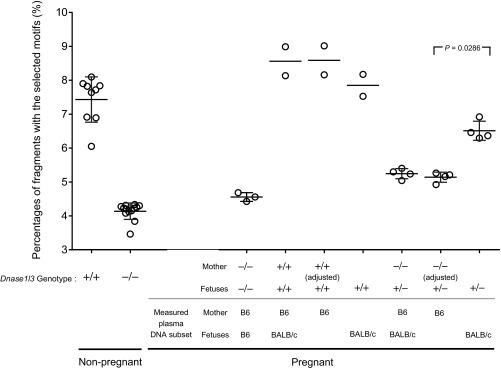
Circulating DNA in plasma consists of short DNA fragments. The biological processes generating such fragments are not well understood. DNASE1L3 is a secreted DNASE1-like nuclease capable of digesting DNA in chromatin, and its absence causes anti-DNA responses and autoimmunity in humans and mice. We found that the deletion of in mice resulted in aberrations in the fragmentation of plasma DNA. Such aberrations included an increase in short DNA molecules below 120 bp, which was positively correlated with anti-DNA antibody levels. We also observed an increase in long, multinucleosomal DNA molecules and decreased frequencies of the most common end motifs found in plasma DNA. These aberrations were independent of anti-DNA response, suggesting that they represented a primary effect of DNASE1L3 loss. Pregnant mice carrying fetuses showed a partial restoration of normal frequencies of plasma DNA end motifs, suggesting that DNASE1L3 from -proficient fetuses could enter maternal systemic circulation and affect both fetal and maternal DNA fragmentation in a systemic as well as local manner. However, the observed shortening of circulating fetal DNA relative to maternal DNA was not affected by the deletion of Collectively, our findings demonstrate that DNASE1L3 plays a role in circulating plasma DNA homeostasis by enhancing fragmentation and influencing end-motif frequencies. These results support a distinct role of DNASE1L3 as a regulator of the physical form and availability of cell-free DNA and may have important implications for the mechanism whereby this enzyme prevents autoimmunity.
血浆中的循环 DNA 由短的 DNA 片段组成。产生这些片段的生物学过程尚未被很好地理解。DNASE1L3 是一种分泌型的 DNASE1 样核酸内切酶,能够消化染色质中的 DNA,其缺失会导致人类和小鼠产生抗 DNA 反应和自身免疫。我们发现,在小鼠中缺失 会导致血浆 DNA 片段化异常。这种异常包括 120bp 以下的短 DNA 分子增加,这与抗 DNA 抗体水平呈正相关。我们还观察到长的、多核小体 DNA 分子增加,以及血浆 DNA 中最常见的末端基序的频率降低。这些异常与抗 DNA 反应无关,表明它们代表了 DNASE1L3 缺失的主要影响。携带 胎儿的妊娠 小鼠表现出血浆 DNA 末端基序正常频率的部分恢复,表明来自 - 有功能胎儿的 DNASE1L3 可以进入母体系统循环,并以系统和局部方式影响胎儿和母体的 DNA 片段化。然而,观察到的循环胎儿 DNA 相对于母体 DNA 的缩短不受 缺失的影响。总之,我们的研究结果表明,DNASE1L3 通过增强片段化和影响末端基序频率,在循环血浆 DNA 稳态中发挥作用。这些结果支持 DNASE1L3 作为游离 DNA 物理形式和可用性调节剂的独特作用,并且可能对该酶防止自身免疫的机制具有重要意义。


 Zotero 插件