
一种新的衰老衡量标准可捕捉来自 NHANES IV 的不同亚人群的发病和死亡风险:一项队列研究。
A new aging measure captures morbidity and mortality risk across diverse subpopulations from NHANES IV: A cohort study.
机构信息
Department of Pathology, Yale School of Medicine, New Haven, Connecticut, United States of America.
Longitudinal Studies Section, Translational Gerontology Branch, National Institute on Aging, National Institutes of Health, Baltimore, Maryland, United States of America.
出版信息
PLoS Med. 2018 Dec 31;15(12):e1002718. doi: 10.1371/journal.pmed.1002718. eCollection 2018 Dec.
BACKGROUND
A person's rate of aging has important implications for his/her risk of death and disease; thus, quantifying aging using observable characteristics has important applications for clinical, basic, and observational research. Based on routine clinical chemistry biomarkers, we previously developed a novel aging measure, Phenotypic Age, representing the expected age within the population that corresponds to a person's estimated mortality risk. The aim of this study was to assess its applicability for differentiating risk for a variety of health outcomes within diverse subpopulations that include healthy and unhealthy groups, distinct age groups, and persons with various race/ethnic, socioeconomic, and health behavior characteristics.
METHODS AND FINDINGS
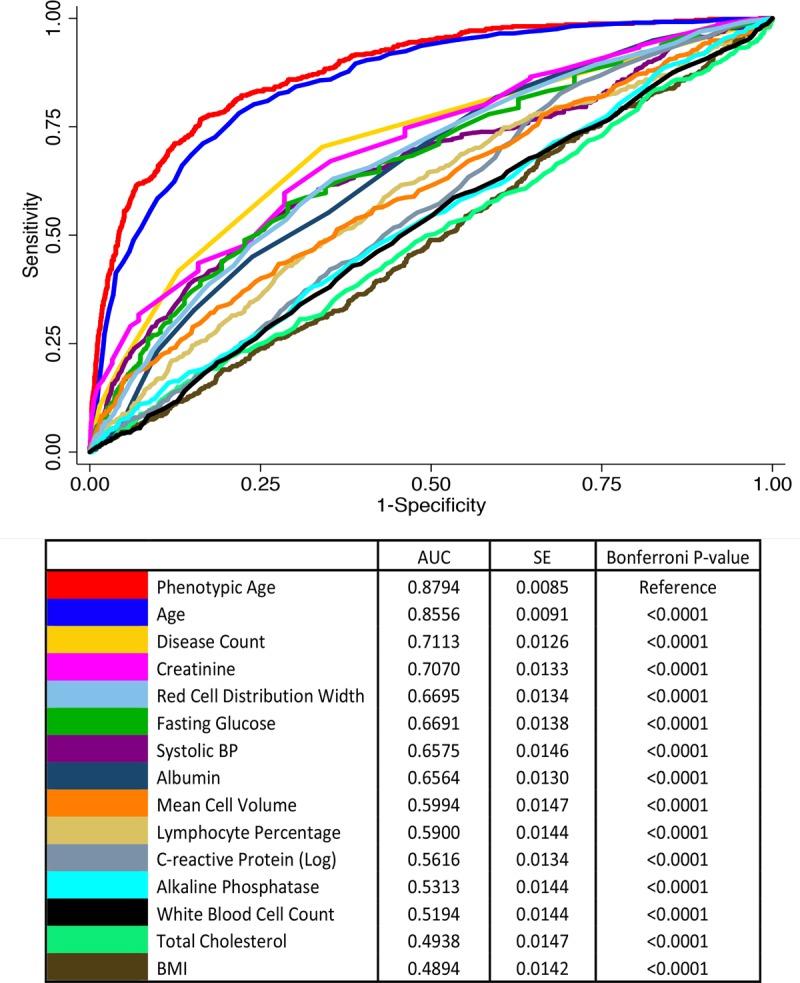
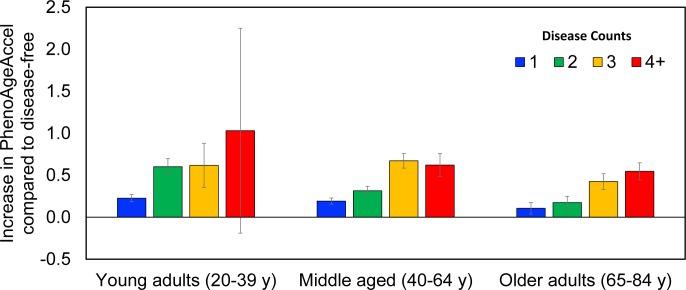
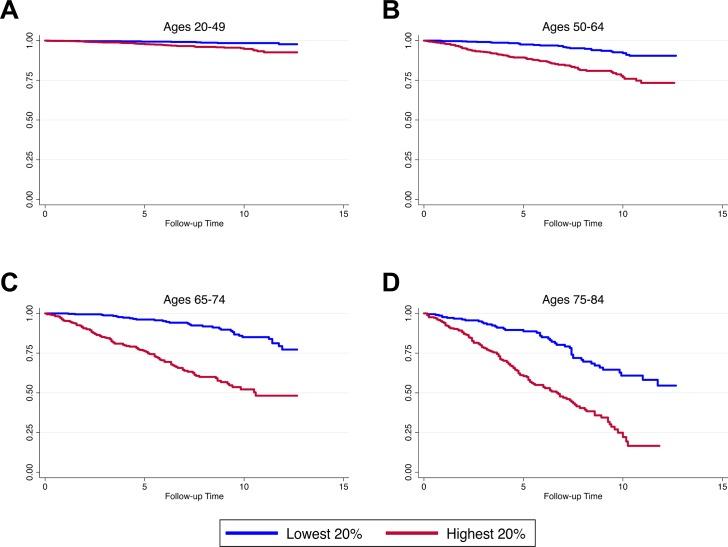
Phenotypic Age was calculated based on a linear combination of chronological age and 9 multi-system clinical chemistry biomarkers in accordance with our previously established method. We also estimated Phenotypic Age Acceleration (PhenoAgeAccel), which represents Phenotypic Age after accounting for chronological age (i.e., whether a person appears older [positive value] or younger [negative value] than expected, physiologically). All analyses were conducted using NHANES IV (1999-2010, an independent sample from that originally used to develop the measure). Our analytic sample consisted of 11,432 adults aged 20-84 years and 185 oldest-old adults top-coded at age 85 years. We observed a total of 1,012 deaths, ascertained over 12.6 years of follow-up (based on National Death Index data through December 31, 2011). Proportional hazard models and receiver operating characteristic curves were used to evaluate all-cause and cause-specific mortality predictions. Overall, participants with more diseases had older Phenotypic Age. For instance, among young adults, those with 1 disease were 0.2 years older phenotypically than disease-free persons, and those with 2 or 3 diseases were about 0.6 years older phenotypically. After adjusting for chronological age and sex, Phenotypic Age was significantly associated with all-cause mortality and cause-specific mortality (with the exception of cerebrovascular disease mortality). Results for all-cause mortality were robust to stratifications by age, race/ethnicity, education, disease count, and health behaviors. Further, Phenotypic Age was associated with mortality among seemingly healthy participants-defined as those who reported being disease-free and who had normal BMI-as well as among oldest-old adults, even after adjustment for disease prevalence. The main limitation of this study was the lack of longitudinal data on Phenotypic Age and disease incidence.
CONCLUSIONS
In a nationally representative US adult population, Phenotypic Age was associated with mortality even after adjusting for chronological age. Overall, this association was robust across different stratifications, particularly by age, disease count, health behaviors, and cause of death. We also observed a strong association between Phenotypic Age and the disease count an individual had. These findings suggest that this new aging measure may serve as a useful tool to facilitate identification of at-risk individuals and evaluation of the efficacy of interventions, and may also facilitate investigation into potential biological mechanisms of aging. Nevertheless, further evaluation in other cohorts is needed.
背景
一个人的衰老速度对其死亡和患病风险有重要影响;因此,使用可观察到的特征来量化衰老对于临床、基础和观察性研究具有重要意义。基于常规临床化学生物标志物,我们之前开发了一种新的衰老衡量标准,表型年龄,代表与一个人估计的死亡率相对应的人群中预期的年龄。本研究的目的是评估其在区分不同亚人群的各种健康结果风险方面的适用性,这些亚人群包括健康和不健康群体、不同年龄组以及具有不同种族/民族、社会经济和健康行为特征的人群。
方法和发现
表型年龄是根据线性组合计算得出的,包括年龄和 9 个多系统临床化学生物标志物,符合我们之前建立的方法。我们还估计了表型年龄加速(PhenoAgeAccel),它代表考虑到年龄后的表型年龄(即一个人看起来比预期更老[正值]还是更年轻[负值],生理上)。所有分析均使用 NHANES IV(1999-2010 年,来自最初用于开发该指标的样本的独立样本)进行。我们的分析样本包括 11432 名 20-84 岁的成年人和 185 名最高年龄为 85 岁的最年长老年人。我们观察到 1012 人死亡,随访 12.6 年以上(基于国家死亡指数数据,截至 2011 年 12 月 31 日)。比例风险模型和受试者工作特征曲线用于评估全因和特定原因死亡率预测。总体而言,疾病较多的参与者表型年龄较大。例如,在年轻人中,患有 1 种疾病的人比无疾病的人在表型上要老 0.2 岁,而患有 2 种或 3 种疾病的人在表型上要老 0.6 岁。在调整了年龄和性别后,表型年龄与全因死亡率和特定原因死亡率显著相关(除了脑血管疾病死亡率)。全因死亡率的结果在按年龄、种族/民族、教育程度、疾病数量和健康行为进行分层时仍然稳健。此外,表型年龄与看似健康参与者的死亡率相关,这些参与者定义为报告无疾病且 BMI 正常的人,以及最年长的老年人,即使在调整疾病流行率后也是如此。本研究的主要局限性是缺乏表型年龄和疾病发生率的纵向数据。
结论
在具有代表性的美国成年人群体中,表型年龄与死亡率相关,即使在调整了年龄后也是如此。总体而言,这种关联在不同的分层中是稳健的,特别是按年龄、疾病数量、健康行为和死亡原因进行分层。我们还观察到表型年龄与个体所患疾病数量之间存在很强的关联。这些发现表明,这种新的衰老衡量标准可以作为一种有用的工具,有助于识别高危人群和评估干预措施的效果,也可以促进对衰老潜在生物学机制的研究。然而,需要在其他队列中进一步评估。



 Zotero 插件