
通过表型、基因组和表观基因组数据评估睡眠时间对生物衰老的非线性影响。
Evaluating the nonlinear effects of sleep duration on biological aging across phenotypic, genomic, and epigenomic data.
作者信息
Wu Xueyao, Zhao Xunying, Ge Aaron, Han Zhitong, Hou Can, Hao Yu, Xiao Jinyu, Fan Mengyu, Burgess Stephen, Li Jiayuan, Jiang Xia
机构信息
Department of Epidemiology and Health Statistics, West China School of Public Health and West China Fourth Hospital, Sichuan University, Chengdu, China.
University of Maryland School of Medicine, Baltimore, MD 21201, USA.
出版信息
Aging (Albany NY). 2025 Aug 25;17(8):2126-2151. doi: 10.18632/aging.206306.
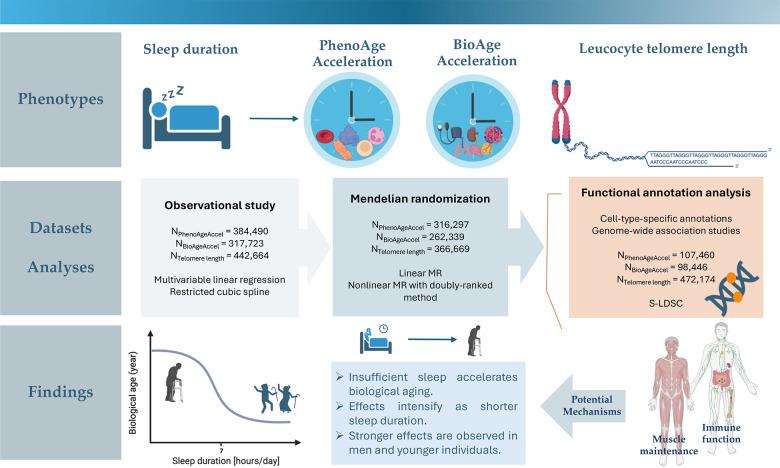
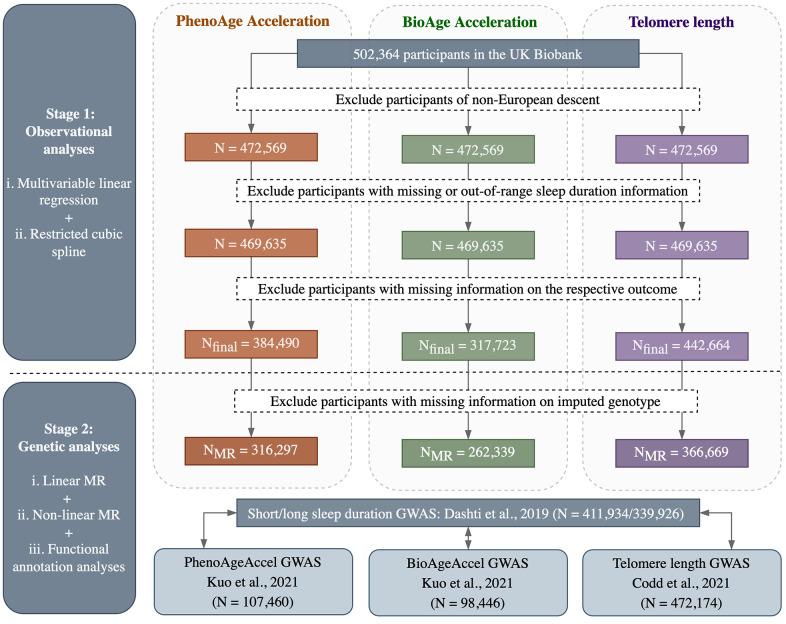
Short and long sleep durations have been inconsistently linked to aging and health outcomes, potentially due to underexplored nonlinear associations. Using phenotypic and genomic data from the UK Biobank (n=442,664), we applied multivariable linear regression, restricted cubic splines, and Mendelian randomization (MR) to analyze nonlinear relationships between self-reported sleep duration and biomarkers of accelerated aging: PhenoAge acceleration (PhenoAgeAccel), BioAge acceleration (BioAgeAccel), and leukocyte telomere length (LTL). Functional annotation analyses were performed to assess potential shared biological pathways using epigenomic profiles. Observational analyses supported U-shaped phenotypic associations between sleep duration and PhenoAgeAccel/BioAgeAccel, with optimal sleep around 7 h/d. For LTL, linear models suggested a U-shape, while spline models indicated an inverted reverse J-pattern. MR analyses corroborated the deleterious impacts of insufficient, but not excessive, sleep, by revealing a threshold nonlinear relationship between increasing genetically-predicted sleep duration up to 7 h/d and lower PhenoAgeAccel/BioAgeAccel, and a linear relationship with longer LTL. Cell-type enrichment analyses connected short sleep to BioAgeAccel/LTL through pathways related to muscle maintenance and immune function. These findings suggest that extending sleep may mitigate accelerated aging, though further research is needed to clarify the underlying biological mechanisms and whether excessive sleep also contributes causally to biological aging.
短期和长期睡眠时长与衰老及健康结果之间的关联并不一致,这可能是由于尚未充分探索的非线性关联。利用英国生物银行(n = 442,664)的表型和基因组数据,我们应用多变量线性回归、受限立方样条和孟德尔随机化(MR)来分析自我报告的睡眠时长与加速衰老生物标志物之间的非线性关系:PhenoAge加速(PhenoAgeAccel)、生物年龄加速(BioAgeAccel)和白细胞端粒长度(LTL)。进行功能注释分析以使用表观基因组概况评估潜在的共享生物学途径。观察性分析支持睡眠时长与PhenoAgeAccel/BioAgeAccel之间呈U形表型关联,最佳睡眠时间约为7小时/天。对于LTL,线性模型显示为U形,而样条模型表明为倒转的反J形模式。MR分析通过揭示在遗传预测的睡眠时长增加至7小时/天与较低的PhenoAgeAccel/BioAgeAccel之间的阈值非线性关系以及与较长LTL的线性关系,证实了睡眠不足而非过多的有害影响。细胞类型富集分析通过与肌肉维持和免疫功能相关的途径将短睡眠与BioAgeAccel/LTL联系起来。这些发现表明延长睡眠可能减轻加速衰老,不过需要进一步研究来阐明潜在的生物学机制以及过多睡眠是否也因果性地导致生物学衰老。


 Zotero 插件