
睡眠质量在加速生物衰老及其对空气污染损伤的潜在预防作用中的作用:来自英国生物库队列的研究结果。
Role of sleep quality in the acceleration of biological aging and its potential for preventive interaction on air pollution insults: Findings from the UK Biobank cohort.
机构信息
Department of Occupational and Environmental Health Sciences, School of Public Health, Peking University, Beijing, China.
Department of Epidemiology and Biostatistics, School of Public Health, Peking University, Beijing, China.
出版信息
Aging Cell. 2022 May;21(5):e13610. doi: 10.1111/acel.13610. Epub 2022 Apr 14.
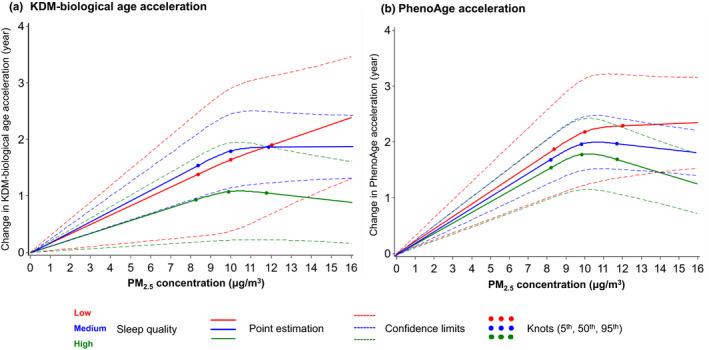
Sleep has been associated with aging and relevant health outcomes, but the causal relationship remains inconclusive. In this study, we investigated the associations of sleep behaviors with biological ages (BAs) among 363,886 middle and elderly adults from UK Biobank. Sleep index (0 [worst]-6 [best]) of each participant was retrieved from the following six sleep behaviors: snoring, chronotype, daytime sleepiness, sleep duration, insomnia, and difficulties in getting up. Two BAs, the KDM-biological age and PhenoAge, were estimated by corresponding algorithms based on clinical traits, and their residual discrepancies with chronological age were defined as the age accelerations (AAs). We first observed negative associations between the sleep index and the two AAs, and demonstrated that the change of AAs could be the consequence of sleep quality using Mendelian randomization with genetic risk scores of sleep index and BAs. Particularly, a one-unit increase in sleep index was associated with 0.104- and 0.119-year decreases in KDM-biological AA and PhenoAge acceleration, respectively. Air pollution is another key driver of aging. We further observed significant independent and joint effects of sleep and air pollution (PM and NO ) on AAs. Sleep quality also showed a modifying effect on the associations of elevated PM and NO levels with accelerated AAs. For instance, an interquartile range increase in PM level was associated with 0.009-, 0.044-, and 0.074-year increase in PhenoAge acceleration among people with high (5-6), medium (3-4), and low (0-2) sleep index, respectively. Our findings elucidate that better sleep quality could lessen accelerated biological aging resulting from air pollution.
睡眠与衰老和相关健康结果有关,但因果关系仍不确定。在这项研究中,我们调查了 363886 名英国生物库中中老年人的睡眠行为与生物年龄 (BA) 的关联。从以下六种睡眠行为中检索到每个参与者的睡眠指数 (0 [最差] - 6 [最佳]):打鼾、昼夜节律、白天嗜睡、睡眠时间、失眠和起床困难。根据临床特征,使用相应的算法估算了两种 BA,即 KDM 生物年龄和 PhenoAge,并将其与实际年龄的残差定义为年龄加速 (AA)。我们首先观察到睡眠指数与两种 AA 之间存在负相关,并通过使用睡眠指数和 BA 的遗传风险评分进行孟德尔随机化,证明 AA 的变化可能是睡眠质量的结果。具体而言,睡眠指数增加一个单位与 KDM 生物 AA 和 PhenoAge 加速分别减少 0.104 年和 0.119 年相关。空气污染是衰老的另一个关键驱动因素。我们还观察到睡眠和空气污染 (PM 和 NO ) 对 AA 具有显著的独立和联合影响。睡眠质量也对 PM 和 NO 水平升高与加速 AA 之间的关联有修饰作用。例如,PM 水平升高一个四分位距与高 (5-6)、中 (3-4) 和低 (0-2) 睡眠指数人群的 PhenoAge 加速分别增加 0.009 年、0.044 年和 0.074 年。我们的研究结果表明,更好的睡眠质量可以减轻空气污染导致的加速生物衰老。


 Zotero 插件