
在医疗保险处方药受益人群中,同时使用阿片类药物和苯二氮䓬类药物与阿片类药物相关过量风险之间的暴露-反应关联。
Exposure-Response Association Between Concurrent Opioid and Benzodiazepine Use and Risk of Opioid-Related Overdose in Medicare Part D Beneficiaries.
机构信息
Department of Pharmacy and Therapeutics, School of Pharmacy, University of Pittsburgh, Pittsburgh, Pennsylvania.
Department of Epidemiology, Graduate School of Public Health, University of Pittsburgh, Pittsburgh, Pennsylvania.
出版信息
JAMA Netw Open. 2018 Jun 1;1(2):e180919. doi: 10.1001/jamanetworkopen.2018.0919.
IMPORTANCE
Concurrent benzodiazepine use is associated with an increased risk of opioid-related overdose; however, it remains unknown how the overdose risk varies with the days of exposure to both medications.
OBJECTIVE
To evaluate the exposure-response association between the days with concurrent prescription opioid and benzodiazepine use and the risk of overdose.
DESIGN, SETTING, AND PARTICIPANTS: Retrospective cohort study of Medicare Part D claims data from January 1, 2013, to December 31, 2014. Analyses were conducted in fall 2017 and spring 2018. Participants were Medicare Part D beneficiaries who filled at least 1 prescription for an opioid in 2014.
EXPOSURES
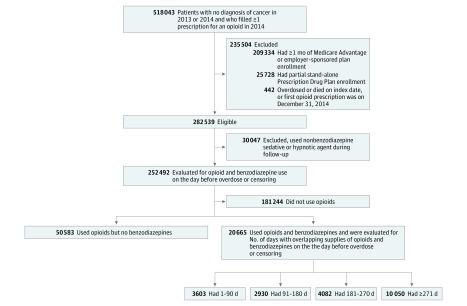
Patients were divided into 2 groups based on whether they had opioid and benzodiazepine supplies on the day before overdose or censoring. The first group only had a supply of opioids (n = 50 583) and the second group had supplies of opioids and benzodiazepines (n = 20 665). The second group was further categorized into 4 subgroups based on the cumulative number of days with overlapping supplies of opioids and benzodiazepines: 1 to 90 days (n = 3603), 91 to 180 days (n = 2930), 181 to 270 days (n = 4082), and 271 days or more (n = 10 050).
MAIN OUTCOMES AND MEASURES
Cox proportional hazard models were constructed to compare opioid-related overdose (including fatal and nonfatal overdoses) across time-dependent treatment groups, controlling for demographic characteristics, insurance factors, clinical characteristics, and number of unique opioid and benzodiazepine prescribers.
RESULTS
Of 71 248 total participants, 25 600 (35.9%) were male and 59 532 (83.6%) were white. Mean (SD) age was 66.5 (14.8) years. On the day before overdose or censoring event, 20 665 of 71 248 patients with an opioid prescription (29.0%) were concurrently using benzodiazepines and 14 132 of 20 665 concurrent users (68.4%) had more than 180 days of overlapping supplies of both medications. The risk of overdose was highest on the first days of concurrent opioid and benzodiazepine use and decreased over time; compared with opioid use alone, the hazard ratio for overdose was 5.05 (95% CI, 3.68-6.93) during the first 90 days of concurrent opioid and benzodiazepine use and 1.87 (95% CI, 1.25-2.80) for days 91 to 180 among those who did not have an event before 90 days.
CONCLUSIONS AND RELEVANCE
During the first 90 days, concurrent benzodiazepine use is associated with a 5-fold increase in the risk of opioid-related overdose. The implementation of policies deterring concurrent opioid and benzodiazepine use is warranted. Patients using both medications should be closely monitored, particularly during the first days of concurrent use.
重要性
同时使用苯二氮䓬类药物与阿片类药物相关过量的风险增加有关;然而,尚不清楚在暴露于这两种药物的天数方面,过量风险是如何变化的。
目的
评估同时使用处方类阿片类药物和苯二氮䓬类药物的天数与过量风险之间的暴露-反应关联。
设计、地点和参与者:回顾性队列研究,使用 2013 年 1 月 1 日至 2014 年 12 月 31 日的医疗保险处方药 D 索赔数据。分析于 2017 年秋季和 2018 年春季进行。参与者为在 2014 年至少使用过一种阿片类药物处方的医疗保险处方药 D 受益人群。
暴露
根据在过量或截止日期前一天是否有阿片类药物和苯二氮䓬类药物供应,将患者分为两组。第一组仅接受阿片类药物供应(n=50583),第二组接受阿片类药物和苯二氮䓬类药物供应(n=20665)。第二组根据重叠供应阿片类药物和苯二氮䓬类药物的累积天数进一步分为 4 个亚组:1 至 90 天(n=3603)、91 至 180 天(n=2930)、181 至 270 天(n=4082)和 271 天或以上(n=10050)。
主要结果和措施
构建 Cox 比例风险模型,比较随时间变化的治疗组中阿片类药物相关过量(包括致命和非致命过量),控制人口统计学特征、保险因素、临床特征和使用阿片类药物和苯二氮䓬类药物的独特处方者数量。
结果
在 71248 名总参与者中,25600 名(35.9%)为男性,59532 名(83.6%)为白人。平均(SD)年龄为 66.5(14.8)岁。在过量或截止日期前一天,71248 名接受阿片类药物处方的患者中有 20665 名(29.0%)同时使用苯二氮䓬类药物,20665 名同时使用者中有 14132 名(68.4%)有超过 180 天的两种药物重叠供应。在开始同时使用阿片类药物和苯二氮䓬类药物的最初几天,过量的风险最高,随着时间的推移而降低;与单独使用阿片类药物相比,在 90 天内同时使用阿片类药物和苯二氮䓬类药物的前 90 天内,过量的风险比为 5.05(95%CI,3.68-6.93),在没有在 90 天前发生事件的情况下,91 至 180 天的风险比为 1.87(95%CI,1.25-2.80)。
结论和相关性
在最初的 90 天内,同时使用苯二氮䓬类药物与阿片类药物相关过量的风险增加 5 倍。有必要实施抑制同时使用阿片类药物和苯二氮䓬类药物的政策。应密切监测同时使用这两种药物的患者,尤其是在开始同时使用的最初几天。

 Zotero 插件